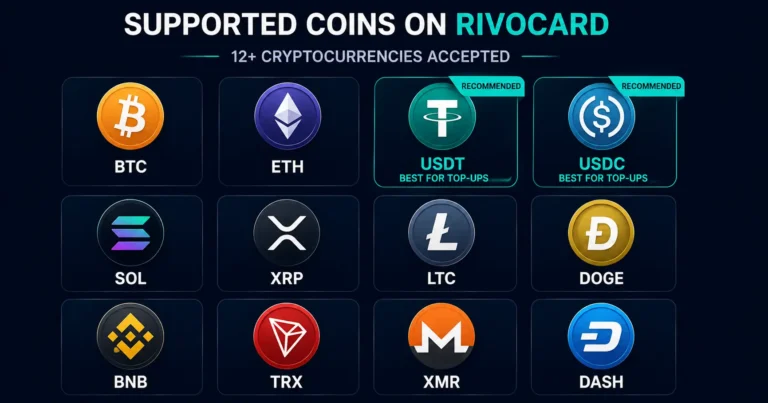
Quick answer: Rivocard supports 12+ cryptocurrencies for card funding: Bitcoin (BTC), Ethereum (ETH), Tether USDT on TRC-20 and ERC-20, USD Coin (USDC), Solana (SOL), Litecoin (LTC), Monero (XMR), Dash (DASH), Ripple (XRP), Dogecoin (DOGE), Binance Coin (BNB), and Tron (TRX). All 12+ coins deposit free to your Rivocard wallet and convert to a dollar balance you can load onto unlimited virtual Visa cards. The 5% card funding fee applies when you move balance to a card — not at deposit. Multi-cryptocurrency support has become the standard feature among leading crypto card companies in 2026 — but the number of supported coins matters less than whether the coins you hold are supported and whether the deposit is efficient for each.
Why Supported Coin Count Matters Less Than You Think
When evaluating a crypto prepaid card, “supports 500+ coins” sounds better than “supports 12 coins.” In practice, the number is almost irrelevant. What matters is:
1. Are the coins you hold supported? If you hold BTC, ETH, USDT, and SOL — the four most commonly held crypto assets globally — you need a card that supports those four. Supporting 500 obscure tokens you do not hold adds no practical value.
2. Are the deposit networks efficient? USDT on TRC-20 (Tron) costs fractions of a cent and confirms in seconds. USDT on ERC-20 (Ethereum) costs $1-$30+ and takes 1-30 minutes. A card that “supports USDT” but only via ERC-20 is significantly worse for regular top-ups than one supporting TRC-20.
3. Does the platform convert properly? Some platforms convert volatile coins at unfavorable rates with hidden spreads. Rivocard converts at the live market rate with no spread markup — the difference between the market rate and what you receive is $0.
4. Are there minimum amounts that make small deposits impractical? Rivocard’s $10 minimum works for all 12+ coins. Platforms with $50-$100 minimums per coin effectively exclude some assets from practical use.
All Supported Cryptocurrencies on Rivocard
Stablecoins (Recommended for Most Top-Ups)
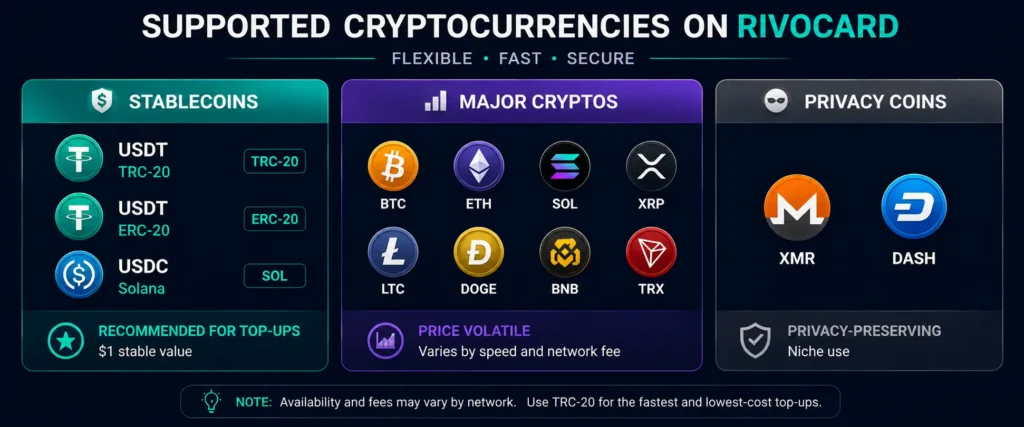
USDT — Tether (TRC-20 and ERC-20) The world’s largest stablecoin by market cap and daily trading volume. Pegged to $1. Rivocard accepts USDT on both the Tron network (TRC-20 — recommended, fractions of a cent fees, seconds to confirm) and Ethereum network (ERC-20 — higher fees, longer confirmation). For most users, TRC-20 is the default choice.
USDC — USD Coin (Solana and potentially other networks) Issued by Circle with monthly reserve attestations. Pegged to $1. On Solana, USDC confirms in seconds with near-zero fees — equivalent to TRC-20 USDT for practical deposit purposes. Strong institutional backing and transparent reserve management make USDC the preferred stablecoin for institutional and compliance-sensitive users.
Major Cryptocurrencies
BTC — Bitcoin The original and most widely recognized cryptocurrency. Rivocard accepts native BTC on the Bitcoin mainnet. Confirmation time: 20-60 minutes under normal conditions. Network fees: $1-$20+ variable. Best for: large planned deposits with timing flexibility, or BTC holders who prefer direct conversion without swapping. See our Bitcoin prepaid card guide for full details.
ETH — Ethereum The second largest cryptocurrency and the foundation of DeFi, NFTs, and smart contracts. Rivocard accepts ETH on the Ethereum mainnet. Confirmation time: 1-30+ minutes depending on congestion. Network fees: $1-$30+ variable. Note: sending from Layer 2 networks (Arbitrum, Optimism, Base) only works if explicitly supported — check your dashboard. See our Ethereum prepaid card guide for details.
SOL — Solana Solana’s native coin. High-throughput blockchain with fast confirmations (under 5 seconds) and minimal fees (under $0.01). SOL carries price volatility like other non-stablecoin assets, but the near-instant confirmation window limits practical price risk at deposit.
XRP — Ripple XRP is the native asset of the XRP Ledger, designed for fast and low-cost value transfer. Confirmations in 3-5 seconds, fees under $0.01. XRP holders can deposit directly without conversion at minimal cost.
LTC — Litecoin Created as a faster alternative to Bitcoin. Confirmation time: 2-5 minutes. Network fees: typically under $0.05. A practical deposit option for LTC holders — significantly faster and cheaper than Bitcoin.
DOGE — Dogecoin Originally a meme coin, Dogecoin has become a genuinely used payment cryptocurrency with broad exchange support. Confirmation time: 1-3 minutes. Fees: typically under $0.10. Widely held, fast enough for practical card top-ups.
BNB — Binance Coin (BEP-20) Binance Smart Chain’s native token. Confirmation time: 3-15 seconds. Fees: under $0.10. For Binance ecosystem users, BNB is a practical direct deposit option without needing to convert to another asset.
TRX — Tron (native) Tron’s native cryptocurrency — the same network that makes TRC-20 USDT so fast and cheap. TRX itself shares those network characteristics (seconds to confirm, fractions of a cent in fees) but carries price volatility unlike USDT. For TRX holders, direct deposit is practical.
Privacy Coins
XMR — Monero Monero is the leading privacy-focused cryptocurrency — all transactions are private by default using ring signatures, stealth addresses, and RingCT. Confirmation time: 5-20 minutes. Fees: typically under $0.05. Rivocard’s acceptance of XMR enables users to convert privacy-preserving crypto to a standard Visa card spending balance.
DASH — Dash Dash offers InstantSend for rapid transaction confirmation (seconds) and PrivateSend for optional privacy. Fees: under $0.01 with InstantSend. One of the most practical non-stablecoin assets for card top-ups due to its speed.
What the Network Means for Each Coin
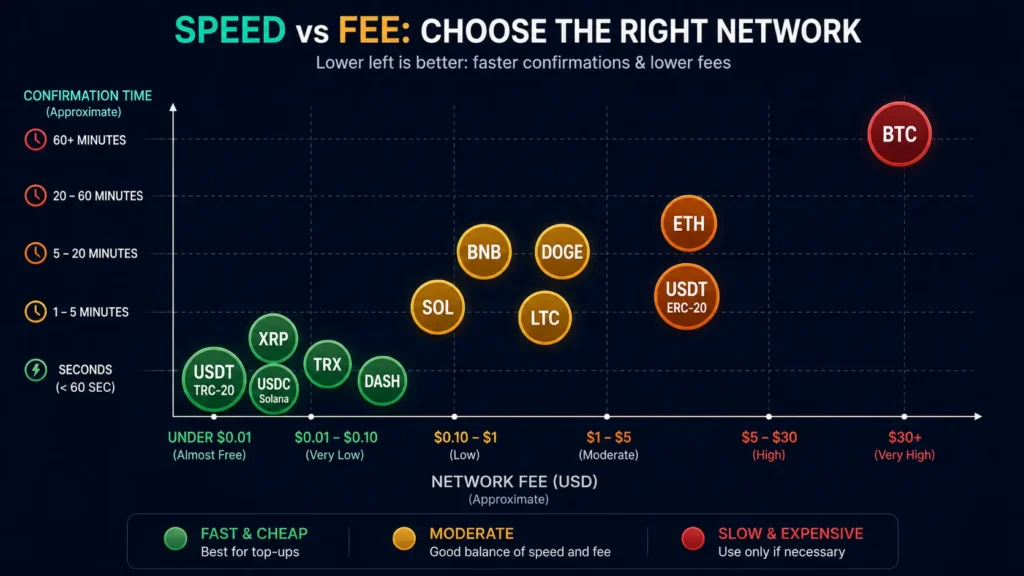
Some coins run on multiple networks — this matters significantly for deposit efficiency:
| Coin | Network | Deposit address format | Confirmation | Fee |
|---|---|---|---|---|
| USDT (recommended) | Tron TRC-20 | Starts with T | Seconds | Under $0.01 |
| USDT (alternative) | Ethereum ERC-20 | Starts with 0x | 1-30+ min | $1-$30+ |
| USDC | Solana | Solana format | Seconds | Under $0.01 |
| BTC | Bitcoin mainnet | Starts with 1, 3, or bc1 | 20-60+ min | $1-$20+ |
| ETH | Ethereum mainnet | Starts with 0x | 1-30+ min | $1-$30+ |
| BNB | Binance Smart Chain (BEP-20) | Starts with 0x | Seconds | Under $0.10 |
| XRP | XRP Ledger | Alphanumeric r… | 3-5 seconds | Under $0.01 |
| SOL | Solana | Solana format | Under 5 sec | Under $0.01 |
| TRX | Tron | Starts with T | Seconds | Under $0.01 |
| DOGE | Dogecoin mainnet | Starts with D | 1-3 min | Under $0.10 |
| LTC | Litecoin mainnet | Starts with L or M | 2-5 min | Under $0.05 |
| DASH | Dash mainnet | Starts with X | Seconds (InstantSend) | Under $0.01 |
| XMR | Monero mainnet | Long alphanumeric | 5-20 min | Under $0.05 |
Industry Context: What Coin Support Looks Like Across Cards in 2026
Multi-cryptocurrency support is becoming the standard feature among leading cryptocurrency debit card companies in 2026. The market has evolved toward broader coin support, but with important distinctions:
Exchange-linked cards typically support every coin listed on their parent exchange — potentially hundreds or thousands. However, they usually convert at the point of purchase, meaning your coins stay as crypto until you spend, with conversion spread applied at that moment.
Prepaid card platforms like Rivocard support a focused list of practically useful coins and convert at deposit — giving you a stable dollar balance that does not fluctuate with crypto markets after conversion.
Custodial cards with staking support a specific list of coins but require holding the platform’s native token to access competitive rates — meaning the useful coin list is effectively narrower than the advertised list.
Rivocard’s 12+ coin support covers the practical holdings of the vast majority of crypto users without the complexity of exchange-linked or staking-required models.
Which Coins Are Most Popular for Rivocard Top-Ups
Based on the practical characteristics of each supported asset, here is how adoption typically breaks down:
Highest adoption — Stablecoins on fast networks USDT on TRC-20 and USDC on Solana dominate for routine top-ups. The combination of price stability, near-zero fees, and instant confirmation makes them optimal for regular card funding. Users who receive income in stablecoins or hold stablecoin reserves use these as their primary deposit asset.
Second tier — XRP, BNB, TRX Fast, cheap, and with short enough confirmation windows that price volatility risk is minimal. Popular among users already active in these ecosystems.
Third tier — Bitcoin Despite being the most recognized cryptocurrency, Bitcoin is the least efficient card funding asset. Used primarily by long-term Bitcoin holders who want to convert holdings to spending power without first swapping to stablecoins.
Niche use — XMR, DASH, LTC Privacy coin users (XMR, DASH) and Litecoin holders who specifically prefer direct conversion without an intermediate step.
Adding New Coin Support
Rivocard’s supported coin list reflects the assets most commonly held globally and most practically useful for card funding. As new assets gain broad adoption, platforms typically add support through banking and compliance partner approvals.
For the current, up-to-date list of all supported cryptocurrencies on Rivocard, including any newly added assets, see the supported cryptocurrencies page.
What All Supported Coins Have in Common on Rivocard
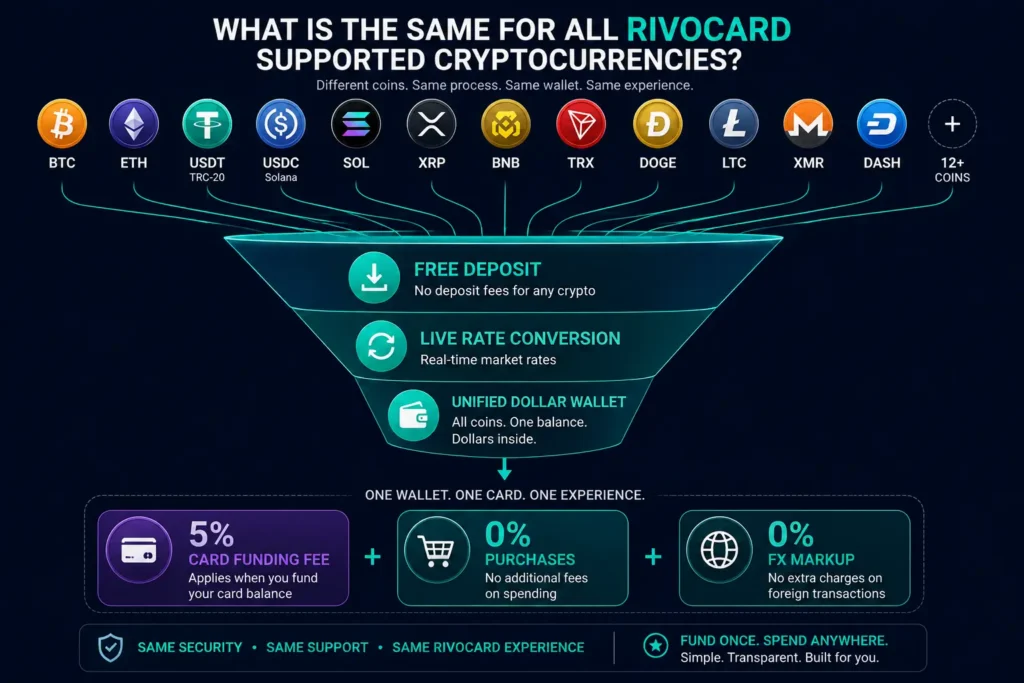
Regardless of which supported coin you deposit:
- Deposit to your wallet is always free
- Conversion to dollar wallet balance happens automatically
- The 5% card funding fee applies only at the wallet-to-card step
- Purchase fee is always 0%
- International transaction fee is always 0%
- All coins fund the same unified wallet balance — you can mix deposits from multiple coins into one balance
- All coins fund the same unlimited virtual Visa cards
The deposit asset choice affects only the cost and speed of the deposit step — everything from wallet balance onward is identical.
FAQs
What cryptocurrencies does Rivocard support for card top-ups?
Rivocard supports 12+ cryptocurrencies including BTC, ETH, USDT (TRC-20 and ERC-20), USDC, SOL, LTC, XMR, DASH, XRP, DOGE, BNB, and TRX. All deposit free to your wallet. The 5% fee applies only when you fund a virtual card from your wallet balance.
Can I use multiple cryptocurrencies on one Rivocard account?
Yes. You can deposit different cryptocurrencies at different times — BTC one week, USDT the next — and they all convert to and add to the same wallet balance. There is no per-coin separation.
Does Rivocard support USDT on both TRC-20 and ERC-20?
Yes. Rivocard accepts USDT on the Tron network (TRC-20) and the Ethereum network (ERC-20). TRC-20 is recommended — it confirms in seconds and costs fractions of a cent. ERC-20 is available for users who already hold USDT on Ethereum, but carries higher gas fees ($1-$30+).
Does it cost more to deposit some coins than others?
Rivocard charges nothing for deposits regardless of the coin. The cost difference comes from each coin’s blockchain network fee — paid to miners or validators, not to Rivocard. USDT on TRC-20 is effectively free (under $0.01). Bitcoin can cost $1-$20+ per deposit. See our best crypto to use for prepaid card guide for the full comparison.
Is the 5% Rivocard fee the same regardless of which coin I deposit?
Yes. The 5% card funding fee is the same regardless of which cryptocurrency funded your wallet. The fee is charged at the wallet-to-card step — not at deposit — and the deposit asset does not affect it.
Does Rivocard support Monero (XMR)?
Yes. Rivocard accepts XMR deposits, enabling users to convert Monero — the leading privacy-focused cryptocurrency — to a spendable Visa card balance. Confirmation time is 5-20 minutes with fees under $0.05.
How many cryptocurrencies does Rivocard support compared to other cards?
Rivocard supports 12+ coins covering the most widely held cryptocurrencies. Some exchange-linked cards advertise 100-500+ coin support, but typically convert at the point of sale (not at deposit) and may apply conversion spreads. For deposit-based prepaid cards, Rivocard’s 12+ coin coverage is comprehensive for practical real-world use.
Can I use Solana (SOL) to fund a Rivocard card?
Yes. SOL is supported as a deposit asset. Solana confirmations take under 5 seconds with near-zero fees — one of the faster deposit options. Note that SOL carries price volatility unlike stablecoins.
Does Rivocard add new supported cryptocurrencies over time?
Card platforms typically expand their supported coin list as new assets gain broad adoption and as banking and compliance partner approvals are obtained. For the current list of all supported coins, check rivocard.com/which-cryptocurrencies-does-rivocard-support.
What is the minimum deposit amount for each supported coin?
The minimum deposit is $10 USD equivalent regardless of which coin you deposit. The relevant consideration is that for high-fee networks (Bitcoin, Ethereum), network fees can represent a significant percentage of small deposits — TRC-20 USDT has near-zero fees even at the $10 minimum.
Get Started
Hold multiple coins? Deposit whichever is most convenient — they all fund the same card. See all supported cryptocurrencies on Rivocard →