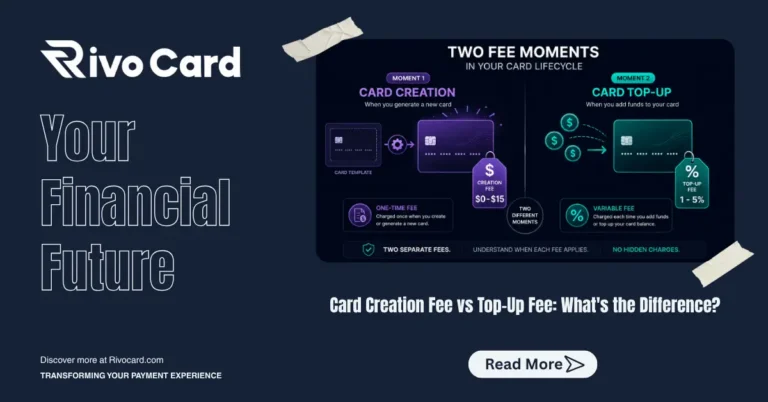
Quick answer: In 2026, crypto card fees fall across five categories: top-up fees (0-5%+), conversion spreads (0-3%+), foreign transaction fees (0-3%), monthly subscriptions ($0-$50+), and staking requirements (none to $400,000+). A reasonable crypto card charges $0 issuance, $0 monthly, 1% top-up, 1% FX, $0 per transaction, and modest ATM fees — though “reasonable” varies significantly by user profile. Rivocard’s structure is a single 5% card funding fee with 0% on everything else and no staking — higher than the 1% benchmark on top-up, but with no FX fee, no spread, no subscription, and no capital at risk. Whether that trades off favorably depends entirely on how you spend.
The State of Crypto Card Fees in 2026
The crypto card market has matured significantly. Most major card programs now support Apple Pay and Google Pay, settle on Visa or Mastercard rails, and have moved toward more transparent pricing than early products. But the fee structures remain diverse — and comparing them still requires understanding five separate cost categories, not just the headline number.
Annual fees range from $0 up to $1,499, with FX fees near 1.5%, swap fees starting at 1%, and APRs reaching 29.99% on credit products. The range is wide enough that two cards that both appear “cheap” can differ by 3-5x in actual annual cost for the same spending pattern.
The Five Fee Categories in 2026
Top-Up / Loading Fee
The percentage charged when adding funds to the card. This is typically the most prominently displayed fee.
| Range | What it means |
|---|---|
| 0% | No stated top-up fee — costs recovered elsewhere (spread, subscription, staking) |
| 1-2% | Industry midpoint for verified-user tiers |
| 3-5% | Common for no-KYC or entry-tier products |
| 5%+ | Premium no-KYC tiers or products with high infrastructure costs |
Rivocard: 5% deducted from funded amount at all tiers.
Key caveat: A 0% top-up fee card almost always recovers this cost through a conversion spread applied at the exchange rate level — meaning the effective top-up cost is often 1-3% even when “0%” is advertised. Even cards with “0% FX fees” may still charge a spread — always check the actual exchange rate used compared to the live market rate.
Conversion Spread
The hidden markup applied to the exchange rate when crypto converts to fiat. Not named as a fee — visible only by comparing the rate you receive against the live market rate.
| Range | Real-world impact |
|---|---|
| 0% | Rate matches live market exactly |
| 0.5-1% | Common on stablecoin-funded cards |
| 1-2.5% | Standard on exchange-linked cards with volatile asset funding |
| 2.5-3%+ | High-cost range, often on legacy or lesser-known products |
Rivocard: 0% spread. Deposits convert at the live market rate.
Why it matters: A high-fee card with a 2% conversion spread plus 1% FX fee on non-domestic spending plus 3% ATM fee can reach $58/month for a user spending $2,000/month — or $696/year. The spread alone at 2% on $2,000/month is $480/year, appearing nowhere in the fee schedule as a named line item.
Foreign Transaction Fee (FX Fee)
Applied on purchases in a currency other than the card’s base currency.
| Range | Typical context |
|---|---|
| 0% | Premium self-custodial cards, some exchange-linked cards |
| 0.5-1% | Competitive mid-tier |
| 1.5% | Industry average in 2026 |
| 2-3% | Standard on traditional bank-linked prepaid cards and many entry-tier crypto cards |
Rivocard: 0% on all international transactions.
Impact at scale: A user spending $1,000/month internationally at 1.5% FX pays $180/year in FX fees alone. At 3%, that is $360/year. These fees compound on every single international transaction.
Monthly / Annual Subscription
Recurring fees that gate access to the platform’s lowest per-use rates.
| Range | What you get |
|---|---|
| $0 | No subscription required — current rates apply regardless of usage |
| $5-$15/month | Entry paid tier — typically unlocks lower top-up rate or free ATM allowance |
| $15-$50/month | Mid premium — typically 0% top-up, expanded ATM limits, cashback |
| $50-$125/month | High premium — maximum cashback, airport lounge access, concierge |
| $1,499/year | Ultra-premium metal card tier — typically requires significant staking as well |
Rivocard: $0 at all tiers. No subscription at any level.
The subscription math: A $10/month subscription ($120/year) requires $2,400/year in card funding to break even against Rivocard’s 5% fee-based model (at 5%, $2,400 funded generates $120 in fees). Below that funding volume, the subscription is more expensive. Above it, the subscription saves money if it unlocks a meaningfully lower top-up rate.
Staking Requirement
Capital that must be locked in a platform’s native token to access certain tiers or fee rates.
| Range | What it means in practice |
|---|---|
| None | All tiers accessible through KYC or subscription only |
| $500-$2,000 | Entry staking tier — typically unlocks 1-2% cashback |
| $5,000-$40,000 | Mid-premium tier — unlocks 3-5% cashback and lower fees |
| $40,000-$400,000 | Top-tier — maximum cashback, all perks |
Rivocard: No staking required at any tier.
The staking cost: Capital locked in a volatile token carries price risk. If you stake $5,000 and that token drops 30%, you lose $1,500 in real value — which may exceed the annual savings from the lower fee tier the staking unlocks.
The Industry Benchmark: What “Reasonable” Looks Like
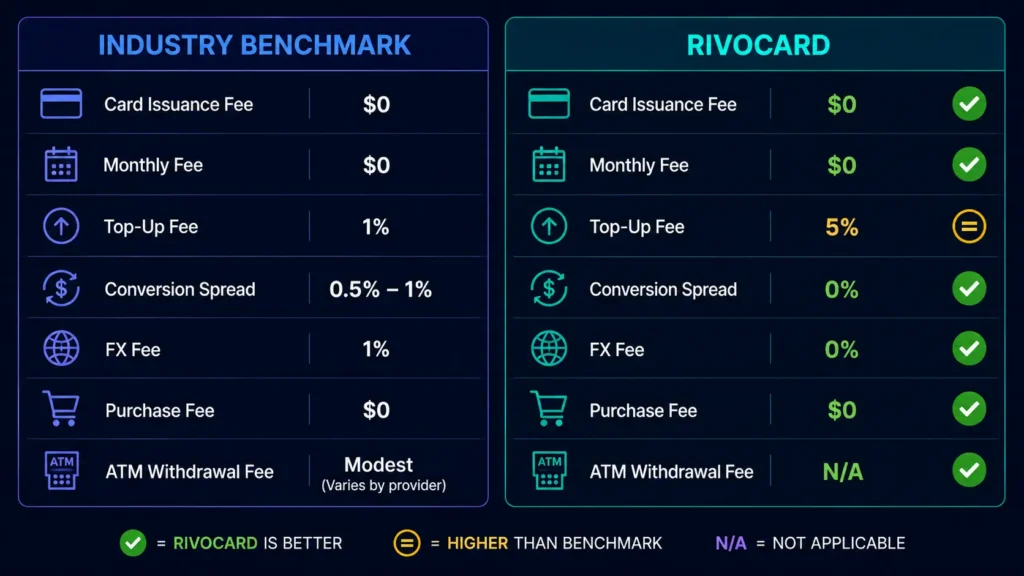
A reasonable crypto card in 2026 charges $0 issuance, $0 monthly, 1% top-up, 1% FX, $0 per transaction, and modest ATM fees — anything higher is either a premium card with genuine perks or an overpriced product.
Using this benchmark as a reference point for comparison:
| Fee category | Industry benchmark | Rivocard |
|---|---|---|
| Card issuance / creation | $0 | $0 ✅ |
| Monthly fee | $0 | $0 ✅ |
| Top-up fee | 1% | 5% ⚠️ |
| Conversion spread | ~0.5-1% (often hidden) | 0% ✅ |
| FX fee | 1% | 0% ✅ |
| Purchase fee | $0 | $0 ✅ |
| ATM fee | Modest | N/A (virtual cards) |
| Staking requirement | Varies | None ✅ |
Rivocard’s top-up fee is above the benchmark. Every other fee category meets or beats it.
Calculating Real Cost: Three User Profiles
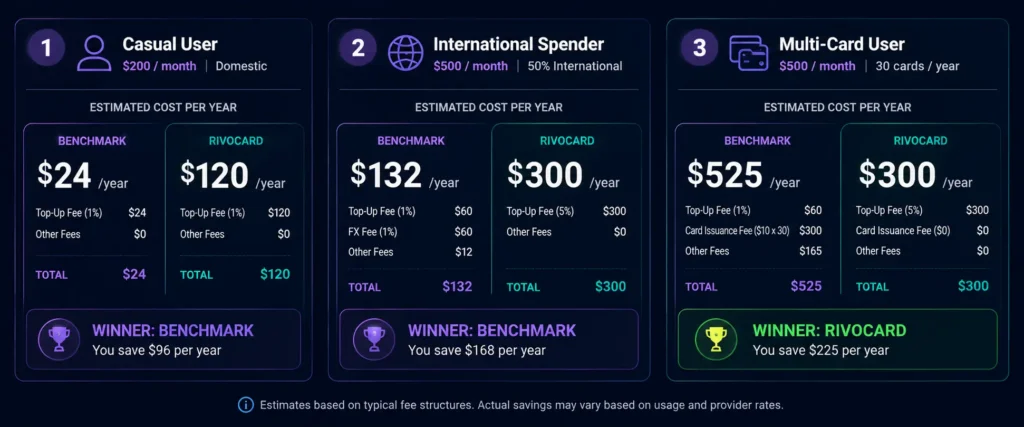
Profile 1: Casual user ($200/month funding, domestic spending, 1 card)
| Fee structure | Annual calculation | Total |
|---|---|---|
| Benchmark (1% top-up, 1% FX, $0 sub) | ($24 top-up) + ($0 FX, domestic) | $24 |
| Rivocard (5% top-up, 0% FX, $0 sub) | ($120 top-up) + ($0 FX) | $120 |
Rivocard costs $96 more annually. Benchmark wins for this profile.
Profile 2: International spender ($500/month funding, 50% international, 1 card)
| Fee structure | Annual calculation | Total |
|---|---|---|
| Benchmark (1% top-up, 1% FX, 1% spread) | ($60 top-up) + ($36 FX) + ($36 spread) | $132 |
| Rivocard (5% top-up, 0% FX, 0% spread) | ($300 top-up) + ($0) + ($0) | $300 |
Rivocard still costs more. Benchmark wins again — unless the spread is higher than 1%, which narrows the gap.
Profile 3: Multi-card user ($500/month funding, 30 cards/year, no-KYC)
| Fee structure | Annual calculation | Total |
|---|---|---|
| No-KYC card ($10/card, 3% top-up, 1.5% FX) | ($180 top-up) + ($45 FX) + ($300 card fees) | $525 |
| Rivocard (5% top-up, 0% FX, free creation) | ($300 top-up) + ($0 FX) + ($0 card fees) | $300 |
Rivocard costs $225 less. Free card creation dominates at high card volumes.
Where Rivocard’s Model Competes
Based on the comparison framework:
Rivocard wins on total cost for:
- Multi-card users (10+ cards) — free card creation eliminates per-card fees
- Heavy international spenders — 0% FX saves 1-3% per transaction
- No-KYC users at similar fee tiers — 5% with 0% FX often beats 3% + 1.5% FX
- Users who want no capital at risk — no staking requirement
- Users who value predictability — one number, no hidden costs
Rivocard loses on total cost for:
- Single-card domestic users at low funding volumes — 1% benchmark beats 5%
- High-volume users willing to pay a subscription — $10/month subscription at 0% top-up saves money above $200/month funding
- Exchange-linked card users already in those ecosystems — lower effective fees from existing infrastructure
The Emerging Fee Categories Worth Watching
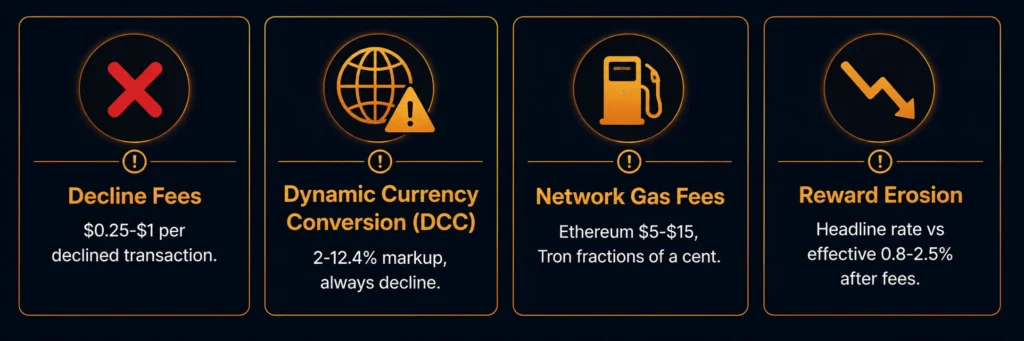
Beyond the five core categories, several newer fee patterns have appeared in 2026:
Decline fees: Some cards charge $0.25-$1 per declined transaction, which stacks fast if a card has a low balance. Rivocard charges $0 for declined transactions.
Network routing fees: On-chain gas fees for deposits are the user’s cost on all platforms — not the card provider’s. Ethereum mainnet fees can run $5-$15 per top-up during congestion. Tron TRC-20 fees are fractions of a cent. Network choice matters.
Dynamic Currency Conversion (DCC): When an ATM or merchant offers to charge you in your home currency instead of the local one, this is DCC. DCC markups range from 2% to 12.4% on ATM withdrawals — consumers are financially worse off in practically every case when they accept DCC. Always decline DCC and pay in local currency.
Reward erosion: Cashback paid in volatile platform tokens may be worth significantly less by the time you redeem it. In 2026, most crypto cards offer effective reward rates between 0.8% and 2.5% after accounting for fees and spreads — well below the headline rates that may appear in marketing.
The Honest Summary
There is no single cheapest crypto card in 2026 — the right answer depends on your usage profile.
For a complete breakdown of what Rivocard specifically charges (and does not charge) across all fee categories, see our crypto prepaid card fees breakdown.
For guidance on detecting hidden fees in cards you are evaluating, see hidden fees in crypto cards.
FAQs
What are the typical crypto card fees in 2026?
The typical fee structure includes: top-up fees (0-5%), conversion spread (0-3%), FX fee (0-3%), monthly subscription ($0-$50+), and staking requirements (none to $400,000+). A reasonable mid-market card charges around 1% top-up, 1% FX, and no monthly fee at entry tier.
How does Rivocard’s fee compare to the industry average?
Rivocard’s 5% top-up fee is above the 1% industry midpoint for verified-user tiers. However, Rivocard charges 0% conversion spread, 0% FX fee, no monthly subscription, and no staking requirement — which can make the total annual cost competitive or lower depending on usage pattern.
What is the average FX fee on a crypto card in 2026?
Foreign transaction fees average around 1.5% in 2026, with some cards charging up to 3% and others charging 0%. For international spenders, this fee can exceed the top-up fee in total annual cost.
What is a reasonable total fee for a crypto card in 2026?
A reasonable card charges $0 issuance, $0 monthly, approximately 1% top-up, approximately 1% FX, and $0 per transaction with modest ATM fees. Anything significantly above this without premium perks (cashback, lounge access) is likely an overpriced product.
Why do some crypto cards advertise 0% fees but still cost money?
Cards advertising “0% fees” typically apply the cost through a conversion spread hidden in the exchange rate, an FX fee on international purchases, a monthly subscription to access the advertised tier, or a staking requirement. Always check the actual exchange rate used and the full terms for all fee categories.
When is Rivocard’s 5% fee cheaper than a card with a lower top-up rate?
Rivocard’s 5% becomes cheaper when: (1) a competitor charges per-card creation fees and you create many cards, (2) a competitor charges FX fees that compound on international spending, or (3) a competitor’s lower top-up rate requires a subscription or staking that costs more than the top-up savings.
What is a conversion spread on a crypto card?
A conversion spread is a markup applied to the exchange rate when your crypto converts to fiat. A card offering “0% conversion fee” may still deliver fewer dollars per coin than the live market rate — the difference is their revenue, not disclosed as a named fee. Rivocard applies no conversion spread.
How do staking requirements affect the true cost of a crypto card?
Staking locks capital in a volatile token for a fixed period. If the token drops in value during lock-up, the effective cost of the staking requirement increases. A 30% drop on $5,000 staked represents $1,500 in lost value — potentially exceeding the annual savings from the lower fee tier the staking unlocks.
Are crypto credit card APRs a fee I should include in comparisons?
Yes, if you ever carry a balance. Crypto credit cards carry variable APRs between 18.99% and 29.99% in 2026. Interest on even a small carried balance erases rewards quickly — a $2,000 balance at 24% APR costs approximately $40/month in interest, outpacing most cashback rates within weeks.
How often do crypto card fees change?
Frequently. Providers adjust pricing as they enter new markets, launch new tiers, or respond to competition. Always verify current fees directly on each provider’s official website rather than relying on comparison articles, which may lag actual changes by weeks or months.
Get Started
See exactly what Rivocard charges — one number, fully transparent. Read the complete Rivocard fees breakdown →