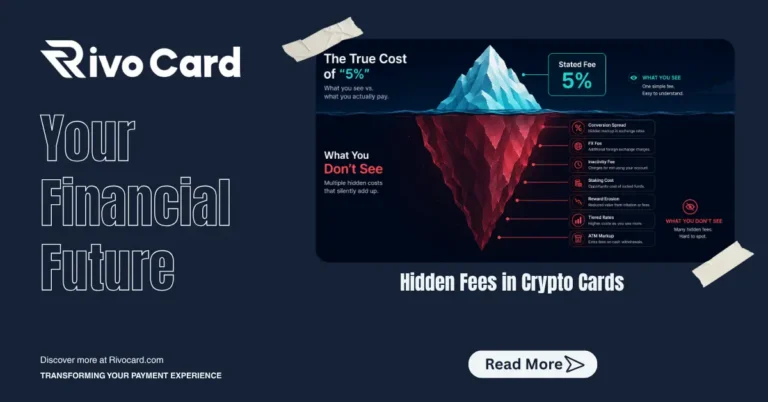
Quick answer: The most common hidden fees in crypto cards are conversion spreads (a markup on the exchange rate that is not named as a fee), foreign transaction fees buried in terms, inactivity fees triggered after months of no use, staking requirements that tie up capital with price risk, and reward erosion (cashback paid in volatile tokens that lose value before you spend them). These costs frequently appear on cards that advertise “0% fees” or “free” tiers. On Rivocard, the only fee is a transparent 5% deducted when you fund a card — no spread, no FX fee, no inactivity fee, no staking requirement.
This guide exposes every hidden fee pattern used in the crypto card industry in 2026, explains how each one is disguised in marketing language, and shows you how to detect them before choosing a card.
Why Hidden Fees Exist in Crypto Cards
Every card platform has operational costs: technology infrastructure, regulatory compliance, payment network fees, customer support, and fraud management. These costs must be recovered somewhere.
Platforms that advertise lower or zero headline fees typically recover costs through less visible mechanisms — spreads embedded in exchange rates, subscription tiers that gate competitive rates, or token-denominated rewards that appear generous until the token price drops.
Understanding where the money goes does not require assuming bad faith from providers — it just requires knowing where to look.
Hidden Fee #1: The Conversion Spread
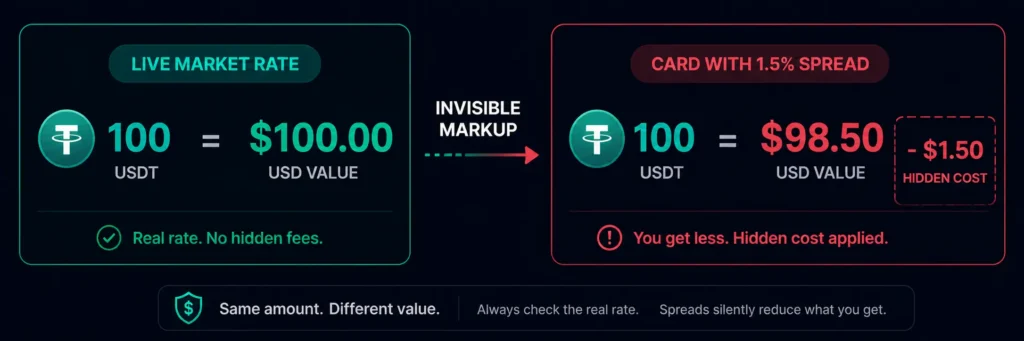
What it is: A markup on the exchange rate when crypto converts to fiat. When your deposit of 100 USDT should yield exactly $100 at the market rate, a card with a 1.5% spread credits you $98.50 instead. The $1.50 difference is revenue to the platform, not disclosed as a fee line item.
How it is disguised: Platforms describe this as “competitive rates” or “real-time conversion” without stating the specific spread. The only way to detect it is to compare the rate applied at deposit against the live market price on an independent price source.
How to detect it: Check the effective rate on a $100 deposit. If you deposit $100 worth of USDT and your wallet shows $98.50, the spread is 1.5%. If it shows $100.00, the spread is 0%.
Why it matters at scale: Conversion spreads on volatile crypto are the highest hidden cost most users miss. At 1.5% on $1,000/month in deposits, the spread costs $15/month — $180/year — without appearing anywhere in the platform’s fee schedule.
On Rivocard: 0% spread. Deposits convert at the live market rate. The 5% card funding fee is a separate, named charge — not embedded in the exchange rate.
Hidden Fee #2: Foreign Transaction Fees Buried in Terms
What it is: An additional percentage charged on purchases made in a currency other than the card’s base currency. Standard on traditional bank cards; present on many crypto cards.
How it is disguised: Often listed in the full terms and conditions under a section heading like “International Transactions” or “Cross-Border Fees” rather than in the headline fee summary. Some cards list this as a “currency conversion fee” which sounds like it applies only when converting currencies, not all international transactions.
How to detect it: Search the provider’s full fee schedule for: “foreign transaction,” “FX fee,” “cross-border,” “international transaction,” and “currency conversion.” If any of these appear with a percentage attached, it applies to international spending.
Why it matters: A 3% fee on a $500 hotel booking costs $15 — potentially wiping out your crypto rewards entirely. For regular travelers or anyone who shops from international merchants online, FX fees compound significantly.
Industry range: Foreign transaction fees average around 1.5% in 2026, with some cards charging up to 3%.
On Rivocard: 0% foreign transaction fee on all purchases, regardless of merchant location or currency.
Hidden Fee #3: Inactivity Fees
What it is: A monthly or annual fee triggered when a card account has no spending activity for a defined period — typically 6 to 12 months.
How it is disguised: Listed in terms under “Dormancy,” “Inactivity,” or “Maintenance” — rarely in the headline fee summary. The timing means users who pause card use for a season (travel, life changes) return to find their balance quietly reduced.
How to detect it: Search the provider’s full terms for “inactivity,” “dormancy,” “maintenance fee,” and “inactive account.” Note the specific trigger period and the monthly charge amount.
Real example: Crypto.com charges $4.95 per month of inactivity after 12 months of no cardholder-initiated financial activity, with this fee increasing to $5.95 effective September 2026. On a small card balance, this can exhaust the balance entirely over time.
On Rivocard: No inactivity fee at any usage level. Your wallet and card balances remain unchanged regardless of how long the account is inactive.
Hidden Fee #4: Staking Requirements as Hidden Capital Cost
What it is: Some exchange-linked crypto cards require you to purchase and lock up the platform’s native token for a fixed period to access certain tiers, fee rates, or features. The staking amount itself is not charged as a fee — but it has real financial cost.
How it is disguised: Presented as “unlock premium benefits” or “access better rates” rather than as a cost. The staking amount appears to be returnable capital. What is not highlighted: the price risk on that capital during the lock-up period.
The hidden cost mechanics:
- Capital lock-up: $5,000 staked for 180 days is illiquid for 6 months
- Price risk: If the staked token drops 30% during lock-up, the real cost is $1,500 in lost value
- Opportunity cost: That $5,000 cannot be deployed elsewhere during lock-up
How to detect it: Look for any requirement to hold, stake, or “lock up” a specific token to access the advertised fee tier. Then calculate the potential cost if that token’s price falls during the required period.
On Rivocard: No staking requirement at any tier. All spending tiers are unlocked through KYC verification, not capital lock-up.
Hidden Fee #5: Reward Erosion
What it is: Cashback or rewards paid in a volatile native token rather than stablecoins or fiat. The reward appears generous at the time of earning but may be worth significantly less by the time you use it — or worthless if the platform’s token collapses.
How it is disguised: Headline reward rates (“up to 8% cashback”) are advertised without noting that the reward is denominated in a platform-specific token with its own price risk. The effective reward rate depends on the token’s price at the time of redemption, not at the time of earning.
Real example: A card offering 5% cashback in a platform token that subsequently drops 80% in price delivers an effective reward of 1% — the original 5% rate was a marketing number tied to a specific token price that no longer exists.
How to detect it: Identify the specific token used for rewards. Check its price history. Ask: what happens to my reward value if this token drops 50% or 90%? Is the token widely traded and liquid, or is it primarily a platform utility token?
On Rivocard: Rivocard does not offer cashback or rewards — so this specific hidden cost does not apply. The fee structure is entirely transparent: 5% to fund cards, 0% on purchases.
Hidden Fee #6: Tiered Fees That Front-Load the Marketing
What it is: Advertised fee rates that only apply at premium tiers — requiring a monthly subscription, staking, or high spend volume to access. The free or entry tier has meaningfully higher fees, but the premium rate is featured in all marketing.
How it is disguised: “0% conversion fee” in the headline, with the disclosure that this only applies at the $15/month Premium tier buried in the pricing page. The free tier may charge 1.5-2%.
How to detect it: Find the specific fee schedule for the free or lowest tier (no subscription, no staking). Compare that against the advertised rates. The difference between the two is the effective cost of accessing the marketing-featured rate.
On Rivocard: One fee, all tiers. The 5% card funding fee applies at every KYC level. No subscription unlocks a lower rate.
Hidden Fee #7: ATM Markup Above Network Cost
What it is: ATM withdrawal fees charged by the card issuer that exceed the actual cost of the blockchain transaction or network fee. Some platforms mark up ATM fees 200-500% above their actual cost.
How it is disguised: Advertised as “free ATM withdrawals up to X per month” — but the “free” quota may be monthly and the per-use fee above that quota is not prominently displayed.
How to detect it: Check the specific per-use fee for ATM withdrawals beyond the free monthly allowance, and whether fees are charged as flat amounts or percentages.
On Rivocard: Virtual cards cannot be used at ATMs (physical card required). This fee category does not apply to Rivocard virtual cards.
Hidden Fee #8: Replacement and Re-issuance Fees
What it is: Fees charged for replacing a card number after a security compromise, or for issuing a new card after expiry.
How it is disguised: Not listed prominently in fee summaries. Re-issuance fees on metal cards often run higher than $50.
How to detect it: Search provider terms for “replacement card,” “re-issuance,” and “card expiry.”
On Rivocard: Creating a new virtual card (replacement) is always free and unlimited. No re-issuance fee applies.
The “0% Fee” Marketing Pattern
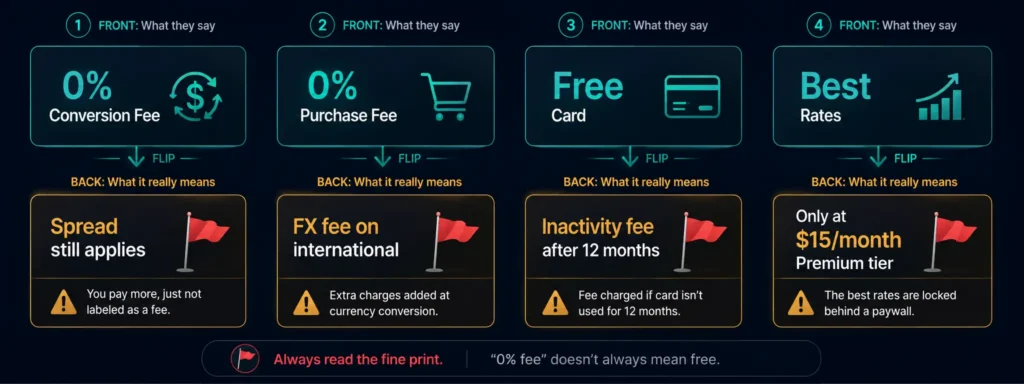
Many crypto cards advertise “0% fees” — this phrase has no standard definition. It can legitimately mean:
- 0% purchase fee (but still charged a conversion spread)
- 0% subscription fee (but charged per-transaction)
- 0% top-up fee at premium tiers only (entry tier fees not mentioned)
- 0% conversion fee (but FX fee applies to international purchases)
When you see “0% fee” in a crypto card advertisement, the correct response is: “0% of which fee, specifically?” Then check each of the eight categories above independently.
How to Audit a Crypto Card’s True Fee Structure
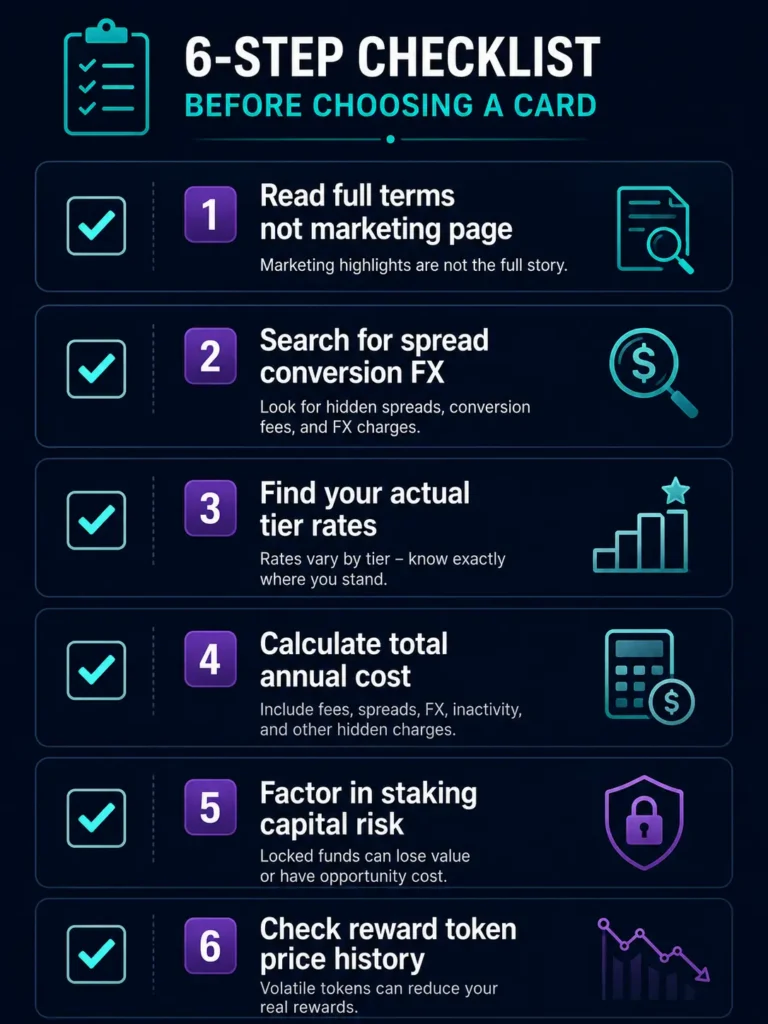
Step 1: Find the full terms and conditions, not the marketing page. Step 2: Search for: “spread,” “conversion,” “FX,” “foreign,” “inactivity,” “dormancy,” “maintenance,” “staking,” “lock-up,” “re-issuance,” “replacement,” “ATM.” Step 3: Identify the tier you would actually use — not the premium tier with the best marketed rates. Step 4: Calculate total annual cost at your expected spending volume using the actual fee rates for your tier. Step 5: Factor in the capital cost of any staking requirements. Step 6: Assess reward sustainability — what is the reward token’s price history and liquidity?
What Rivocard’s Transparency Looks Like in Practice
On Rivocard, the complete fee disclosure is one number: 5% deducted when you fund a virtual card. Everything else — deposits, purchases, international transactions, card creation, account maintenance — is $0.
There is no spread to detect. No FX fee to search for in terms. No inactivity fee to worry about during periods of low use. No staking capital at risk. No reward token to track.
The trade-off is straightforward: Rivocard does not offer cashback or rewards. The fee model is purely transactional — 5% to convert wallet balance to card spending power, and nothing beyond that. Whether that trade-off makes sense depends on your spending volume and whether reward programs on other cards generate real value after accounting for their hidden costs.
For a complete side-by-side fee structure of every Rivocard charge, see our crypto prepaid card fees breakdown.
FAQs
What are the most common hidden fees in crypto cards?
The most common hidden fees are: conversion spreads (markup on the exchange rate at deposit), foreign transaction fees on international purchases, inactivity fees after periods of no use, staking requirements that tie up capital with price risk, reward erosion when cashback is paid in volatile tokens, and tiered fees where the advertised rate only applies to premium subscription tiers.
What is a conversion spread on a crypto card and how do I detect it?
A conversion spread is a markup applied when crypto converts to fiat — charging you more per dollar of spending power without calling it a fee. To detect it, compare the rate applied to your deposit against the live market price on CoinGecko or CoinMarketCap. If 100 USDT deposits as $98.50, the spread is 1.5%.
What is an inactivity fee on a crypto card?
An inactivity fee is a monthly charge triggered when a card account has no spending activity for a defined period (typically 6-12 months). It quietly reduces card or wallet balances during periods of non-use. Rivocard charges no inactivity fee.
Does Rivocard have any hidden fees?
No. The only Rivocard fee is 5% deducted when you fund a virtual card from your wallet balance. This is shown clearly before you confirm any card funding action. There are no conversion spreads, FX fees, inactivity fees, subscription fees, staking requirements, or undisclosed charges.
What does “0% fee” actually mean on a crypto card?
“0% fee” has no standard definition — it can mean 0% on one specific fee type while other fees apply. Always ask: “0% of which fee, specifically?” Then check each fee category (conversion spread, FX fee, subscription, inactivity, ATM, replacement) independently in the full terms, not the marketing page.
How do staking requirements create a hidden cost?
Staking requirements lock up capital in a platform token for a fixed period (often 180 days). The hidden cost is the price risk on that capital — if the token drops in value during lock-up, the effective cost of accessing the “better” fee tier increases. A $5,000 staking requirement on a token that drops 30% during lock-up represents a $1,500 hidden cost.
What is reward erosion on a crypto card?
Reward erosion occurs when cashback is paid in a volatile platform token. The headline rate (e.g., “5% cashback”) is based on the token’s price at the time of marketing — if the token drops, the effective reward rate falls proportionally. A 5% cashback in a token that loses 80% of its value delivers an effective rate of 1%
How do I find the real fee rate at the tier I would actually use?
Go directly to the provider’s full fee schedule or terms and conditions — not the marketing page. Find the fee rates for the free or entry tier (no subscription, no staking). The difference between entry-tier and premium-tier rates represents the implicit cost of not paying the subscription or staking.
Are ATM fees a hidden cost on crypto cards?
They can be. Many cards advertise “free ATM withdrawals” with a monthly cap. The per-use fee beyond that cap is often not prominently displayed. Search the full terms for ATM-specific fee schedules.
Get Started
Want to use a card with no hidden fees and one clearly stated charge? See exactly what Rivocard costs before you sign up →