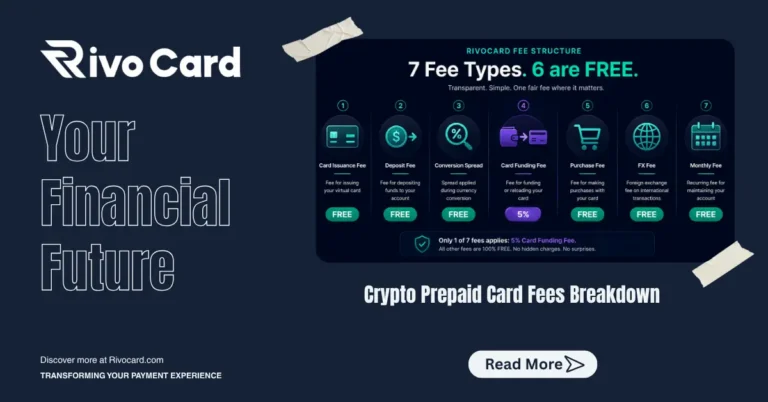
Quick answer: A crypto prepaid card can involve up to seven different fee types: card issuance fee, deposit/top-up fee, conversion spread, card funding fee, purchase fee, foreign transaction fee, and monthly/annual subscription fee. On Rivocard, only one of these applies: a 5% fee deducted when you fund a virtual card from your wallet. Everything else — depositing crypto, creating cards, making purchases, spending internationally, freezing cards, and cancelling your account — is free. This guide explains every fee type in the industry so you know exactly what to look for and what you are paying.
Why Crypto Prepaid Card Fees Are Confusing
Most crypto card providers advertise “free” cards while hiding costs in the conversion spread — a fee that is technically disclosed but practically invisible in the checkout experience. This makes comparing cards by headline numbers alone meaningless.
The real question is not “what is the top-up fee?” It is: “what is the total cost from the moment I send crypto to the moment I complete a purchase?” That path can involve multiple fees from multiple parties, and understanding each one separately is the only way to compare honestly.
The Seven Fee Types That Can Apply to a Crypto Prepaid Card
1. Card Issuance Fee
What it is: A one-time fee charged when a virtual or physical card is created.
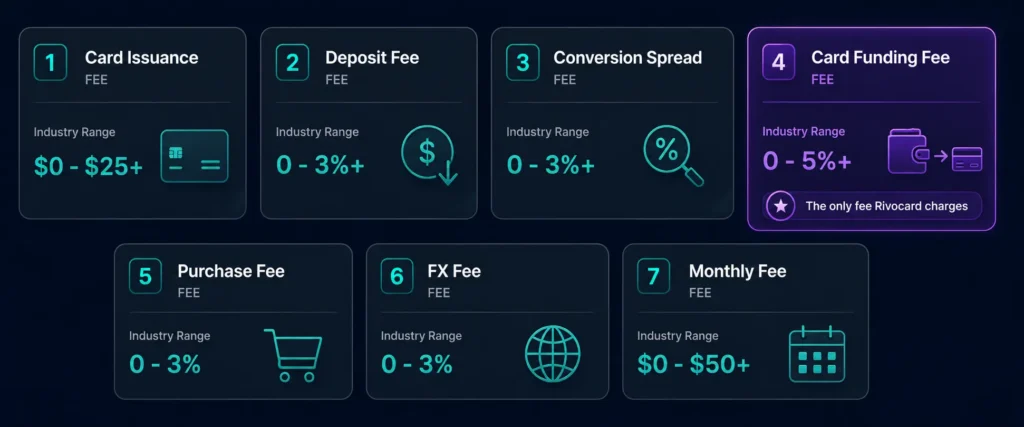
Industry range: $0 to $25+ for virtual cards; $5 to $100+ for physical cards.
On Rivocard: $0. Card creation is always free and unlimited. You can create as many virtual cards as you need at no cost.
When it applies: Some providers charge this fee per card created, even for virtual cards. Others charge it only for physical card orders. Always check whether a provider distinguishes between virtual and physical issuance fees.
2. Deposit Fee (Top-Up Fee to Wallet)
What it is: A fee charged when you send cryptocurrency to the card platform’s wallet — the step where your crypto arrives and converts to a fiat balance.
Industry range: 0% to 3%+ of the deposited amount.
On Rivocard: 0%. Depositing any supported cryptocurrency (BTC, USDT, ETH, and 12+ others) to your Rivocard wallet is always free.
Note: Separate from this is the blockchain network fee — paid to miners or validators, not to the card platform. This varies by network: fractions of a cent on Tron TRC-20, potentially $1-$20+ on Ethereum or Bitcoin during congestion.
3. Conversion Spread
What it is: A hidden markup applied to the exchange rate when cryptocurrency converts to fiat. A card advertising “0% conversion fee” may still apply a 1-2.5% spread — charging you more per dollar of spending power without it appearing as a named fee line item.
Industry range: 0% to 3%+ per conversion.
On Rivocard: 0%. Crypto deposits convert at the live market rate with no spread markup. The 5% card funding fee (explained below) is separate and explicitly named — not embedded in the exchange rate.
How to detect a spread: Compare the exchange rate shown during a top-up against the current live rate on CoinGecko or CoinMarketCap. A spread is visible as the difference between the market rate and the rate the platform applies.
4. Card Funding Fee (Loading Fee)
What it is: A fee charged when you move money from your platform wallet balance to a specific virtual card. This is the step that activates the card for spending.
Industry range: 0% to 5%+ of the funded amount.
On Rivocard: 5%, deducted from the funded amount. Fund a card with $100, the card receives $95. This is the only Rivocard fee. It applies to initial card creation funding and to every subsequent reload.
The math:
| Funded Amount | 5% Fee | Card Balance |
|---|---|---|
| $50 | $2.50 | $47.50 |
| $100 | $5.00 | $95.00 |
| $200 | $10.00 | $190.00 |
| $500 | $25.00 | $475.00 |
| $1,000 | $50.00 | $950.00 |
5. Purchase Fee (Transaction Fee)
What it is: A fee charged on each individual purchase from the card balance. Can be a percentage of the transaction or a flat fee per use.
Industry range: 0% to 3% per transaction; some cards charge $0.20-$0.50 flat fees per transaction after a monthly quota.
On Rivocard: 0%. Every purchase is free, regardless of size, frequency, or merchant category.
6. Foreign Transaction Fee (FX Fee)
What it is: An additional percentage charged when spending in a currency different from the card’s base currency. Common on traditional debit cards, and present on many crypto cards.
Industry range: 0% to 3% per foreign currency transaction. The industry average for crypto cards with FX fees is approximately 1.5% in 2026.
On Rivocard: 0%. International spending in any currency is free — no FX surcharge, regardless of the merchant’s location or currency.
7. Monthly / Annual Subscription Fee
What it is: A recurring fee charged for maintaining the card account, typically regardless of usage.
Industry range: $0 to $50+/month; some premium tiers charge $99-$1,499/year.
On Rivocard: $0. No monthly fee, no annual fee, no subscription tier. The account is free to maintain indefinitely.
Inactivity fees (a related charge): Some providers charge a monthly fee if the card is not used for a period of time. Crypto.com charges $4.95 per month of inactivity after 12 months of no cardholder-initiated financial activity. Rivocard does not charge inactivity fees.
Secondary Fees Worth Knowing
ATM Withdrawal Fee
What it is: A fee for using the card at an ATM to withdraw cash. Typically charged per withdrawal, sometimes with a free monthly allowance.
On Rivocard: Virtual cards cannot be used at ATMs (ATMs require a physical card with a chip or magnetic stripe). If Rivocard offers a physical card option, check the current fees page for ATM-specific terms.
Card Replacement Fee
What it is: A fee charged when you request a replacement card — typically after a card number is compromised or a physical card is lost.
On Rivocard: $0. Creating a new virtual card (which functions as a replacement) is always free. There is no replacement fee for virtual cards.
Account Cancellation Fee
What it is: A fee charged when closing a card account.
On Rivocard: $0. Account cancellation is free with no exit penalty.
The Complete Rivocard Fee Picture
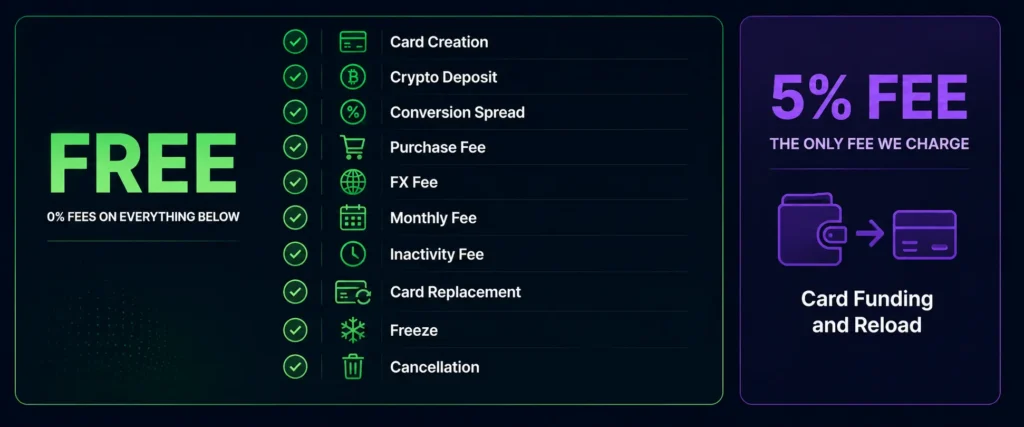
| Fee Type | Rivocard Amount |
|---|---|
| Card issuance / creation | Free |
| Crypto deposit to wallet | Free |
| Blockchain network fee (to network, not Rivocard) | Varies by network |
| Conversion spread | 0% |
| Card funding / reload | 5% (deducted) |
| Purchase fee | 0% |
| Foreign transaction fee | 0% |
| Monthly subscription | $0 |
| Annual fee | $0 |
| Inactivity fee | $0 |
| Card replacement | Free |
| Card freeze / unfreeze | Free |
| Account cancellation | Free |
One fee. Everything else free.
The Total Cost Calculation
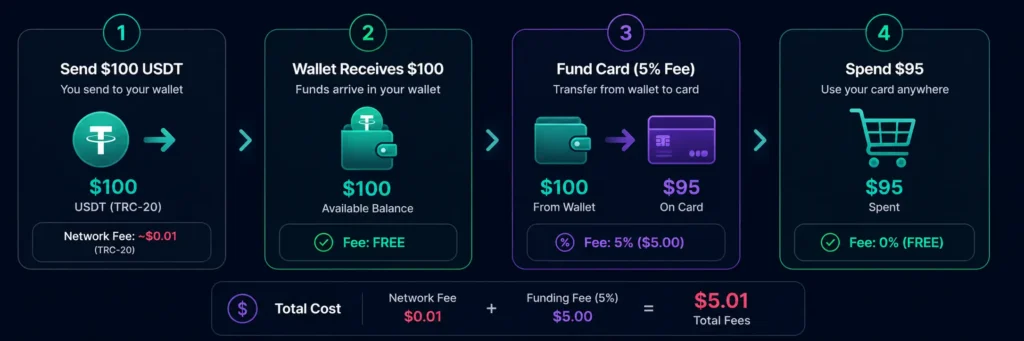
To understand what you actually pay using a crypto card, calculate the total cost across the full deposit-to-spend pipeline:
For a $100 USDT TRC-20 deposit → $95 on card → spend $95:
| Cost item | Rivocard |
|---|---|
| TRC-20 network fee | ~$0.01 |
| Deposit fee | $0.00 |
| Conversion spread | $0.00 |
| Card funding fee (5% of $100) | $5.00 |
| Purchase fee | $0.00 |
| FX fee (international purchase) | $0.00 |
| Total cost to spend $95 | ~$5.01 |
| Effective total cost % | ~5.01% |
This is the honest all-in number. For every $100 sent, approximately $95 is spendable and $5 covers all fees combined (almost entirely the card funding fee).
Why a Single Fee Is Different From a Lower Fee With Multiple Charges
This comparison is worth making concrete. Consider a hypothetical card with a lower headline fee structure:
Hypothetical Card: 1.5% top-up, 1% conversion spread, 1.5% FX fee, $5/month subscription
For the same $100 USDT deposit, spent internationally, with 12 months of subscription:
| Cost item | Amount |
|---|---|
| Top-up fee (1.5% of $100) | $1.50 |
| Conversion spread (1% of $100) | $1.00 |
| FX fee (1.5% of $98.50 spent) | $1.48 |
| Monthly subscription (12 months) | $60.00 |
| Total costs | $63.98 |
This comparison is not realistic for a single $100 transaction — the subscription cost dominates at low volumes. But it illustrates the compounding nature of multi-fee structures at scale.
At $500/month of spending for 12 months with that structure: $18 in top-up fees + $60 in spreads + $107 in FX fees + $60 subscription = $245/year.
At $500/month of spending for 12 months on Rivocard: $25 × 12 = $300/year in card funding fees, $0 in all other categories.
The Rivocard model is more expensive at low-to-medium international spending volumes with the specific subscription + spread + FX structure above. It becomes more cost-competitive as FX spending increases (since Rivocard’s 0% FX fee saves proportionally more) and as spending volume decreases below subscription break-even thresholds.
Fee Transparency: What to Look For
When evaluating any crypto prepaid card, ask these specific questions:
- What is the exact conversion spread applied at deposit? Not the advertised rate — the actual rate compared to live market price.
- Is the purchase fee 0% or is there a per-transaction charge above a monthly quota?
- What is the FX fee for international spending?
- Is there an inactivity fee?
- What are the card replacement and cancellation policies?
- Are there fees for ATM withdrawals?
- Does accessing the best fee tier require staking platform tokens?
On Rivocard, all of these questions have simple answers: 0%, $0, or free — except for the card funding fee, which is 5% and clearly stated.
FAQs
What fees does a crypto prepaid card charge?
A crypto prepaid card can charge up to seven fee types: card issuance, deposit/top-up, conversion spread, card funding, purchase fee, foreign transaction fee, and monthly/annual subscription. On Rivocard, only the card funding fee applies at 5% — all other fee categories are free.
What is the difference between a deposit fee and a card funding fee?
A deposit fee is charged when you send crypto to the card platform’s wallet. A card funding fee is charged when you move money from the platform wallet to a specific virtual card. On Rivocard, depositing to your wallet is free; the 5% fee applies only at the card funding step.
What is a conversion spread on a crypto card?
A conversion spread is a hidden markup on the exchange rate when crypto converts to fiat. A card advertising “0% conversion fee” may still apply a 1-2.5% spread. Rivocard converts at the live market rate with no spread markup.
Does Rivocard charge a foreign transaction fee?
No. Spending in any currency at any merchant worldwide is 0% on Rivocard — no foreign transaction or FX surcharge.
Is there a monthly fee for a Rivocard account?
No. Rivocard charges no monthly fee, no annual fee, and no inactivity fee at any usage level.
How much does Rivocard charge per card creation?
Card creation is always free on Rivocard, regardless of how many cards you create. The 5% fee applies only when you fund a card with balance from your wallet.
What is the total all-in cost on Rivocard to spend $100?
Deposit $100 USDT via TRC-20 (free, plus ~$0.01 network fee), fund a card with $100 (5% = $5 fee, card has $95), spend $95 (0%). Total cost: approximately $5.01 — about 5% of the amount sent.
Are there any hidden fees on Rivocard?
No. The only Rivocard fee is the 5% card funding fee, which is shown clearly before you confirm any card funding action. There are no conversion spreads, subscription fees, inactivity fees, or undisclosed charges.
What happens if I do not use my Rivocard for a long time?
The complete fee schedule is always available at rivocard.com/fees-limits/. For a plain-language explanation of how the 5% fee works in practice, see the Rivocard fees breakdown.
Get Started
Seen enough to know the fee structure works for you? Create your Rivocard account — card ready in under 2 minutes →