Quick answer: A USDT prepaid card lets you deposit Tether (USDT) to your Rivocard wallet for free, then fund unlimited virtual Visa cards from that balance. A 5% fee is deducted when you fund a card — deposit $100 USDT, fund a card with $100, the card has $95 to spend anywhere Visa is accepted with zero purchase fees. Because USDT is a stablecoin pegged to $1, there is no price volatility between deposit and spending — what you send is what you get.
Most USDT guides either compare crypto card providers or explain how to buy USDT with a card. This guide covers something more specific: how to use USDT to fund a Rivocard virtual card and spend it like cash, anywhere in the world — with the fastest deposit network, the lowest fees, and no KYC required to get started.
Why USDT Is the Best Crypto for Funding a Prepaid Card
Before the steps, this is worth understanding — because USDT is not just another supported coin. It is structurally the most practical deposit option for everyday card use, for three specific reasons.
1. Price stability eliminates the volatility window. When you deposit Bitcoin, the dollar value of your deposit is locked in at the moment the blockchain confirms it — which could be 20–60 minutes after you send. During that window, Bitcoin’s price can move, meaning you get slightly more or less than expected. USDT is pegged to $1. Send $200 USDT, get $200 credited to your wallet. No timing risk, no conversion surprise.
2. TRC-20 is the fastest and cheapest deposit network. USDT on the Tron network (TRC-20) typically confirms in seconds, not minutes — and network fees are a fraction of a cent. Compare that to Bitcoin (20–60 minutes, $1–$20+ fees) or Ethereum (1–5 minutes, variable gas fees). For frequent card top-ups, TRC-20 is the clear practical choice.
3. USDT is already denominated in dollars. Your card balance is in dollars. Your USDT deposit is in dollars. There is no mental math needed, no conversion uncertainty — $100 USDT in equals approximately $100 in your wallet, with no deposit fee.
For a direct comparison of USDT vs Bitcoin for card funding, see our Bitcoin guide.
What Is USDT
Tether (USDT) is a stablecoin — a cryptocurrency designed to maintain a fixed value of $1 USD at all times. Unlike Bitcoin or Ethereum whose prices fluctuate continuously, USDT stays at approximately $1 by backing each token with equivalent reserves.
USDT runs on multiple blockchains simultaneously. The three most relevant for Rivocard deposits are:
- TRC-20 (Tron network) — fastest, cheapest, recommended for all Rivocard deposits
- ERC-20 (Ethereum network) — widely supported but slower and more expensive during congestion
- BEP-20 (Binance Smart Chain) — fast and cheap, check your dashboard for availability
This is a critical detail: USDT on TRC-20 and USDT on ERC-20 are the same asset in value ($1 each) but completely different on-chain. Sending to the wrong network is the single most common and most costly mistake USDT users make.
How to Fund a Rivocard Card With USDT Step by Step
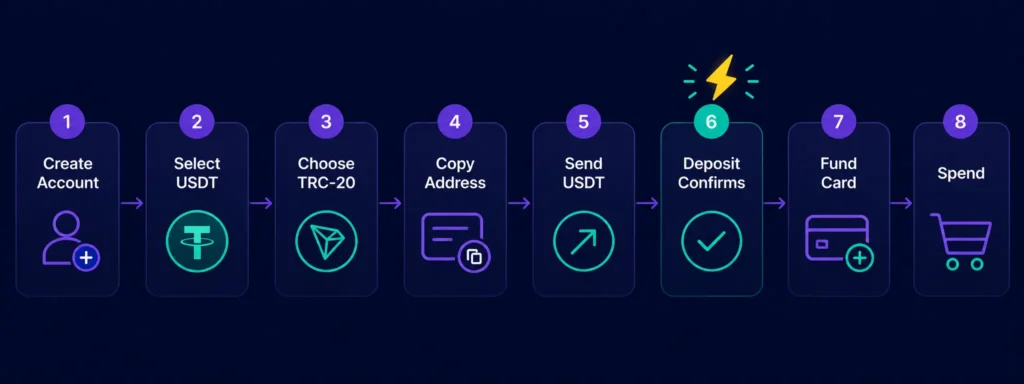
Step 1: Create your Rivocard account. Sign up with your email, verify it, and your Rivocard wallet is ready instantly. No KYC required to start — you can deposit and fund cards up to your Basic KYC tier limit without submitting any ID. Full guide: how to create a Rivocard account.
Step 2: Navigate to the deposit section and select USDT. In your Rivocard dashboard, go to the wallet deposit section and choose USDT as your deposit asset. You will see network options — TRC-20 and ERC-20 are both typically available.
Step 3: Choose the TRC-20 network. Select TRC-20 unless you have a specific reason to use ERC-20. TRC-20 gives you confirmations in seconds, network fees of fractions of a cent, and no congestion spikes or gas fee uncertainty.
Step 4: Copy the USDT deposit address. Your dashboard will show a TRC-20 USDT deposit address (starts with “T”) and a QR code. Copy it exactly — do not type it manually. A single wrong character means funds go to an unintended address with no recovery possible.
Step 5: Send USDT from your wallet or exchange. Open your USDT wallet — Trust Wallet, Ledger, Binance, Bybit, OKX, or any exchange that supports TRC-20 withdrawals — and paste the Rivocard TRC-20 deposit address, select TRC-20 as the network, enter the amount (minimum $10 USDT), and send.
Step 6: Deposit confirms within seconds. TRC-20 USDT transactions typically confirm in under a minute. The dollar equivalent appears in your Rivocard wallet with no fee deducted — what you sent is what lands.
Step 7: Create a virtual card and fund it. From your dashboard, create a new virtual Visa card (free) and choose how much to fund it from your wallet balance. The 5% fee is deducted from the funded amount — fund a card with $200 from your wallet, and the card receives $190.
Step 8: Spend anywhere Visa is accepted. Your card is active with its full balance. Use it for online shopping, subscriptions, Google Ads, Meta Ads, travel bookings, Apple Pay and Google Pay. All purchases: 0% fee. International transactions: 0% fee.
The USDT Network Decision TRC-20 vs ERC-20
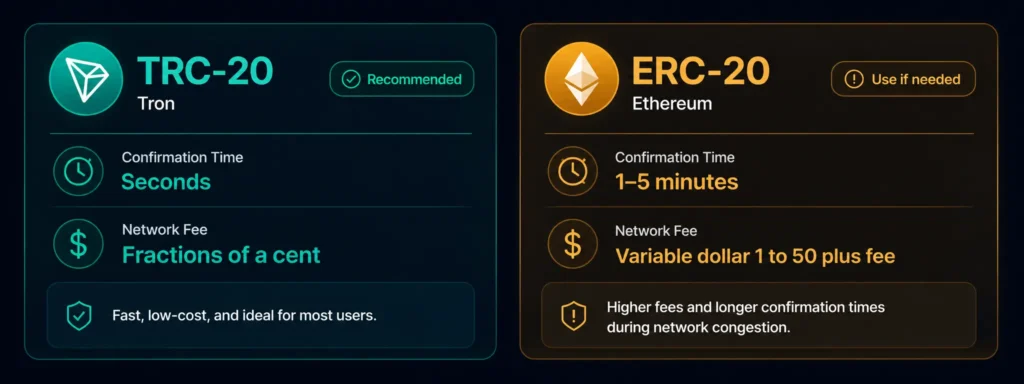
| TRC-20 (Tron) | ERC-20 (Ethereum) | |
|---|---|---|
| Confirmation time | Seconds to ~1 minute | 1–5 minutes (longer during congestion) |
| Network fee | $0.01–$1 (very stable) | $1–$50+ (highly variable) |
| Fee predictability | Extremely predictable | Spikes without warning |
| Address format | Starts with T | Starts with 0x |
| Best for | All deposits, any size | Only if you hold ERC-20 USDT already |
Default to TRC-20 for every Rivocard deposit unless you have a specific reason not to. The only time ERC-20 makes sense is if your USDT is already on Ethereum and gas fees are acceptable at that moment.
Card Funding Fee Calculator
| You Fund Card With | 5% Fee Deducted | Card Balance |
|---|---|---|
| $100 USDT | $5 | $95 |
| $200 USDT | $10 | $190 |
| $500 USDT | $25 | $475 |
| $1,000 USDT | $50 | $950 |
| $5,000 USDT | $250 | $4,750 |
The fee is shown before you confirm any card funding action — no surprises.
USDT vs Other Deposit Options on Rivocard
| Asset | Speed | Network Fee | Price Risk | Best For |
|---|---|---|---|---|
| USDT TRC-20 | Seconds | Very low | None | Frequent deposits, all sizes |
| USDT ERC-20 | 1–5 min | Variable | None | If already on Ethereum |
| USDC Solana | Seconds | Very low | None | USDC holders |
| Bitcoin BTC | 20–60 min | $1–$20+ | Yes | Large one-time deposits |
| Ethereum ETH | 1–5 min | Variable | Yes | ETH holders |
| Ripple XRP | Seconds | Very low | Yes | XRP holders |
Spending Limits by KYC Tier
| KYC Tier | Card Load Limit | Daily Spend | Monthly Spend |
|---|---|---|---|
| Basic KYC | $2,000 | $1,000 | $5,000 |
| Full KYC | $20,000 | $10,000 | $50,000 |
| Enhanced KYC | $100,000 | $50,000 | Unlimited |
For most everyday use cases — subscriptions, online shopping, travel — Basic KYC limits are more than sufficient and require no ID submission. For full fee details see our Rivocard fees breakdown.
The Most Common USDT Deposit Mistakes
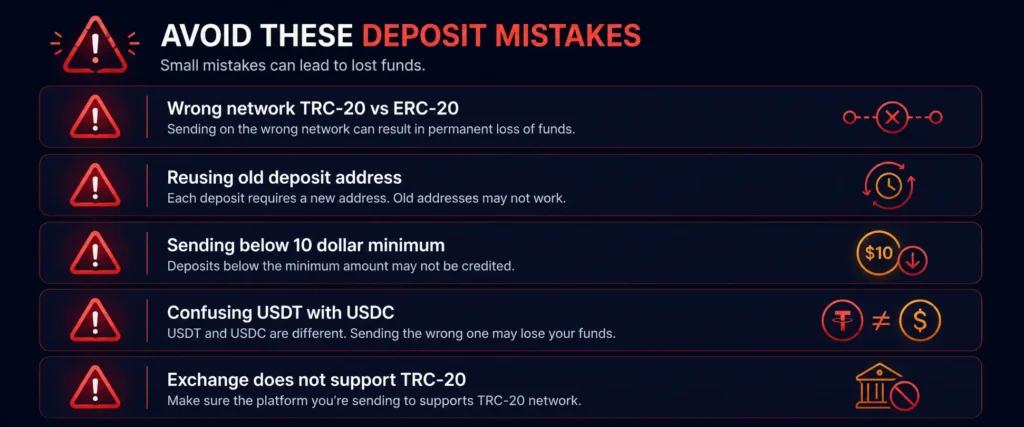
Sending on the wrong network. A TRC-20 USDT address starts with T and an ERC-20 USDT address starts with 0x. They look completely different but people still confuse them by selecting the wrong network in their wallet’s withdrawal screen. Always confirm: the network selected in your wallet matches the network shown on Rivocard’s deposit page.
Reusing an old deposit address. Rivocard generates fresh deposit addresses for security. Always copy the current address from your dashboard before each deposit — do not reuse an address from a previous session.
Sending below the minimum. The minimum deposit is $10 USDT equivalent. Anything below this may not credit to your account.
Confusing USDT with USDC. Both are stablecoins pegged to $1 and they look similar in wallet interfaces. They are different tokens — USDC sent to a USDT deposit address will not credit correctly. Always confirm the asset matches what the deposit page expects.
Sending from an exchange that does not support TRC-20 withdrawals. Most major exchanges (Binance, OKX, Bybit, Kraken) support TRC-20 USDT withdrawals. Some smaller exchanges only support ERC-20. Check your exchange’s withdrawal options before depositing.
Who Benefits Most From a USDT Prepaid Card
Freelancers and remote workers paid in USDT. If your clients pay in USDT, a Rivocard card is the fastest path from crypto income to everyday spending — without a bank account involved.
Digital advertisers. Running ads on Google, Meta, or TikTok requires a card. Fund your Rivocard with USDT, fund a card, use it for ad spend. The 5% card funding fee is typically offset by the time and friction saved versus a traditional bank transfer pipeline.
Crypto traders who hold USDT as a stable reserve. Instead of converting USDT to fiat through an exchange withdrawal, fund a card directly and spend from your stable reserve when needed.
Privacy-conscious spenders. USDT deposits do not require linking a bank account. The card itself runs on Visa rails like any other prepaid card, without your bank in the loop.
Travelers. Load a card with $500 USDT before a trip. The balance is locked in at today’s dollar value — no market movement risk. Spend it at any Visa merchant globally with zero international transaction fees.
Is USDT Safe to Use for Card Funding
USDT is the world’s largest stablecoin by market cap and volume. Using it as a deposit asset for a regulated card platform is one of the lower-risk ways to engage with crypto payments. Once your USDT deposit confirms and converts to a wallet balance, it is protected under the same PCI DSS-compliant security infrastructure as any regulated card product. You can review Rivocard’s security measures for full details.
Ready to fund your first card with USDT? Get started with RivoCard — no KYC required to start.
FAQs
Can I use USDT to fund a prepaid card?
Yes. Rivocard accepts USDT deposits on both TRC-20 and ERC-20 to your wallet, and you can fund unlimited virtual Visa cards from that balance. Deposits are free — the 5% fee only applies when you fund or reload a card.
Which USDT network should I use TRC-20 or ERC-20?
Use TRC-20 (Tron) for almost all deposits. It confirms in seconds, fees are fractions of a cent, and it is the most practical network for card funding. Only use ERC-20 if your USDT is already on Ethereum and you do not want to swap networks first.
How long does a USDT TRC-20 deposit take?
Usually under a minute — often under 30 seconds. TRC-20 is one of the fastest blockchain networks for stablecoin transfers.
Is there a fee for depositing USDT to Rivocard?
No. Depositing USDT to your Rivocard wallet is always free. The 5% fee only applies when you move funds from your wallet balance onto a virtual card. There is also a small network fee paid to the Tron blockchain itself, separate from Rivocard fees and typically under $1.
What is the minimum USDT deposit?
$10 USDT equivalent. Unlike Bitcoin where network fees can eat into a small deposit, TRC-20 fees are negligible even on the minimum amount.
What if I accidentally send ERC-20 USDT to a TRC-20 address?
This is a serious mistake — the funds typically will not arrive and may be unrecoverable. Always double-check the network selected in your wallet matches the network shown on Rivocard’s deposit screen before confirming any transaction.
Can I send USDT directly from Binance to Rivocard?
Yes. Binance supports TRC-20 USDT withdrawals. Select TRC-20 as the withdrawal network in Binance, paste the Rivocard TRC-20 deposit address, and send. The same process works from OKX, Bybit, Kraken, KuCoin, and most major exchanges.
Does the 5% fee apply every time I reload my card?
Yes — the 5% fee applies to both the initial card funding and any subsequent reloads. To minimize total fees, fund larger amounts less frequently rather than many small reloads.
Is USDT the same as real USD?
No. USDT is a crypto token issued by Tether Limited, pegged to $1 through reserve backing. It functions like $1 for practical payment purposes, but it is not government-backed or FDIC-insured.
Can I use USDT to fund a card without KYC?
Yes — up to your Basic KYC tier spending limits, no identity verification is required to deposit USDT and fund a card. KYC is only needed if you want to access higher spending tiers.