Quick answer: A virtual crypto card is a digital payment card — with a real card number, expiry date, and CVV — funded by cryptocurrency instead of a bank account. There is no physical plastic. You deposit crypto, the platform converts it to a spendable dollar balance, and you use the card number to pay anywhere Visa or Mastercard is accepted online, in apps, or through Apple Pay and Google Pay. On Rivocard, virtual cards are issued instantly with no KYC required to start, and you can create unlimited cards from a single account.
If you have ever wondered how to actually spend Bitcoin, USDT, or Ethereum on real purchases without going through the exchange-to-bank-to-card pipeline, a virtual crypto card is the answer. This guide explains what it is, how it works, what makes it different from a regular card, and what to look for when choosing one.
The Short Definition
A virtual crypto card is exactly what the name says — a card that exists only digitally (no plastic), funded with cryptocurrency. It has three components every payment card has:
- Card number — the 16-digit number used to identify the card at checkout
- Expiry date — the month and year the card is valid until
- CVV — the 3-digit security code used for online transactions
These three pieces of information are all you need to make any online purchase. The card works on Visa or Mastercard rails, which means it is accepted everywhere those networks are — well over 100 million merchants worldwide.
The crypto part happens before you ever use the card at a checkout. You deposit cryptocurrency to the card platform’s wallet, the platform converts it to fiat currency, and that converted balance becomes your spending power on the card. The merchant never sees or interacts with cryptocurrency at any point.
How a Virtual Crypto Card Actually Works
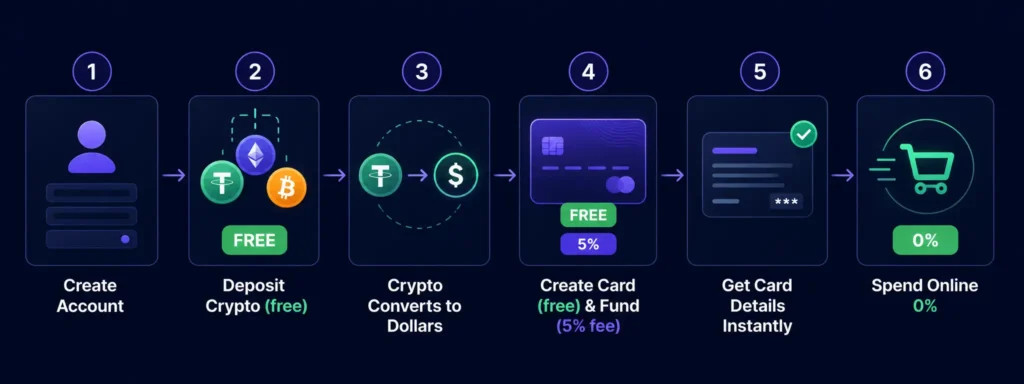
The flow from “I hold crypto” to “I just paid for something” has several distinct steps:
1. You create an account with a virtual crypto card platform. On Rivocard, this takes under a minute — email, password, email verification. No KYC required to start spending up to your Basic KYC tier limit.
2. You deposit cryptocurrency to your platform wallet. The platform gives you a deposit address for each supported cryptocurrency. You send funds from your own wallet or exchange to that address. The deposit is free — no fee at this step.
3. The platform converts your crypto to a dollar balance. Once the blockchain confirms the transaction, your crypto converts to its dollar equivalent at the live market rate. That dollar amount sits in your platform wallet.
4. You create a virtual card and fund it from your wallet. You select how much of your wallet balance to put on a card. A 5% fee is deducted from the funded amount — fund a card with $100 and the card has $95 to spend. Card creation itself is free, and on Rivocard you can create unlimited cards.
5. You receive the card details instantly. Card number, expiry date, and CVV appear in your dashboard within seconds of card creation. No waiting for mail. No activation process.
6. You spend anywhere Visa or Mastercard is accepted. Enter the card details at online checkout, add it to Apple Pay or Google Pay, or use it for any subscription or digital service. Purchases are 0% — no transaction fees.
What Makes It “Virtual” — and Why That Matters
The absence of a physical card is not just a cosmetic difference. It changes several things about how the card works and what you can do with it:
Instant availability. A physical card has to be manufactured, printed, and shipped — typically 5-10 business days. A virtual card appears in your dashboard within seconds of creation.
Unlimited cards. On Rivocard, you can create as many virtual cards as you want at no cost. This is practically useful — you might use one card for ad spend, another for subscriptions, another for travel bookings. Each has its own balance and can be funded independently.
Safer for online use. Because the card exists only digitally, there is nothing to lose, steal, or skim. If a card number is compromised, you can freeze or delete it and create a new one instantly — without waiting for a replacement card in the mail.
No delivery address required. Physical cards need a shipping address. Virtual cards work for anyone, anywhere, without a postal address ever being involved.
Immediate freeze and replacement. From your dashboard, you can freeze a virtual card in seconds, create a replacement with a new card number immediately, and keep spending without interruption.
Virtual Crypto Card vs. Regular Prepaid Card
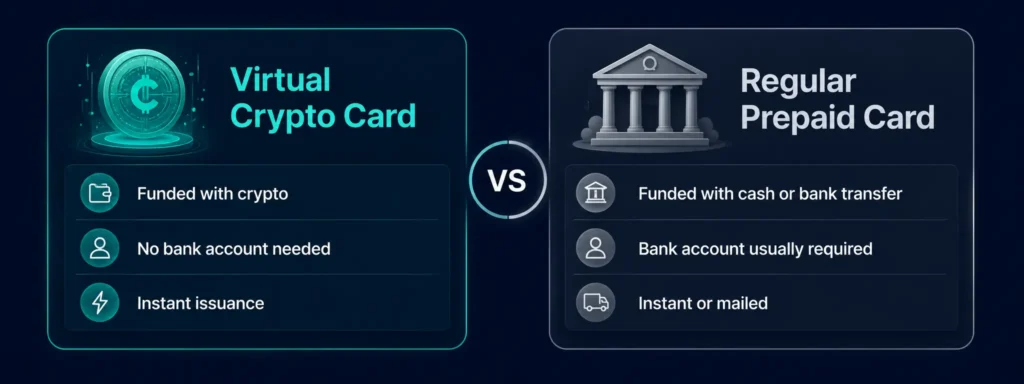
The core concept is the same — both are prepaid cards you fund before spending — but the funding mechanism and setup process are fundamentally different:
| Virtual Crypto Card | Regular Prepaid Card | |
|---|---|---|
| Funded with | Cryptocurrency | Cash or bank transfer |
| Conversion step | Crypto to fiat at deposit | None needed |
| Issuance | Instant, digital only | Usually instant for virtual, 5-10 days for physical |
| Bank account needed | No | Usually yes (for funding) |
| KYC required | Varies by platform and tier | Usually yes |
| Card number | Real 16-digit Visa or Mastercard number | Same |
| Accepted where | Everywhere Visa or Mastercard is accepted | Same |
The practical difference comes down to funding. A regular prepaid card connects to traditional banking infrastructure. A virtual crypto card connects to blockchain infrastructure instead — letting anyone with crypto fund a spendable card without going through a bank at all.
Virtual Crypto Card vs. Physical Crypto Card
Some platforms offer both virtual and physical versions. Here is how they compare:
| Virtual Card | Physical Card | |
|---|---|---|
| Delivery | Instant | 5-10 business days by mail |
| In-person use | Only via Apple Pay / Google Pay (NFC) | Full — tap, swipe, or chip |
| Online use | Full | Full |
| ATM cash withdrawals | No | Yes (where supported) |
| Card replacement | Instant | Days |
| Cost | Usually free | Sometimes a fee |
| Risk of loss or theft | None (no physical card exists) | Exists |
For most everyday use cases — online shopping, subscriptions, digital services, Google and Facebook ad spend — a virtual card handles everything without any disadvantage. A physical card adds value primarily for in-person cash withdrawals (ATM) and merchants that do not have contactless terminals.
What You Can Use a Virtual Crypto Card For
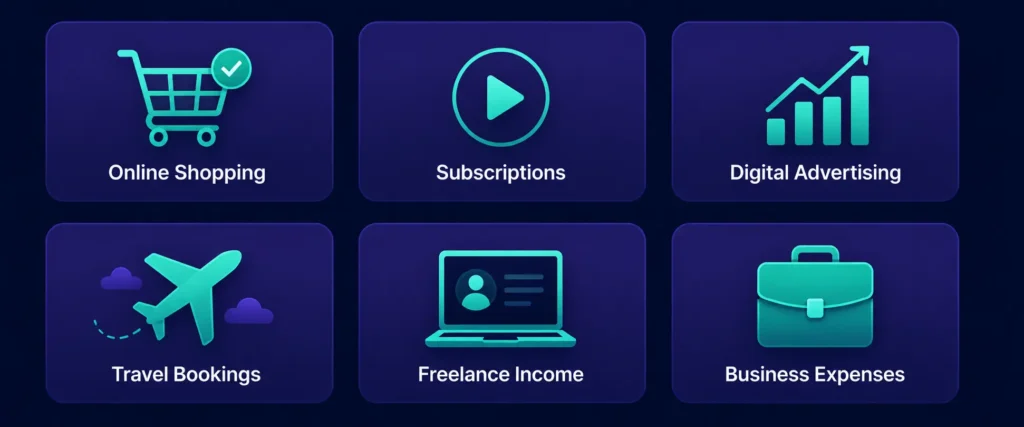
The most common use cases, roughly in order of frequency:
Online shopping. Any e-commerce site that accepts Visa or Mastercard accepts your virtual crypto card. Amazon, AliExpress, Shopify stores, independent retailers — all work identically.
Digital subscriptions. Netflix, Spotify, Adobe Creative Cloud, Microsoft 365, cloud hosting, SaaS tools — any recurring subscription that charges a card works with a virtual crypto card.
Digital advertising. Google Ads, Meta Ads, TikTok Ads, LinkedIn Ads all accept Visa or Mastercard for billing. Many digital marketers and media buyers use crypto cards specifically to fund ad accounts, since it avoids the complications of linking business bank accounts to ad platforms.
Travel bookings. Flights, hotels, car rentals — all major travel platforms accept Visa or Mastercard. A virtual card works for booking, and the card can be added to Apple Pay for contactless use during the trip.
Freelance and contractor payments to themselves. People who receive income in cryptocurrency — remote workers, Web3 contractors, freelancers paid in USDT — use virtual crypto cards as their primary spending mechanism, converting income directly to a spendable card balance without touching a bank.
Gaming and digital content. In-app purchases, Steam wallet, PlayStation Store, App Store — all accept card payments that virtual crypto cards can fulfill.
Business expenses. Creating separate virtual cards for each vendor, team member, or expense category gives businesses clean transaction records without exposing a primary bank account.
What a Virtual Crypto Card Is Not
A few things it is important to clarify, since the terminology gets confused:
It is not a credit card. A virtual crypto card is prepaid — you can only spend what you have loaded. There is no credit line, no monthly bill, no interest charge. If your balance reaches zero, the card declines.
It is not a crypto wallet. The card holds a fiat dollar balance after conversion, not cryptocurrency. You cannot receive crypto on the card or send it out as crypto.
It does not hold cryptocurrency. The moment your deposit converts, it becomes dollars. The card is a spending tool for fiat currency that was funded via crypto.
It does not give you exposure to crypto price movements after funding. Once your deposit converts to dollars in your wallet, market movements do not affect that balance. This is a feature, not a limitation — it means predictable spending power.
Key Features to Look For in a Virtual Crypto Card
If you are comparing options beyond Rivocard, here are the features that actually matter:
Instant issuance. The card should be available within seconds of creation. If there is a processing delay, it is a platform architecture issue, not a regulatory one.
No KYC to start. The best platforms let you create a card and begin spending without submitting ID verification for lower spend tiers. KYC should be opt-in for higher limits, not mandatory before any spending.
Multiple cards. Single-card platforms limit how you manage spending. A platform that lets you create unlimited cards gives you real flexibility for separating budgets, protecting privacy per merchant, or managing team spending.
Transparent fee structure. The 5% fee Rivocard charges is straightforward — deducted at card funding, nothing else. Avoid platforms with layered fees: conversion spread + monthly maintenance + inactivity fee + foreign transaction fee.
Wide crypto support. USDT, USDC, BTC, and ETH at minimum. Tron-based USDT (TRC-20) support specifically matters for fast, low-cost deposits.
Apple Pay and Google Pay compatibility. This extends the card’s usefulness to in-person spending without a physical card — tap your phone at any NFC terminal.
Instant freeze and replacement. Security controls should be in your hands, in real time, from your dashboard.
How Rivocard’s Virtual Card Works Specifically
On Rivocard, the virtual card model has a few features worth highlighting:
No KYC to start. You can create an account, deposit crypto, fund a card, and make purchases without submitting ID — up to your Basic KYC tier’s spending limits. KYC is optional and only needed if you want to access higher spending tiers.
Unlimited cards. There is no cap on how many virtual cards you can create. Card creation itself is free — the 5% fee only applies when you fund a card with balance.
Wallet-first model. Your deposited crypto converts to a wallet balance first (free). You then fund cards from that wallet (5% fee). This gives you control — deposit in bulk when it is convenient, fund cards on demand.
Instant issuance. Cards appear in your dashboard within seconds of creation. You can start using the card number immediately for online purchases.
5% fee, nothing else. No monthly fee, no subscription, no foreign transaction fee, no purchase fee. The only fee is the 5% deducted when you fund a card.
For a full walkthrough of setting up your account and creating your first card, see our step-by-step guide to creating a Rivocard account.
Is a Virtual Crypto Card Safe?
Virtual crypto cards carry the same security infrastructure as any regulated card product. Reputable platforms operate under PCI DSS-compliant card processing — the same standard used by banks and major card networks. Transactions run on Visa or Mastercard rails, which means standard card-network fraud protections apply.
The additional security advantages of virtual over physical are meaningful: no card to lose or steal, instant freeze from your phone, and the ability to replace a compromised card number in seconds without waiting for a new card in the mail.
The primary security responsibility on your end is protecting your account credentials — strong unique password, two-factor authentication if available, and never sharing your card number in unsecured environments.
Curious how it works in practice? Create account on RivoCard and get your first crypto virtual card issued in under a minute.
FAQs
What is a virtual crypto card?
A virtual crypto card is a digital payment card — with a real card number, expiry date, and CVV — funded with cryptocurrency instead of a bank account. There is no physical plastic. You deposit crypto, the platform converts it to a fiat balance, and you spend using the card details anywhere Visa or Mastercard is accepted.
How does a virtual crypto card work?
You deposit cryptocurrency to the card platform’s wallet (free). The platform converts your crypto to a dollar balance. You create a virtual card and fund it from that wallet balance (5% fee on Rivocard). You receive a card number, expiry, and CVV instantly and can use them to pay online or through Apple Pay and Google Pay.
Do I need a bank account for a virtual crypto card?
No. The entire process — depositing crypto, converting it, creating cards, and spending — happens without a bank account. The card runs on Visa or Mastercard rails, but your funding comes from crypto, not a bank.
Is there a fee for a virtual crypto card?
It depends on the platform. On Rivocard, card creation is free and purchases are 0%. The only fee is 5%, deducted when you fund or reload a card from your wallet balance. There are no monthly fees, subscription fees, or foreign transaction fees.
How many virtual crypto cards can I create?
On Rivocard, there is no limit on the number of virtual cards you can create. Card creation is always free. You can have separate cards for different purposes — ad spend, subscriptions, travel — each with its own balance.
Can I use a virtual crypto card for Apple Pay or Google Pay?
Yes. Most virtual crypto card platforms, including Rivocard, support adding the card to Apple Pay and Google Pay. This lets you use the card for NFC contactless payments in person, even without a physical card.
What cryptocurrencies can I use to fund a virtual crypto card?
On Rivocard, you can fund your card wallet with 12+ cryptocurrencies including BTC, ETH, USDT (TRC-20 and ERC-20), USDC, SOL, LTC, XMR, DASH, XRP, DOGE, BNB, and TRX. See the full list at rivocard.com/which-cryptocurrencies-does-rivocard-support.
Is a virtual crypto card the same as a physical crypto card?
No. A virtual card exists only digitally — instant issuance, no physical plastic, no delivery wait. A physical crypto card is a real plastic card that ships by mail and supports in-person payments and ATM withdrawals. On Rivocard, virtual cards are available instantly; physical cards may be optionally available.
Do I need to pass KYC to get a virtual crypto card on Rivocard?
No. On Rivocard, you can create an account, fund a card, and start spending without submitting identity documents — up to your Basic KYC tier spending limits. KYC is only required if you want to access higher spending tiers.
Can I freeze a virtual crypto card?
Yes. From your Rivocard dashboard, you can freeze a card instantly. If you need to replace a compromised card number, you can create a new card immediately — no waiting for a replacement to arrive in the mail, unlike with physical cards.
Is a virtual crypto card safe for online purchases?
Yes. Virtual crypto cards are well-suited for online purchases — the card number is separate from your main account, can be frozen or deleted instantly if compromised, and new card numbers can be issued immediately. Combined with PCI DSS-compliant processing and standard card-network protections, the security profile is solid.
Get Started
Ready to create your first virtual crypto card? Get started with Rivocard →