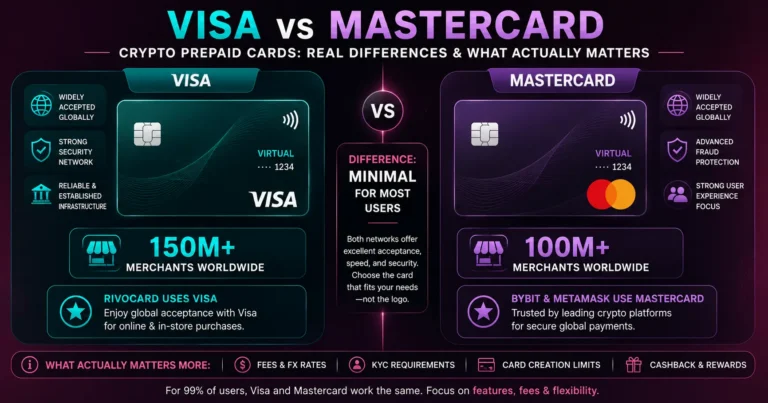
Quick answer: For most everyday spending, the difference between a Visa and Mastercard crypto prepaid card is negligible. Both networks are accepted at virtually the same global merchant locations — over 150 million for Visa, over 100 million for Mastercard. The practical differences are in specific edge cases: some merchants or terminals have preferences, some countries see one network dominating slightly over the other, and the networks differ in their approach to crypto settlement infrastructure. What matters more than the network is the specific card provider’s fee structure, KYC requirements, and geographic availability. Rivocard issues on the Visa network. This guide explains when the network choice actually matters and when it does not.
Global Acceptance: Visa vs Mastercard
Visa is accepted at over 150 million merchant locations worldwide, while Mastercard is accepted at over 100 million. In practice, this numerical gap is largely irrelevant for users in developed markets — both networks are accepted at all major retailers, e-commerce platforms, subscription services, and digital advertising platforms globally.
Where the gap has some practical relevance:
- Remote or rural areas in certain developing markets may have a slightly higher density of one network vs the other
- Some country-specific or niche merchants may accept only one network
For online purchases — the primary use case for crypto cards — both Visa and Mastercard are accepted universally at any e-commerce site that accepts card payments.
The honest answer: If you are primarily an online spender using your crypto card for subscriptions, digital services, travel bookings, and e-commerce, Visa vs Mastercard is not a meaningful difference.
Which Crypto Cards Use Which Network
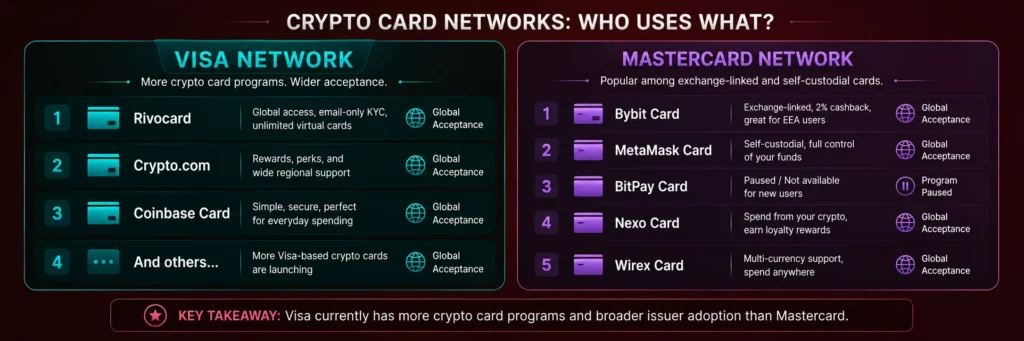
Visa crypto cards:
- Rivocard (virtual Visa)
- Crypto.com Visa
- Coinbase Card (Visa)
- Gemini Credit Card (Mastercard actually — see below)
- Many exchange-linked cards in developing markets
Mastercard crypto cards:
- Bybit Card (Mastercard)
- BitPay Card (Mastercard, paused)
- MetaMask Card (Mastercard)
- Wirex (both Visa and Mastercard depending on region and product)
- Nexo Card (Mastercard)
Mastercard partnerships remain less common than Visa integrations in the crypto card space. The choice between Visa and Mastercard typically depends on the issuer’s existing banking relationships and regional acceptance patterns rather than significant functional differences for end users.
Crypto-Specific Network Differences in 2026
Both Visa and Mastercard have made significant moves in the crypto space in 2026:
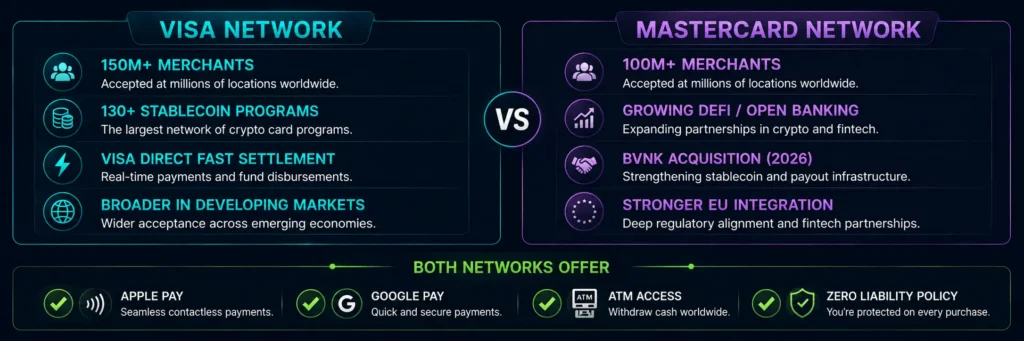
Visa: Visa runs more than 130 stablecoin-linked card programs across more than 50 countries. Visa has been the dominant network for crypto card programs historically, partly because of its deeper relationships with the regulated fintech and banking partners that issue crypto cards.
Visa Direct — Visa’s real-time payment rail — moves crypto settlement faster, particularly for large amounts. Visa’s crypto cards often show up more in developing regions.
Mastercard: Mastercard links tighter with decentralized finance tools across Europe and Open Banking infrastructure. Mastercard acquired BVNK in 2026 for up to $1.8 billion to deepen its stablecoin infrastructure.
MetaMask Card is supported by Mastercard and can be used over 150 million merchants globally wherever Mastercard is accepted. Mastercard has been active in partnering with self-custodial wallet providers.
Where the Network Can Actually Matter
Merchant Acceptance in Specific Countries
Some countries show mild preferences:
- Japan: Both Visa and Mastercard widely accepted, though some smaller merchants may accept only one
- China: UnionPay dominates domestically; both Visa and Mastercard are limited to tourist-area acceptance (both equally limited)
- Latin America and Southeast Asia: Visa generally has slightly wider merchant penetration in smaller markets
- EU: Both universally accepted
For practical international travel purposes, a Visa crypto card has marginally broader acceptance in the most remote or emerging markets. In all developed markets, the difference is zero.
Chargeback and Dispute Policies
Both Visa and Mastercard offer chargeback rights and zero liability policies for unauthorized transactions. The specific terms are slightly different:
Visa Zero Liability Policy: Cardholders not responsible for unauthorized transactions when reported promptly and when basic security practices were followed. Applies to all Visa debit, credit, and prepaid cards.
Mastercard Zero Liability Protection: Similar protection with slightly different specific terms. Applies to all Mastercard consumer cards.
In practice, the chargeback and dispute process for a crypto card dispute flows through the card issuer (Rivocard, Bybit, Crypto.com, etc.) rather than directly with Visa or Mastercard. The network’s zero liability policy is the backstop, but your first point of contact is always the card issuer.
FX Rate Application
Both Visa and Mastercard apply their own wholesale exchange rates when converting between currencies for international transactions. These rates are very similar — both are close to the interbank rate and both have their rates publicly available online for reference.
Visa: visa.com/en_US/support/consumer/travel-support/exchange-rate-calculator.html Mastercard: mastercard.us/en-us/personal/get-support/convert-currency.html
For a crypto card user, the relevant question is not which network gives a better rate, but whether the card provider adds an FX markup on top of the network rate. Rivocard adds 0% on top of the Visa rate. Some Mastercard cards add 0.5-1% on top of the Mastercard rate. The provider markup matters more than the underlying network rate difference.
Apple Pay and Google Pay
Both Visa and Mastercard are fully supported by Apple Pay and Google Pay. There is no meaningful difference in how either network functions within digital wallets for contactless payments.
ATM Access
Both Visa and Mastercard crypto cards provide ATM access (where the card provider enables this feature). ATM availability is slightly more Visa-dominant globally by merchant count, but in practice both networks provide ATM access in every major country. The ATM fee is set by the card provider, not the network.
The Real Decision Factors (That Matter More Than Network)
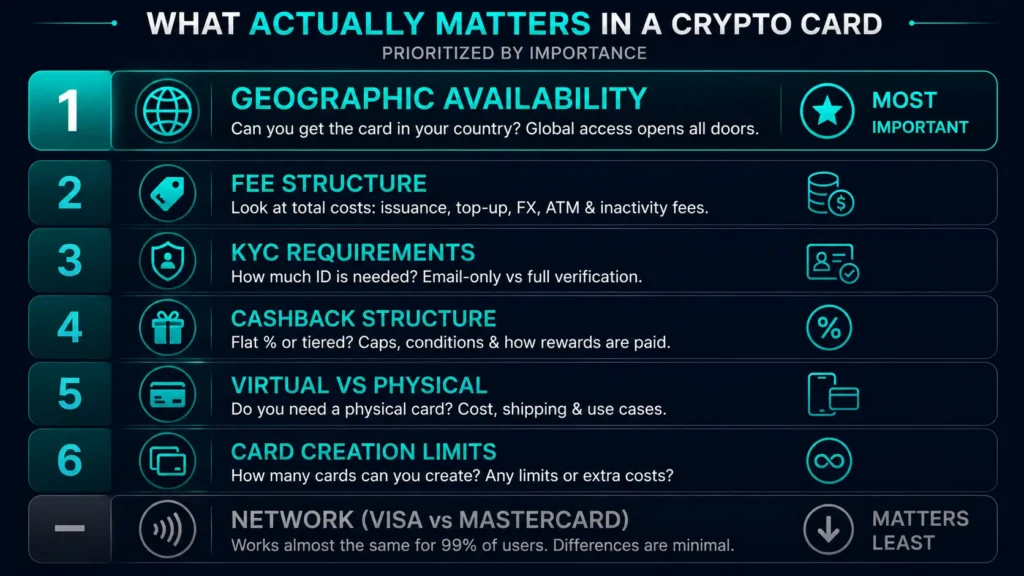
When choosing between a Visa and Mastercard crypto card, the network itself should be one of the last factors considered. The factors that actually determine your experience:
1. Geographic availability of the card provider Can you sign up from your country? Bybit Card (Mastercard) is available in EEA, Australia, and select regions. Rivocard (Visa) is available globally.
2. Fee structure Rivocard (Visa): 5% at card funding, 0% FX. Bybit (Mastercard): 0.9% conversion, 0.5% FX. These differences dwarf any network-level rate difference.
3. KYC requirements Rivocard (Visa): email-only at Basic KYC. All Mastercard crypto cards in this comparison require full identity verification.
4. Cashback structure Bybit (Mastercard): 2% cashback (net ~1.1%). Rivocard (Visa): 0% cashback.
5. Virtual vs physical card Most Visa crypto cards offer virtual-first issuance. Mastercard cards tend to offer physical plus virtual.
6. Card creation limits Rivocard (Visa): unlimited free virtual cards. Bybit (Mastercard): one card per account.
The Network Choice in 2026: A Summary
| Visa (Rivocard example) | Mastercard (Bybit example) | |
|---|---|---|
| Global merchant acceptance | 150M+ locations | 100M+ locations |
| Crypto card availability | Most crypto card programs | Less common but growing |
| FX rate quality | Near interbank rate | Near interbank rate |
| Apple Pay/Google Pay | Fully supported | Fully supported |
| ATM acceptance | Most global ATMs | Most global ATMs |
| Developing market coverage | Slightly broader | Strong in EU/DeFi |
| Network-level difference for users | Minimal in practice | Minimal in practice |
FAQs
What is the difference between a Visa and Mastercard crypto prepaid card?
The functional difference for most users is minimal. Both networks are accepted at virtually the same global merchant locations, support Apple Pay and Google Pay, offer comparable ATM access, and apply similar near-interbank exchange rates for currency conversion. The meaningful differences are in which specific card providers use each network and those providers’ fee structures, geographic restrictions, and KYC requirements.
Is Visa or Mastercard better for a crypto card?
For most users, the network is less important than the card provider. Visa has more crypto card programs globally and slightly broader merchant coverage in developing markets. Mastercard has stronger ties to European Open Banking and DeFi infrastructure. In practical everyday use in developed markets, both are equally accepted.
Which crypto cards are on Visa vs Mastercard?
Major Visa crypto cards include Rivocard, Crypto.com, and Coinbase Card. Major Mastercard crypto cards include Bybit, MetaMask, BitPay (paused), Nexo, and Wirex (on some products). The choice of network is determined by the card provider’s banking partner relationships, not the user.
Does it matter which network my crypto card uses?
For online spending and in-person spending in developed markets: no. For travel to remote or emerging markets: Visa has marginally broader coverage. For specific DeFi or Open Banking integrations: Mastercard has more activity in Europe. For everyday crypto card use, the fee structure and geographic availability of the provider matter far more than the network.
Does Rivocard use Visa or Mastercard?
Rivocard issues cards on the Visa network. Your Rivocard virtual card is accepted at any Visa-accepting merchant globally – over 150 million merchant locations in 200+ countries and territories.
Is the FX rate better on Visa or Mastercard crypto cards?
Both Visa and Mastercard apply near-interbank exchange rates for currency conversion. The rates are very similar and both are publicly accessible for comparison. What matters more is whether the card provider adds an FX markup on top of the network rate. Rivocard adds 0% on top of the Visa rate. Some cards add 0.5-1% on top of either network’s rate – the provider markup is the meaningful variable, not the network.
Do both Visa and Mastercard crypto cards work with Apple Pay?
Yes. Both Visa and Mastercard are fully supported by Apple Pay and Google Pay. There is no meaningful difference in how either network functions within digital wallets for contactless payments.
Which network has more crypto card programs?
Visa. Mastercard partnerships remain less common than Visa integrations in the crypto card space. Visa runs more than 130 stablecoin-linked card programs across 50+ countries. However, Mastercard is growing its crypto and stablecoin programs – its acquisition of BVNK in 2026 signals significant investment in crypto payment infrastructure.
Does the Visa or Mastercard network determine my spending limits?
No. Spending limits on crypto cards are set by the card provider (Rivocard, Bybit, Crypto.com, etc.) based on the user’s KYC tier – not by the underlying card network. Both networks support the same range of spending limits that providers choose to offer.
Does Visa or Mastercard offer better fraud protection on crypto cards?
Both networks offer comprehensive zero liability policies for unauthorized transactions. Visa offers the Visa Zero Liability Policy; Mastercard offers Mastercard Zero Liability Protection. The specific terms differ slightly but both protect cardholders from unauthorized transaction liability when reported promptly. Your first contact for disputes is always the card issuer, not the network directly.
Get Started
Rivocard issues on the Visa network – accepted at 150M+ merchant locations globally. Create your Rivocard account