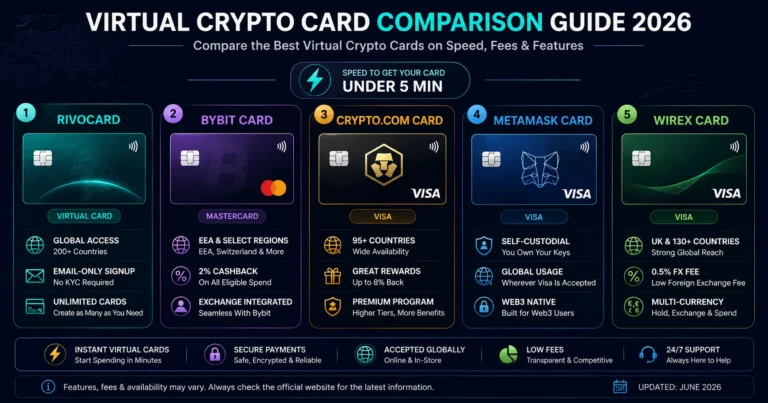
Quick answer: Virtual crypto cards are digital card numbers — no plastic, no postal wait — that work for online purchases, subscriptions, digital advertising, and in-person contactless payments via Apple Pay or Google Pay. The best options hand over usable card details within minutes of approval, covering online payments, subscriptions, mobile wallets, and everyday spending without the wait for plastic in the post. In 2026, virtually every major crypto card platform offers at least a virtual card option. The differentiators that actually matter: how quickly a card is issued after signup, whether unlimited cards can be created free, Apple Pay and Google Pay support, how the funding fee compares to the stated rate, and whether the virtual card can be used internationally at 0% FX. This guide covers the key decision factors and how Rivocard compares specifically as a virtual-first platform.
What Makes a Virtual Crypto Card Different From a Physical One
A virtual crypto card is a set of numbers — 16-digit card number, expiry date, CVV — generated and delivered digitally, with no physical plastic. A virtual crypto card is a card number issued instantly in an app, with no physical plastic. You get the number, expiry, and CVV right after signup, add it to Apple Pay or Google Pay or paste it at online checkout, and spend from your crypto balance.
What virtual cards do better than physical:
- Instant issuance — no 5-10 day postal delivery
- Multiple cards with different numbers for different merchants or purposes
- Immediate replacement if compromised — freeze old number, create new one in seconds
- No physical theft, skimming, or interception risk
- Better suited to online and subscription spending (the majority of modern spending)
- Works anywhere Apple Pay or Google Pay is accepted via NFC
What physical cards do that virtual cannot:
- ATM cash withdrawals (chip and magnetic stripe required)
- Chip-and-PIN-only terminals without NFC
- Situations requiring physical card presentation
For most users in 2026, the ideal setup is one primary virtual card on the phone for daily spending and one physical card as a backup for ATM access. The virtual card handles 95%+ of transactions. The physical card handles the edge cases.
The Five Virtual Card Evaluation Criteria
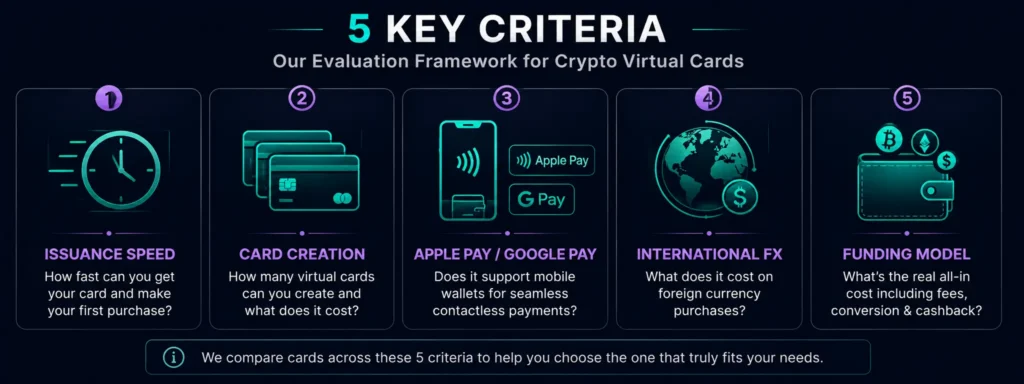
1. Issuance Speed
How quickly does the card become usable after signup?
The fastest virtual cards go from signup to first purchase in under 5 minutes via Apple Pay or Google Pay.
| Platform | Issuance timeline | What’s required first |
|---|---|---|
| Rivocard | Under 2 minutes | Email verification only |
| Bybit Card | Minutes to hours | Full KYC |
| Crypto.com | Hours to days | Full KYC |
| MetaMask Card | Under 5 minutes | KYC |
| Wirex | Hours to days | Full KYC |
Rivocard’s email-only Basic KYC is the fastest path to a usable virtual card. No waiting for ID verification approval — the card is available immediately after clicking a verification link in your inbox.
2. Card Creation Limits and Fees
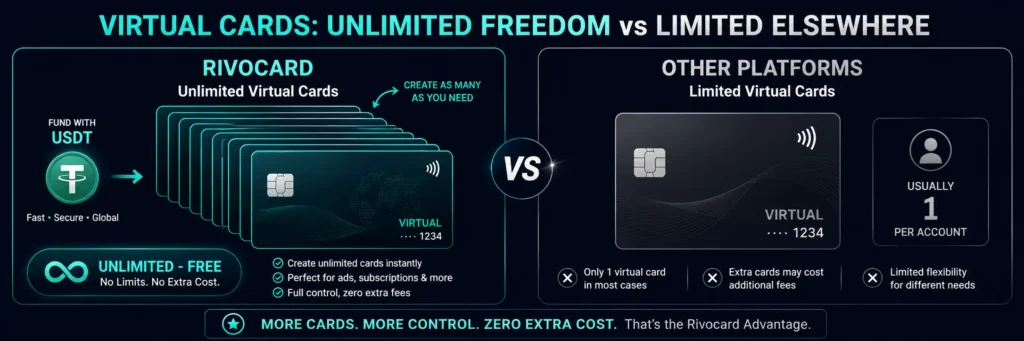
How many virtual cards can you create, and what does each cost?
This is a critical differentiator for users who need multiple cards — per-merchant isolation, per-campaign ad spend, per-subscription management.
| Platform | Cards per account | Per-card creation fee |
|---|---|---|
| Rivocard | Unlimited | $0 |
| Bybit Card | 1 virtual + 1 physical | $0 |
| Crypto.com | 1 virtual + 1 physical | $0 |
| Wirex | Multiple (tier-dependent) | Varies |
| MetaMask Card | 1 | $0 |
Rivocard’s unlimited free card creation is a category-specific advantage. No other major platform in this comparison offers truly unlimited virtual card creation at no per-card cost. For digital advertisers, media buyers, and users who want per-merchant card isolation, this is a meaningful differentiator.
3. Apple Pay and Google Pay Support
Can the virtual card be added to a digital wallet for in-person contactless payments?
| Platform | Apple Pay | Google Pay | Samsung Pay |
|---|---|---|---|
| Rivocard | Yes | Yes | Check dashboard |
| Bybit Card | Yes | Yes | Yes |
| Crypto.com | Yes | Yes | Yes |
| Wirex | Yes | Yes | Yes |
| MetaMask Card | Yes | Yes | Yes |
Most major virtual crypto cards support Apple Pay and Google Pay. Rivocard supports both, enabling in-person NFC contactless payments at any tap-to-pay terminal globally. This means Rivocard’s virtual-only model is sufficient for the vast majority of in-person spending — the physical card is only needed for ATMs and chip-and-PIN-only scenarios.
4. International Acceptance and FX Fees
Virtual cards are particularly useful for international online purchases. FX fee differences matter:
| Platform | FX fee on international purchases | Network |
|---|---|---|
| Rivocard | 0% | Visa |
| Bybit Card | 0.5% (EEA), 1% (AU) | Mastercard |
| Crypto.com | 0% (most tiers) | Visa |
| Wirex | 0% stated (spread applies) | Visa/Mastercard |
| MetaMask Card | Varies | Visa (via Linea L2) |
For international online purchasing — a primary use case for virtual cards — Rivocard’s 0% FX fee is a clear advantage over Bybit’s 0.5-1% and avoids the hidden spread issues of Wirex.
5. Funding Model and Real Fee Structure
How does the virtual card get funded, and what is the true all-in cost?
Understanding fee structure is critical before choosing a provider. The real cost includes the loading fee, conversion spread, and any per-transaction fees.
| Platform | Funding model | Stated fee | Hidden spread | Real all-in cost |
|---|---|---|---|---|
| Rivocard | Wallet-to-card | 5% at card funding | None | 5% at funding |
| Bybit Card | Exchange balance | 0.9% conversion | None (disclosed) | 0.9% per transaction |
| Crypto.com | Exchange balance | 0% load | ~0.5% spread | ~0.5% per transaction |
| Wirex | Wallet load | 0% stated | 1-2% spread | 1-2% effective |
| MetaMask Card | Wallet balance | Varies | Check terms | Check terms |
Rivocard’s 5% is explicitly stated and clearly charged once at card funding. No hidden spread, no per-transaction surprise. Wirex’s “0% fee” with a 1-2% spread is effectively more expensive per transaction for users who spend frequently.
The Virtual-Only vs Virtual-Plus-Physical Question
For users choosing a crypto card primarily for online spending, the virtual-only model is fully sufficient. Consider the actual split of modern spending:
Online purchases: 100% of these work with virtual cards Subscriptions and recurring billing: 100% virtual card capable In-person (NFC contactless): Virtual card via Apple Pay or Google Pay handles this ATM withdrawals: Physical card required Chip-and-PIN-only in-person: Physical card required (rare in 2026) Hotel check-in holds: Varies by property
For most users in 2026, the virtual card handles 95% or more of transactions. The physical card handles edge cases — primarily ATMs and in-person situations that require chip-and-PIN without NFC.
If you do not regularly use ATMs and primarily spend online and via Apple Pay or Google Pay, a virtual-only crypto card is practically equivalent to having a physical card for 95%+ of real-world spending.
Rivocard’s Specific Advantages as a Virtual-First Platform
Rivocard is built as a virtual-first platform — no physical card, no plans for one as a primary offering. This means the virtual card experience is the core product, not a secondary feature alongside a physical card.
Advantages specific to Rivocard’s virtual-first model:
- Unlimited card creation, free — no other major platform offers this
- Email-only entry — fastest path from zero to first purchase
- 0% FX on all international purchases — particularly valuable for online international purchasing
- 12+ supported cryptocurrencies from any external wallet or exchange
- Global coverage — no country-of-residence restriction at Basic KYC
- Per-card balance isolation — each virtual card has its own balance
Where Rivocard falls short vs physical-plus-virtual providers:
- No ATM access (physical card required elsewhere for cash)
- Higher funding fee (5% vs 0.9% for Bybit or lower conversion-fee platforms)
- No cashback rewards
Who Each Virtual Card Type Suits
Rivocard (virtual-only, global, unlimited cards): Best for users who primarily spend online, need multiple cards, are outside exchange-linked card coverage areas, or want email-only entry. Digital advertisers and media buyers who need per-account card isolation get specific value here.
Bybit Card (virtual plus physical, EEA/AU/select, exchange-tied): Best for active Bybit users in supported regions who want net-positive cashback (2% cashback minus 0.9% conversion = ~1.1% net) and also need physical card access for ATMs.
Crypto.com Visa (virtual plus physical, 95+ countries, exchange ecosystem): Best for users who want physical card perks (lounge access at higher tiers) alongside virtual card convenience. The free basic tier earns 0% cashback in 2026 — premium tiers require CRO staking.
MetaMask Card (virtual-only, US/EEA/UK, self-custodial): Best for users who prefer self-custodial architecture — card connects directly to MetaMask wallet without depositing to an exchange. Nascent product with limited track record as of 2026.
Virtual cards from newer entrants (Bleap, KAST, RedotPay): KAST is the stronger virtual-first stablecoin option where it is available. Bleap offers up to 20% cashback with self-custodial architecture. RedotPay issues a Visa prepaid that spends a preloaded stablecoin balance across 100+ countries. These newer options may offer compelling cashback but carry less operational history than established platforms.
The Use-Case Match Table
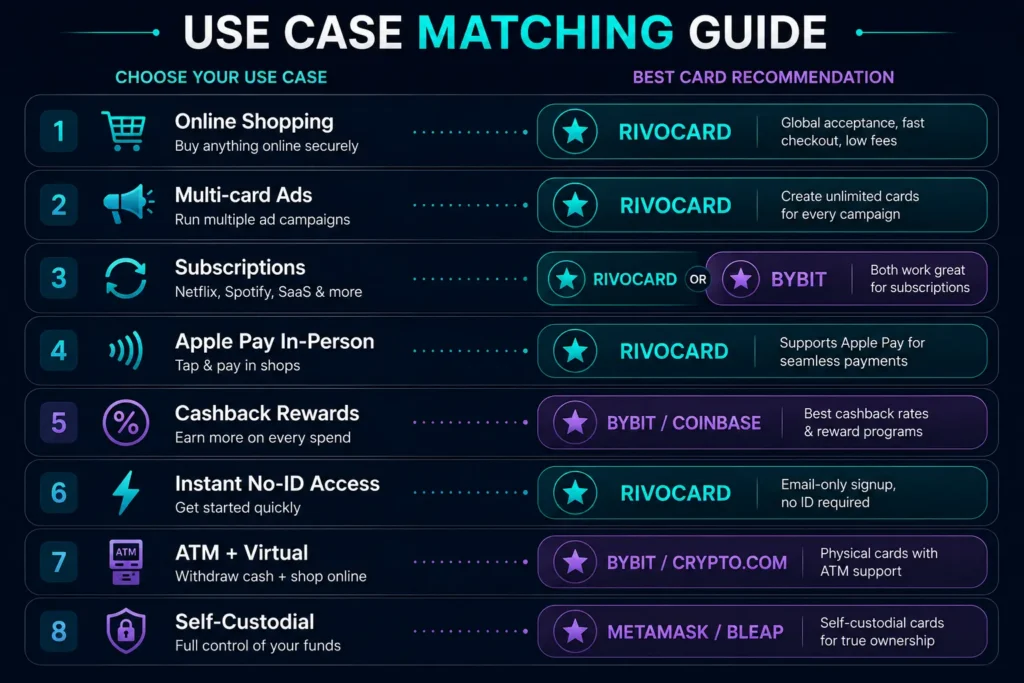
| Use case | Best virtual card option |
|---|---|
| Online shopping globally | Rivocard (0% FX) or Crypto.com |
| Digital advertising multi-card | Rivocard (unlimited free cards) |
| Subscription management | Rivocard or Bybit (if in EEA) |
| In-person via Apple Pay globally | Rivocard (0% FX) or any with Apple Pay support |
| Cashback on everyday spending | Bybit (EEA) or Coinbase (US) |
| Instant access, no ID | Rivocard (email-only Basic KYC) |
| ATM cash access + virtual | Bybit, Crypto.com, Wirex (physical card option) |
| Self-custodial architecture | MetaMask Card, Bleap, Gnosis Pay |
FAQs
What is the best virtual crypto card in 2026?
It depends on your use case. For global access with no exchange account and email-only entry: Rivocard. For cashback rewards in EEA and Australia as an existing Bybit user: Bybit Card. For US-based users on Coinbase: Coinbase Card. For self-custodial architecture: MetaMask Card or Bleap.
Can I use a virtual crypto card in person?
Yes – via Apple Pay or Google Pay. Add your virtual card to either digital wallet and tap at any NFC contactless terminal. This covers most modern in-person merchants globally. The only in-person scenarios a virtual card cannot handle are ATMs (require physical chip or magnetic stripe) and chip-and-PIN-only terminals without NFC.
How many virtual cards can I create on Rivocard?
Unlimited. Card creation on Rivocard is always free regardless of how many cards you create. This is a specific advantage for users who need multiple cards – one per subscription service, one per ad account, one per merchant category.
How fast are virtual crypto cards issued?
The fastest virtual cards issue in under 2 minutes after signup. Rivocard requires only email verification – the card is available within 2 minutes of clicking the verification link. Other platforms that require full KYC (ID verification) issue virtual cards within hours to days depending on verification processing time.
What is the difference between a virtual card and a physical crypto card?
A virtual card is a set of numbers (16-digit number, expiry, CVV) issued digitally with no plastic. It works for online purchases, subscriptions, and in-person contactless via Apple Pay or Google Pay. A physical card adds ATM cash access and chip-and-PIN terminal capability. For most spending, virtual is equivalent. Physical is needed only for ATMs and rare chip-PIN-only situations.
Do virtual crypto cards work with Apple Pay?
Yes. Most major virtual crypto cards support Apple Pay and Google Pay. Rivocard supports both – add the virtual card to your digital wallet and use it for tap-to-pay at any NFC merchant globally. The transaction is processed at 0% FX fee on Rivocard.
Is a virtual crypto card safer than a physical one?
In some ways. Virtual cards have no physical theft, skimming, or postal interception risk. If compromised online, the number can be frozen and replaced instantly. Physical cards carry these risks but add ATM access. For online spending (the primary use case for virtual cards), the security model of virtual cards is at least equivalent to physical and better in some scenarios.
Do virtual crypto cards charge FX fees for international purchases?
It varies by provider. Rivocard charges 0% on all international transactions. Bybit charges 0.5% in EEA. Wirex states 0% but applies a conversion spread. Always verify the specific provider’s FX fee structure – the 0% FX claim is common but “0% fee” does not always mean “no spread in the conversion rate.”
Can I create multiple virtual cards for different purposes?
Yes on Rivocard (unlimited, free). Most other platforms issue one virtual card per account. Rivocard’s unlimited free card creation enables per-merchant or per-category card isolation – useful for subscription management, digital advertising, and security segmentation.
Get Started
Looking for a virtual crypto card with unlimited cards and global access? Create your Rivocard account – card ready in under 2 minutes