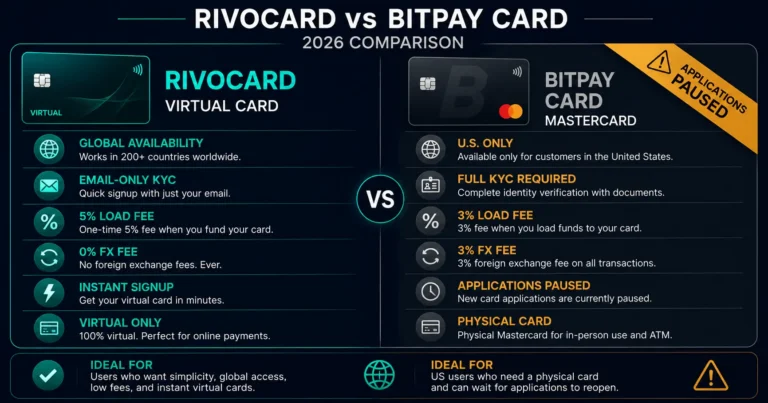
Quick answer: Rivocard and BitPay are both crypto-funded prepaid card options, but in 2026 their situations differ significantly. Rivocard is actively available globally with instant virtual card issuance and email-only entry. BitPay, one of the oldest crypto card providers founded in 2011, has had new card applications paused since June 2023 following its banking partner Metropolitan Commercial Bank’s exit from the crypto sector. The pause has lasted over 2.5 years as of early 2026. Existing BitPay cardholders can still use their cards; new users cannot currently apply. Additionally, BitPay is US-only, charges a 3% foreign transaction fee, has a $5 inactivity fee after 90 days, and requires a $10 card issuance fee.
BitPay Card: The 2026 Reality
BitPay’s history is significant: founded as a Bitcoin payment processor in 2011, BitPay was one of the first crypto card providers — but this is now the second time BitPay has had to discontinue a card program due to banking partner issues (the first was in 2018 when issuer Wave Crest lost Visa network access).
For most people reading a Rivocard vs BitPay comparison in 2026, the most important fact is this: BitPay has paused new card applications during a banking partner transition. The waitlist is available for updates but new users cannot currently get a BitPay card.
BitPay has stated it is working with a new banking partner but has not provided a timeline for resuming applications.
This makes the comparison somewhat asymmetric: Rivocard is available now, globally, with instant card issuance. BitPay is not currently available to new users as of mid-2026.
For existing BitPay cardholders evaluating alternatives, or for anyone monitoring the BitPay waitlist, the detailed comparison below remains relevant.
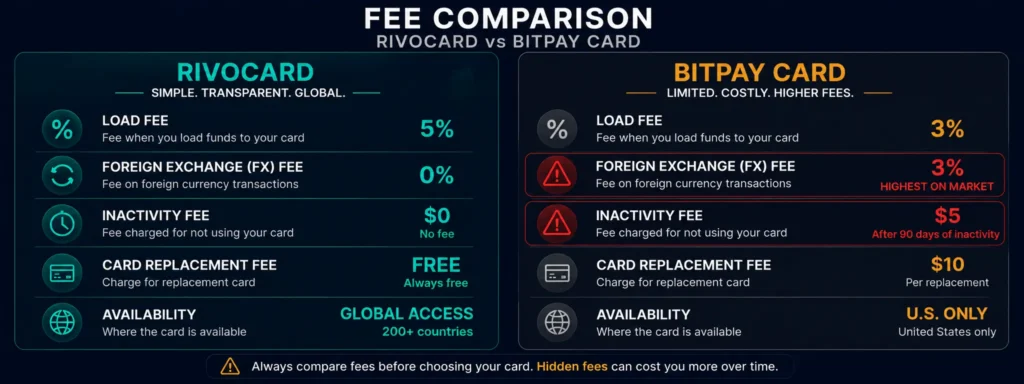
Fee Comparison
| Fee | Rivocard | BitPay |
|---|---|---|
| Card issuance | Free | $10 |
| Annual fee | $0 | $0 |
| Monthly fee | $0 | $0 |
| Card funding / load fee | 5% (Rivocard fee) | 3% conversion fee at load time |
| Conversion spread | 0% | Embedded in conversion rate |
| Foreign transaction fee | 0% | 3% |
| ATM fee (domestic) | N/A (virtual only) | $2.50 per withdrawal |
| ATM fee (international) | N/A | $2.50 plus 3% FX |
| Inactivity fee | $0 | $5 after 90 days of no use |
| Card replacement | Free (new virtual card) | $10 |
| New applications | Open globally | Paused (waitlist only) |
| Country availability | Global | US only |
The Core Fee Difference: 5% vs 3% Load Fee
BitPay and Rivocard both use a pre-load model — you fund the card before spending, with a fee applied at the loading step:
Rivocard: 5% fee when moving wallet balance to a virtual card. No fee at deposit. No purchase fee. No FX fee.
BitPay: 3% conversion fee applied when you load assets from your BitPay wallet to the card. Once loaded, you spend USD from a standard Mastercard prepaid balance with no per-transaction fee domestically.
On a $500 load, Rivocard’s fee is $25 and BitPay’s is $15. BitPay’s load fee is lower in percentage terms.
However, three factors complicate this:
BitPay’s 3% FX fee. For international purchases — any purchase where the merchant is outside the US or bills in a non-USD currency — BitPay adds 3% on top of the standard Mastercard exchange rate. For international use, the 3% FX fee is a clear drawback. At the highest FX rate of any active crypto card, international transactions cost 3% before network spread. Rivocard charges 0% FX.
BitPay’s inactivity fee. A $5 monthly inactivity fee is charged if the card is not used for 90 days. For occasional users or those who load a card for a specific purpose and then leave it idle, this fee quietly drains balances. Rivocard charges $0 inactivity fees indefinitely.
BitPay’s card replacement fee. A lost, stolen, or compromised physical BitPay card costs $10 to replace. A new Rivocard virtual card is free and instant.
International Use: A Major Rivocard Advantage
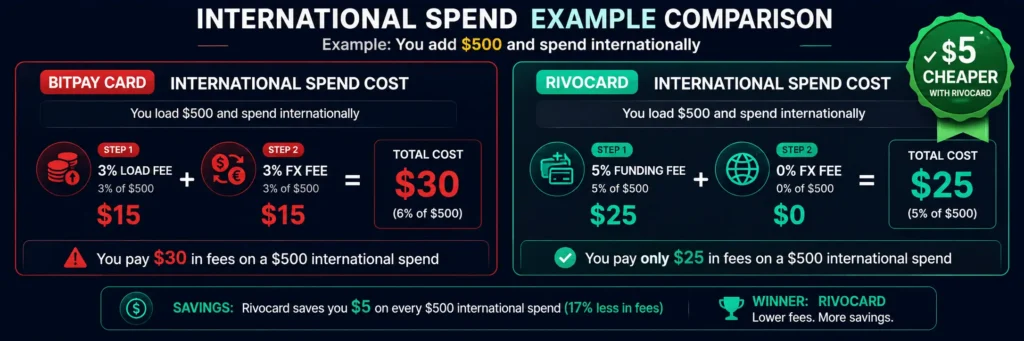
For any spending outside the United States, the comparison shifts dramatically:
Example: $500 spent on international purchases
- BitPay: 3% load fee ($15) plus 3% FX fee ($15) = $30 total fees on $500 in international spend
- Rivocard: 5% card funding fee ($25) plus 0% FX = $25 total fees
BitPay’s 3% FX rate is the highest of any active crypto card. For users with any international spending, Rivocard’s 0% FX fee becomes a meaningful advantage even against BitPay’s lower load fee.
Supported Cryptocurrencies
BitPay: The asset coverage is broader for Bitcoin-ecosystem coins than most competitors. LTC, DOGE, and BCH are supported alongside Bitcoin — notable for long-standing holders of those assets who want to spend them on a card. Also supports USDC. US-only, Mastercard network.
Rivocard: Supports 12+ cryptocurrencies including BTC, ETH, USDT (TRC-20 and ERC-20), USDC, SOL, LTC, XRP, DOGE, BNB, TRX, XMR, DASH. Visa network. Global.
Physical Card vs Virtual Card
BitPay: Issues a physical Mastercard prepaid card, mailed to US addresses. Physical card enables ATM withdrawals up to $6,000/day (among the highest limits in the crypto card space). ATM limits are quite high — while other cards limit to a few hundred dollars per day, BitPay allows up to $6,000 from ATMs.
Rivocard: Virtual cards only. No physical card. No ATM access. In-person spending via Apple Pay or Google Pay at NFC contactless terminals.
The physical card and high ATM limits are genuine BitPay advantages for US users who need cash access. For users who primarily spend online or via contactless mobile payments, the virtual-only model is sufficient.
KYC Requirements
BitPay: Full KYC required (government ID verification) to receive a card. Identity verification is standard for a regulated US financial product.
Rivocard: Email verification only at Basic KYC. Full KYC (ID plus selfie) required only for higher spending limits. The email-only Basic tier gives immediate card access with $5,000/month spending capability.
The Reliability Concern
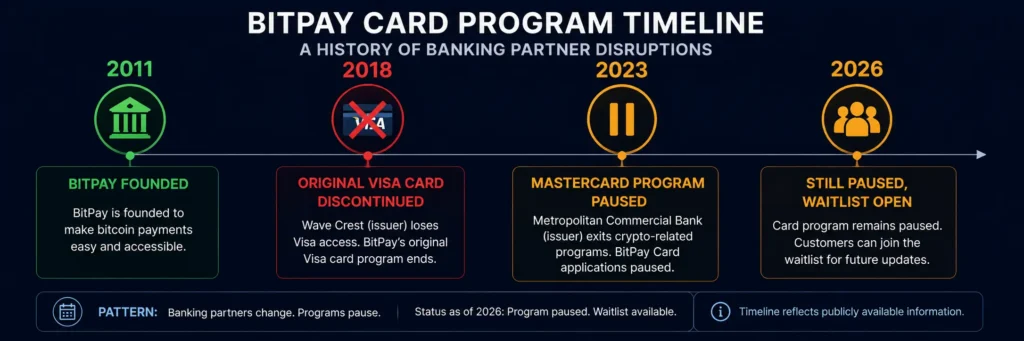
BitPay’s track record with banking partners is a genuine concern that any fair comparison should acknowledge:
The original BitPay Visa card was discontinued in 2018 when issuer Wave Crest lost Visa network access. The current program is the second iteration — now also paused since June 2023 when Metropolitan Commercial Bank exited crypto. This is the second time BitPay has had to discontinue a card program due to banking partner issues.
New applications have been paused for over 2.5 years as of February 2026. BitPay has stated it is working with a new banking partner but has not provided a timeline.
This is not a criticism of BitPay’s underlying product — the US-only cards that did work were functional and served their users. But the pattern of banking partner exits creating card program discontinuations is a relevant consideration for anyone evaluating long-term card reliability.
Rivocard is a newer platform with less operational history — but it is currently operational and accepting new users globally.
Who Is Each Card For in 2026
BitPay (if/when applications resume):
- US residents only
- Bitcoin, Litecoin, Dogecoin, and Bitcoin Cash holders who want to spend those specific assets
- Users who need high ATM cash access (up to $6,000/day)
- Users comfortable with a physical card model and 90-day inactivity fee awareness
- Domestic US spenders where the 3% FX fee is irrelevant
Rivocard:
- Users globally (including those outside the US where BitPay does not operate)
- Users who want immediate card access without waiting for a banking partner transition
- USDT and stablecoin holders who want simple, fast card funding
- Users with any international spending (0% FX advantage)
- Users who want virtual cards for online use, subscriptions, and digital advertising
- Users who prefer no inactivity fee regardless of usage frequency
FAQs
Can I still get a BitPay card in 2026?
New BitPay card applications have been paused since June 2023 following its banking partner’s exit from the crypto sector. Existing cardholders can continue using their cards. A waitlist is available but no timeline for resuming new applications has been announced as of mid-2026.
How does Rivocard’s fee compare to BitPay’s load fee?
Rivocard charges 5% when funding a virtual card from your wallet balance. BitPay charges a 3% conversion fee when loading assets onto the card. BitPay’s load fee is lower in percentage terms. However, BitPay also charges a 3% foreign transaction fee on international purchases, while Rivocard charges 0%. For international spenders, Rivocard’s total cost may be lower despite the higher upfront funding fee.
Is BitPay available outside the United States?
No. BitPay is US-only. Rivocard is available globally. For non-US users, BitPay is not a relevant option.
Does BitPay charge an inactivity fee?
Yes. BitPay charges a $5 monthly inactivity fee if the card is not used for 90 days. Rivocard charges $0 inactivity fees regardless of how long the account sits unused.
Which is better for international purchases – Rivocard or BitPay?
Rivocard, clearly. BitPay charges a 3% foreign transaction fee on international purchases – the highest FX fee of any active crypto card. Rivocard charges 0% on all international transactions. For any spending outside the US, Rivocard’s total cost is lower despite its higher load fee.
Does BitPay support more cryptocurrencies than Rivocard?
BitPay has strong support for Bitcoin-ecosystem assets (BTC, LTC, DOGE, BCH) plus USDC. Rivocard supports 12+ assets including BTC, ETH, USDT (TRC-20 and ERC-20), USDC, SOL, XRP, LTC, DOGE, BNB, TRX, XMR, and DASH – broader overall coverage, especially for non-Bitcoin assets.
Does BitPay offer cashback rewards?
BitPay offers merchant-specific cash back offers through its app (up to 15% at participating merchants), but these are not universal cashback on all spending. There is no guaranteed cashback rate for general purchases. Rivocard offers no cashback on any purchases.
Why did BitPay pause new card applications?
Metropolitan Commercial Bank, BitPay’s card issuing partner, exited the cryptocurrency business in early 2023 as part of the broader post-FTX banking industry withdrawal from crypto. This is the second time BitPay has had to discontinue a card program due to banking partner changes (the first was in 2018). BitPay states it is working with a new banking partner.
Can existing BitPay cardholders still use their cards?
Yes. Existing BitPay cardholders can continue using their cards normally. The pause only affects new card applications. Existing cards remain active under the current program structure.
Should I wait for BitPay or use Rivocard now?
If you are outside the US, BitPay is not an option regardless. If you are a US user who needs a crypto card now, Rivocard provides immediate global access. If BitPay’s specific advantages (high ATM limits, Bitcoin-ecosystem asset support, Mastercard network) are important to you, monitor the BitPay waitlist – but there is no stated timeline for resuming applications.
Get Started
Rivocard is available globally, right now – no waitlist required. Create your account – card ready in under 2 minutes