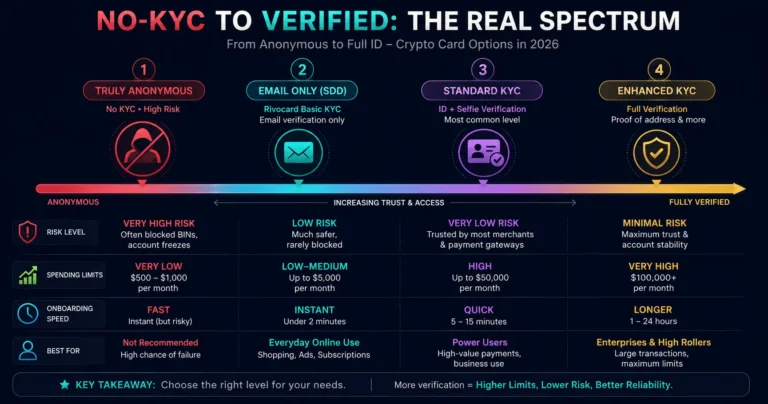
Quick answer: There is no such thing as a truly anonymous crypto card in 2026. Every card on Visa or Mastercard rails requires some level of identity verification. Of 152 active cards tracked across the market, only 6 verify no identity at all and 7 more run light or conditional checks. Everything else requires a government ID. The relevant comparison in 2026 is not “anonymous vs verified” but rather “minimum viable verification vs full KYC.” On this spectrum, Rivocard’s email-only Basic KYC tier is the lightest compliant entry point available on a regulated Visa card with global acceptance. Fully “no-KYC” cards that do exist carry significant risks: high fees (2-10x verified cards), low limits, BIN blocking by major merchants, and frequent sudden shutdowns that freeze user funds.
The No-KYC Myth in 2026
The phrase ‘no KYC’ is marketing, not reality. What actually exists is a spectrum, from cards that need just an email address with strict spending caps to cards that verify your ID in under two minutes and unlock full features immediately.
Why fully anonymous crypto cards cannot practically exist on Visa or Mastercard:
Card issuers ride the Visa and Mastercard rails, and those networks require anti-money laundering compliance from the entity that issues the card. A program that ignores this gets shut off — which is exactly how most ‘no-KYC’ cards end.
The practical result: platforms advertising “no KYC” typically fall into one of three categories:
- Email or phone-only verification with strict limits — this is genuinely light KYC, not zero KYC. Rivocard’s Basic tier falls here.
- Offshore or grey-area programs — operating outside regulated frameworks, with high risk of sudden shutdown and frozen funds.
- Misrepresentation — claiming “no KYC” while actually collecting identity data in non-transparent ways.
The KYC Spectrum for Crypto Cards in 2026
Rather than “no KYC vs KYC,” the actual spectrum is:
| KYC Level | What’s Required | Example Platform | Monthly Limit | Risk Profile |
|---|---|---|---|---|
| None (truly anonymous) | Nothing | BingCard, Goblin Card (unregulated) | Under $1,000 | High — shutdown risk |
| Email only (Simplified Due Diligence) | Email verification | Rivocard Basic KYC | $5,000/month | Low — regulated |
| Light KYC | Email + phone | Some prepaid platforms | $3,000-$5,000 | Medium |
| Standard KYC | Government ID + selfie | Rivocard Full KYC, Bybit, Crypto.com | $50,000/month | Low |
| Enhanced KYC | ID + address proof + source of funds | Rivocard Enhanced, institutional tiers | $100,000+ | Very low |
Rivocard’s email-only Basic KYC tier is at the second level — the lightest compliant tier available on a regulated Visa card. This is formally Simplified Due Diligence (SDD) under AML regulations, not zero verification.
The Real Cost of “No-KYC” Cards
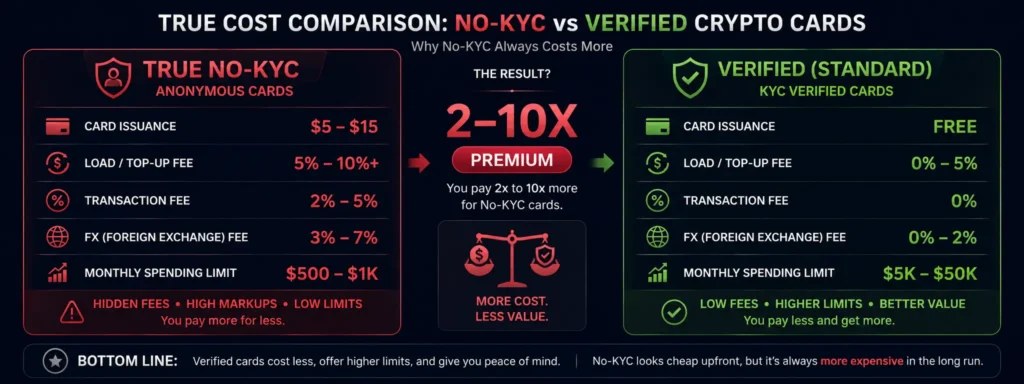
“No KYC” does not mean “no fees.” The privacy premium is real — you are paying 2-10 times more per transaction compared to a verified crypto card.
Typical “no-KYC” card fees vs verified cards:
| Fee type | True no-KYC cards | Verified cards (Standard) |
|---|---|---|
| Card issuance | $5-$15+ | Free to $10 |
| Top-up / load fee | 5-10%+ | 0-5% |
| Transaction fee | 2-5% | 0-1% |
| FX fee | 3-7% | 0-2% |
| Monthly limit | $500-$1,000 | $5,000-$50,000 |
| Merchant acceptance | Often BIN-blocked | Full Visa/Mastercard acceptance |
Limits range from $500 to $5,000+ per month depending on the card and verification tier. Cards with zero verification typically cap at $1,000 per month. Partial verification (email + phone) can unlock $3,000-$5,000.
The practical implication: a card that advertises “no KYC” often costs 3-6% per transaction in combined fees while a Rivocard at email-only entry costs 5% at card funding (once per top-up) with 0% on every transaction. For regular spenders, the no-KYC card’s per-transaction fees accumulate significantly more than a single upfront 5% funding fee.
The BIN Blocking Problem for No-KYC Cards
Apple Pay and Google Pay both have their own compliance requirements. Cards that run afoul of these policies can lose mobile pay support even if the card itself still works.
A more significant problem: many major merchants actively block card BINs (Bank Identification Numbers) associated with unregulated or high-risk card programs. Amazon, Google Ads, Meta Ads, Netflix, Spotify, and other major platforms frequently update their lists of blocked BINs.
In practice for no-KYC card users:
- A card may work at some merchants but decline at others with no explanation
- The card BIN may be blocked from the beginning at specific merchants
- Blocking can happen at any time as merchants update their risk filters
Rivocard’s regulated Visa BIN does not carry these blocking patterns. The card is processed as a standard Visa prepaid card by all merchants.
The Shutdown Risk
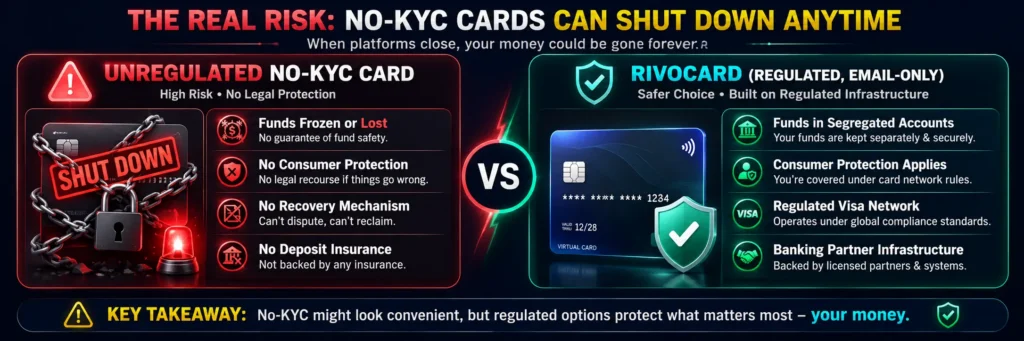
Cards that truly work without identity verification face increasing pressure from card networks, banking partners, and regulators. The primary risks for no-KYC card users are permanent fund loss if the platform shuts down, vulnerability to fraud with no dispute resolution, and complete absence of consumer protection. Some no-KYC card issuers are small operations with minimal regulatory oversight. They can, and do, disappear.
Historical pattern: many no-KYC crypto card providers have exited the market suddenly, leaving users with frozen balances. The absence of regulatory oversight means there is no consumer protection framework when this happens — no deposit protection, no dispute process, no recovery mechanism.
Rivocard operates under regulated financial frameworks with segregated user funds in top-tier banking accounts — user balances are protected even if the platform faces difficulties.
Why Privacy-Motivated Users Often Overestimate No-KYC Privacy
Tax authorities track blockchain transactions independently of card issuers. Using a no-KYC card while failing to report taxable events creates legal risk without meaningful privacy benefit. Consult a crypto-literate tax advisor in your jurisdiction.
The privacy math in 2026:
- Your blockchain deposit to a no-KYC card platform is recorded on a public or semi-public blockchain
- The blockchain address is linkable to your exchange account or wallet
- If your exchange knows your identity (which most do under KYC requirements), the chain of traceability exists regardless of what the card provider collected
- Tax authorities in major jurisdictions have chain analysis capabilities and exchange data-sharing arrangements
True transaction privacy at the blockchain level requires privacy-native tools (Monero, Tornado Cash-style mixers, etc.) — not just a card with less paperwork. Choosing a no-KYC card for tax avoidance purposes creates legal risk while providing limited actual privacy.
Where Rivocard’s Email-Only Tier Fits
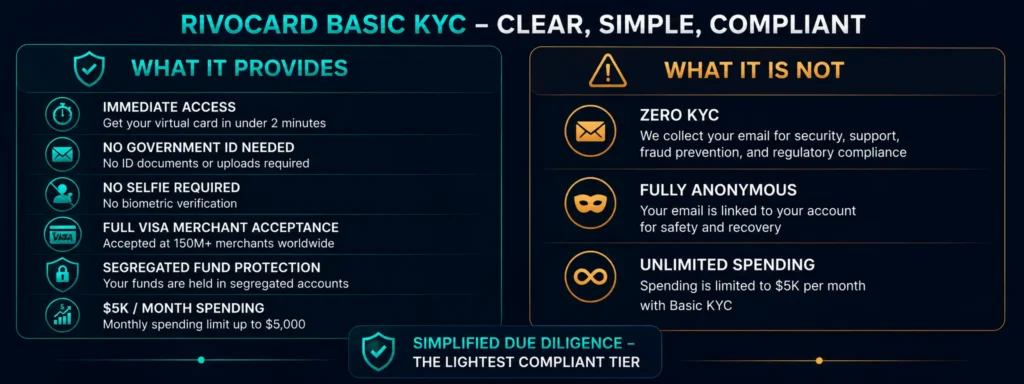
Rivocard’s Basic KYC tier is the practical middle ground:
What it provides:
- Immediate card access after email verification (under 2 minutes)
- No government ID submitted
- No selfie
- Regulated Visa card with full merchant acceptance
- Segregated fund protection
- $500/transaction, $1,000/day, $5,000/month spending
- Stable platform with banking partner relationships
What it is not:
- Zero KYC (email is collected)
- Fully anonymous (email + IP address + transaction data are associated with the account)
- Unlimited spending (Basic KYC limits apply)
This is Simplified Due Diligence (SDD) — the lightest verification tier permitted under AML regulations for a regulated, Visa-network-issued prepaid card. It is not a no-KYC product, but it provides meaningful accessibility for users who do not want to submit government documents for basic spending levels.
Verified Cards: What Full KYC Unlocks
Once Full KYC is completed on Rivocard (government ID + real-time selfie, typically processed in minutes):
| Basic KYC (email) | Full KYC (ID + selfie) | |
|---|---|---|
| Per-transaction limit | $500 | $5,000 |
| Daily spending limit | $1,000 | $10,000 |
| Monthly spending limit | $5,000 | $50,000 |
| Card load limit | $2,000 | $20,000 |
| Processing time | Immediate | Minutes (automated) |
| Consumer protections | Full | Full |
The 10x limit increase from Full KYC is significant. For users who hit Basic KYC limits regularly, completing Full KYC is the practical solution — the verification itself takes under 5 minutes for most users.
The Honest Recommendation
We recommend completing the full KYC upfront. The 2-5 minutes spent verifying identity protects you from frozen accounts, unlocks higher limits, enables fraud protection, and ensures the card will not be disrupted by future compliance changes. If privacy is the primary concern, pair full KYC with a self-custodial card — you get the best of both worlds.
For most users, the question is not whether to do KYC — it is which tier of KYC matches their needs right now:
- Immediate access with minimal disclosure: Rivocard Basic KYC (email only) — suitable for $5,000/month in spending, testing the platform, and everyday moderate use
- Higher limits when needed: Rivocard Full KYC (ID + selfie) — unlocks 10x limits with a 5-minute process
- Maximum limits for enterprise use: Rivocard Enhanced KYC — for high-volume users
The truly no-KYC options — unregulated cards with no verification — carry risks that make them unsuitable for serious or regular spending: high fees, merchant blocking, shutdown risk, and no consumer protection.
FAQs
Do any crypto cards exist with no KYC at all in 2026?
A small number – approximately 6 out of 152 tracked active cards verify no identity at all. These are typically unregulated or offshore programs with spending limits under $1,000/month, frequent BIN blocking at major merchants, and high risk of sudden shutdown. No regulated, major-network crypto card operates without any verification.
What is the lightest KYC requirement for a Visa crypto card?
Rivocard’s Basic KYC tier requires only email verification – no government ID, no selfie, no phone number. This is the lightest verification level available on a regulated Visa card with full merchant acceptance and $5,000/month spending capability.
Is Rivocard a no-KYC card?
Not technically – email verification is required, making it Simplified Due Diligence (SDD) rather than zero KYC. But it is the lightest compliant entry point available: email verification only, immediate card access, $5,000/month spending. No government documents are required at the Basic tier.
Why do no-KYC crypto cards have such high fees?
No-KYC cards typically operate outside mainstream regulated banking infrastructure, which limits their access to low-cost payment rails. They compensate through higher fees (often 5-10%+ per top-up plus 2-5% per transaction) and lower limits. The privacy premium is real and substantial.
Are no-KYC crypto cards legal?
Using a no-KYC crypto card is legal in most jurisdictions. However, the tax obligation to report crypto spending events exists regardless of whether the card provider collected your identity. Tax authorities can trace blockchain transactions independently of card KYC. Using a no-KYC card for tax avoidance creates legal risk without providing meaningful privacy.
Can no-KYC crypto cards be used at major merchants like Amazon and Netflix?
Often not reliably. Many major merchants (Amazon, Google Ads, Meta Ads, Netflix) actively block BINs associated with unregulated or high-risk card programs. Rivocard’s regulated Visa BIN does not carry these restrictions and works at all major Visa-accepting merchants.
What are the risks of using a truly no-KYC crypto card?
High fees (2-10x verified cards), low spending limits (often under $1,000/month), BIN blocking at major merchants, no consumer protection in case of unauthorized use, and high platform shutdown risk. When unregulated no-KYC card issuers shut down – which happens frequently – user funds are typically lost with no recovery mechanism.
How long does KYC take on Rivocard?
Basic KYC (email only) takes under 2 minutes. Full KYC (government ID plus real-time selfie) is typically automated and completes in minutes for clear, well-lit document submissions. Only edge cases requiring manual review take longer.
What are the spending limits without submitting an ID to Rivocard?
At email-only Basic KYC: $500 per transaction, $1,000 per day, $5,000 per month, $2,000 maximum card balance. These limits are sufficient for most everyday spending, subscriptions, and moderate digital advertising budgets.
When should I upgrade from email-only to full KYC?
When you need to make a single purchase over $500, spend more than $1,000 in a day, exceed $5,000/month in total spending, or load more than $2,000 onto a single card. Full KYC (5-minute process) increases all limits by 10x immediately upon approval.
Get Started
Start with email-only entry – upgrade KYC when your spending needs require it. Create your Rivocard account – no ID required to start