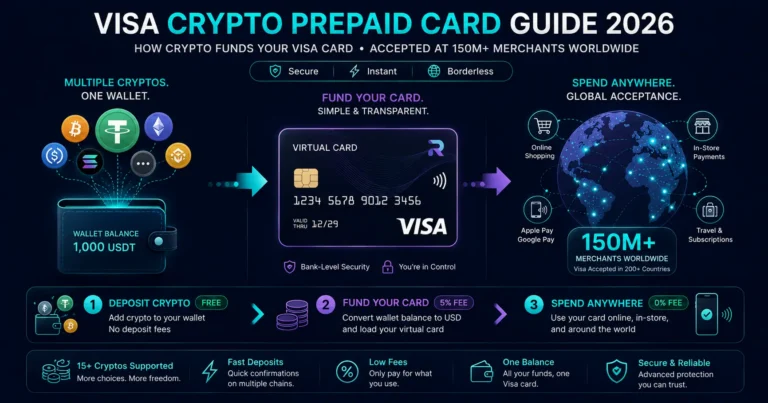
Quick answer: A Mastercard crypto prepaid or debit card is a card on the Mastercard network funded with cryptocurrency. The Bybit Card is a Mastercard-powered card funded from your crypto balance — when you pay at a merchant, your crypto is converted in real time through the Mastercard network. No bank account is required and no manual withdrawal is needed before spending. Mastercard crypto cards in 2026 include Bybit Card (EEA, AU), MetaMask Card (EEA, expanding), BitPay Card (US, paused), Nexo Card (EEA, UK, select US), and Wirex (some products). Rivocard uses the Visa network, not Mastercard — but for users evaluating the network question, this guide explains what Mastercard specifically offers for crypto card users and which platforms use it.
Mastercard’s Role in the Crypto Card Ecosystem
Both Visa and Mastercard are highly active in the crypto card space. Mastercard’s partners include Bybit, Wirex, Gemini, and Nexo.
In 2026, Mastercard moved from accepting stablecoins to settling in them. Regulatory clarity from MiCA in Europe and the GENIUS Act framing US stablecoins made this shift viable at scale.
Key Mastercard moves in 2026:
- BVNK acquisition: Mastercard acquired stablecoin payment infrastructure provider BVNK for up to $1.8 billion, deepening its stablecoin settlement capabilities
- Increased DeFi and Open Banking integration: Mastercard’s European focus aligns with Open Banking standards and DeFi-native card partnerships
- Self-custody card partnerships: MetaMask Card is supported by Mastercard and can be used over 150 million merchants globally wherever Mastercard is accepted. The MetaMask wallet is the funding source — users maintain custody of assets until the moment of payment.
Major Mastercard Crypto Cards in 2026
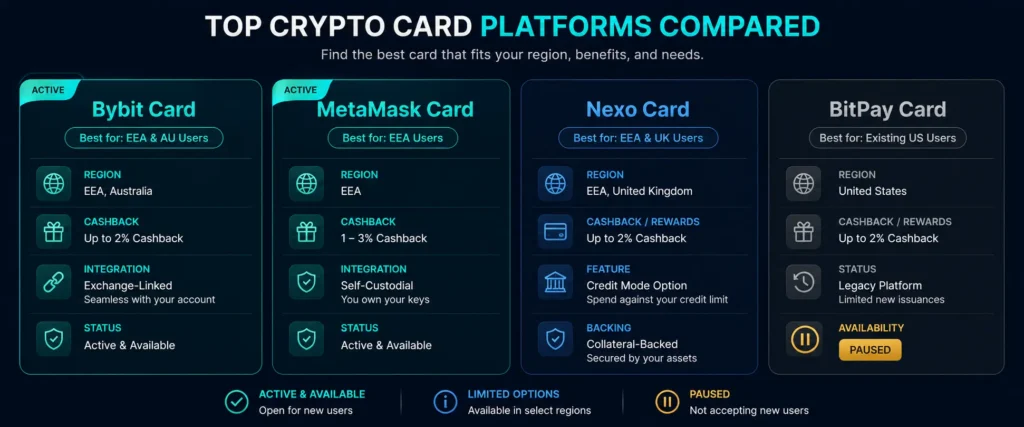
Bybit Card (Mastercard Debit — EEA, AU, Select Markets)
The Bybit Card was launched in partnership with UK payment infrastructure provider Moorwand, which operates under a Mastercard license. The card is linked to your Bybit balance and automatically converts crypto into fiat when you make a payment. The user can choose which asset will be debited, and conversion happens at the moment of the transaction. Available in virtual and physical formats in most supported regions.
Key features:
- Network: Mastercard
- Coverage: EEA (via Bybit EU from Jan 2026), Australia, select APAC and LATAM
- Cashback: 2-10% by VIP tier, paid in USDT (net ~1.1% at Standard after 0.9% conversion)
- FX fee: 0.5% (EEA), 1% (AU)
- Conversion fee: 0.9%
- Physical card: Yes (plus virtual)
- ATM: Free up to ~200 EUR/month, then 2%
- Subscription rebates: Netflix, Spotify, ChatGPT Plus, Amazon Prime from Tier 2
- Apple Pay and Google Pay: Yes
Best for: Active Bybit exchange users in EEA and Australia seeking net-positive cashback with no staking requirement.
MetaMask Card (Mastercard Debit — EEA, Expanding)
The MetaMask Card lets you spend crypto directly from your MetaMask wallet at any Mastercard merchant worldwide, with no conversion fees and up to 3% cashback (Metal Card tier). DeFi-native users who want to spend crypto without giving up custody of their funds.
Key features:
- Network: Mastercard (via Baanx issuer partnership)
- Coverage: EEA (expanding to US and LATAM)
- Settlement: Uses Linea zkEVM network for on-chain settlement
- Cashback: Up to 3% (Metal Card, $199/year fee), 1% (standard tier)
- Cashback paid in: mUSD (Linea stablecoin)
- Self-custodial: Yes — MetaMask wallet retains custody until moment of spend
- FX fee: 0%
- Conversion fee: 0% (uses Linea settlement, no separate conversion spread stated)
- Apple Pay and Google Pay: Yes
- Physical card: Metal Card option
Best for: DeFi-native MetaMask wallet users in EEA who want self-custodial card spending without depositing to an exchange.
Nexo Card (Mastercard — EEA, UK, Select US)
The Nexo card operates in two modes: credit mode (borrow against crypto collateral, no selling required) and debit mode (draw from Nexo balance). Borrowing rates start from 2.9% APR. Dual-functionality makes it one of the few cards offering genuine crypto-backed credit.
Key features:
- Network: Mastercard
- Coverage: EEA, UK, select US
- Credit mode: Spend against crypto collateral without selling (preserves upside, avoids taxable event)
- Debit mode: Draw from Nexo platform balance
- Cashback: Up to 2%
- Borrowing rate (credit mode): From 2.9% APR
Best for: Crypto holders who want spending access without selling holdings, comfortable managing a collateral-backed credit model.
BitPay Card (Mastercard — US, Applications Paused)
BitPay’s card applications have been paused since June 2023. Existing cardholders continue using the card. The card charges 3% at load time and 3% on international transactions.
Not available to new users. Listed for completeness only.
Wirex (Mastercard and Visa — UK, Select APAC)
Wirex offers both Visa and Mastercard products depending on region and product line. Mastercard partners for Wirex apply in certain markets. Check Wirex’s current region-specific product for which network applies.
Mastercard-Specific Features for Crypto Card Users
Mastercard Zero Liability Protection
Mastercard’s Zero Liability Protection is the Mastercard equivalent of Visa’s Zero Liability Policy. Cardholders are not held responsible for unauthorized transactions when:
- The transaction is reported promptly after discovery
- The cardholder exercised reasonable care with card credentials
- The cardholder did not share credentials or authorize the transaction
For Mastercard crypto cards, this protection is backstopped by the Mastercard network and administered through the card issuer (Bybit, MetaMask’s issuer Baanx, etc.).
Mastercard’s DeFi and Open Banking Integration
Mastercard moved from accepting stablecoins to settling in them in 2026. The acquisition of BVNK deepened Mastercard’s stablecoin infrastructure. Mastercard’s European focus aligns with Open Banking standards.
This positioning matters for specific Mastercard crypto cards:
- MetaMask Card uses Linea (a Mastercard-partnered zkEVM) for on-chain settlement
- Nexo’s credit mode works within Mastercard’s framework for collateral-backed spending
- BVNK’s infrastructure, now Mastercard-owned, powers multiple institutional stablecoin card programs
Global Merchant Acceptance
Mastercard is accepted at over 100 million merchant locations globally. MetaMask Card can be used over 150 million merchants globally wherever Mastercard is accepted. (Note: The 150M figure in MetaMask’s marketing is an approximation — Mastercard’s typically-cited acceptance is ~100M unique locations, with total acceptance points higher.)
For everyday spending online and via Apple Pay or Google Pay, Mastercard acceptance is effectively equivalent to Visa in all developed markets. The 50M+ gap versus Visa’s 150M+ primarily represents smaller merchants in emerging markets.
Apple Pay and Google Pay
All major Mastercard crypto cards support Apple Pay and Google Pay where local regulations allow. Bybit Card supports both. MetaMask Card supports both. This enables in-person contactless spending at any NFC terminal globally.
Mastercard uses its own tokenization service for digital wallets — your actual card number is replaced with a digital token for contactless transactions, equivalent to Visa’s Token Service.
Mastercard vs Visa Crypto Cards: Practical Differences
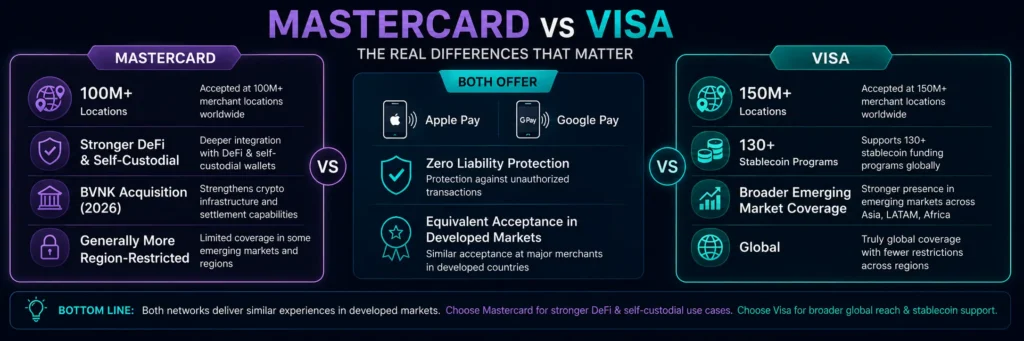
| Mastercard crypto cards | Visa crypto cards | |
|---|---|---|
| Primary examples | Bybit, MetaMask, Nexo | Rivocard, Crypto.com, Coinbase |
| Global merchant acceptance | ~100M+ | 150M+ |
| DeFi / self-custodial focus | Stronger (MetaMask, Gnosis Pay) | Growing |
| Stablecoin settlement | BVNK/Mastercard infrastructure | 130+ Visa stablecoin programs |
| Apple Pay and Google Pay | Yes | Yes |
| Geographic coverage | Generally restricted to specific regions | Often broader |
| Zero Liability | Mastercard Zero Liability Protection | Visa Zero Liability Policy |
For practical everyday use in developed markets, the Mastercard vs Visa distinction matters very little. The platform, fees, cashback, and geographic coverage matter far more.
Note on Rivocard: Visa, Not Mastercard
Rivocard issues cards on the Visa network, not Mastercard. For users who specifically searched for Mastercard crypto cards and landed here: Rivocard offers a Visa-network virtual card with email-only entry, global access, unlimited free card creation, and 0% FX fees. If the platform features match your needs, the Visa network works equivalently in almost all markets.
For users specifically needing a Mastercard (certain merchant-specific requirements, or a preference for the platforms listed above), Bybit Card is the strongest Mastercard option for EEA and Australian users seeking cashback economics.
How to Get a Mastercard Crypto Card
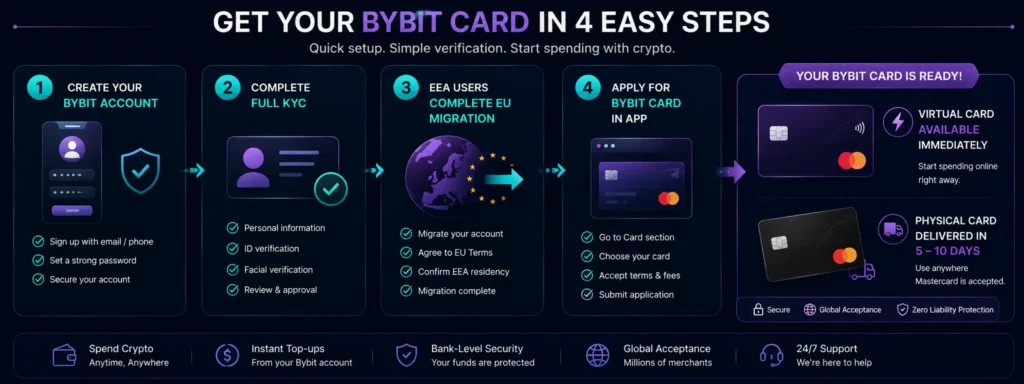
Bybit Card (EEA/AU users):
- Create a Bybit exchange account at bybit.com
- Complete full KYC (government ID + selfie)
- For EEA users: complete the Bybit EU migration (required since Jan 2026)
- Navigate to the Card section in Bybit and apply for the Bybit Card
- Virtual card available immediately; physical card takes 5-10 business days for delivery
MetaMask Card (EEA users):
- Install MetaMask and create or import a wallet
- Go to MetaMask Portfolio and navigate to the Card section
- Complete identity verification through Baanx (MetaMask’s issuing partner)
- Available in EEA; expanding to other regions progressively
Nexo Card (EEA/UK users):
- Create a Nexo account at nexo.com
- Complete KYC
- Deposit crypto as collateral or as balance
- Request the Nexo Card from your account dashboard
FAQs
What is a Mastercard crypto prepaid card?
A Mastercard crypto prepaid card is a prepaid card on the Mastercard network funded with cryptocurrency. When you deposit crypto, it converts to a spendable balance. The card works at any Mastercard-accepting merchant globally. Major examples include Bybit Card (EEA/AU) and MetaMask Card (EEA).
Which crypto cards use Mastercard in 2026?
Major Mastercard crypto cards include: Bybit Card (EEA, AU, select regions), MetaMask Card (EEA), Nexo Card (EEA, UK, select US), BitPay (US, applications paused), and Wirex (select markets). Rivocard uses the Visa network.
Is there a difference between Mastercard and Visa crypto cards for everyday spending?
For everyday spending in developed markets: negligible difference. Both networks are accepted at all major online merchants, subscription services, and modern in-person terminals. Visa has slightly broader coverage in emerging markets. The platform’s fee structure, cashback, KYC requirements, and geographic availability matter far more than the network.
Does Bybit Card use Visa or Mastercard?
Bybit Card uses Mastercard, issued in partnership with Moorwand (a UK payment infrastructure provider operating under a Mastercard license). It is available in EEA, Australia, and select other markets.
What is the MetaMask Card and how does it use Mastercard?
The MetaMask Card is a Mastercard-powered crypto card issued by Baanx (MetaMask’s issuing partner). It lets users spend directly from their MetaMask wallet at any Mastercard merchant. The card uses Linea (a Mastercard-partnered zkEVM layer 2) for on-chain settlement. Currently available in EEA with expansion ongoing.
Does Mastercard have a Zero Liability policy for crypto cards?
Yes. Mastercard Zero Liability Protection covers cardholders against unauthorized transactions when reported promptly and when basic security practices were followed. It is administered through the card issuer (Bybit, Baanx for MetaMask, etc.) as the first point of contact for disputes.
Can I use a Mastercard crypto card with Apple Pay?
Yes. Major Mastercard crypto cards (Bybit, MetaMask) support Apple Pay and Google Pay. Mastercard’s tokenization service replaces your card number with a digital token for contactless payments – your actual card number is never transmitted to merchants during tap-to-pay transactions.
What is the best Mastercard crypto card in 2026?
For EEA and Australian users with active Bybit accounts: Bybit Card (net-positive cashback at Standard tier, streaming rebates at Tier 2). For DeFi-native EEA users who want self-custodial spending: MetaMask Card. For crypto-backed credit (spending without selling): Nexo Card. For US users: Bybit Card is not available, and BitPay applications are paused.
Are Mastercard crypto cards available globally?
Not as broadly as Visa. Bybit Card covers EEA, Australia, and select markets. MetaMask Card is currently EEA with expansion planned. Most major Mastercard crypto cards have more restricted geographic coverage than Visa-network options like Rivocard.
What should I look for in a Mastercard crypto card?
Geographic availability (does it serve your country), cashback rate and what asset it pays in (USDT is better than volatile tokens), conversion fee and FX fee (these are separate from stated cashback), whether staking or ecosystem lock-up is required, and whether the card is custodial (exchange-held) or self-custodial (wallet-retained until spend).
Get Started
Looking for a Visa crypto card with global access? Rivocard works globally with email-only entry. Learn about Rivocard’s Visa card