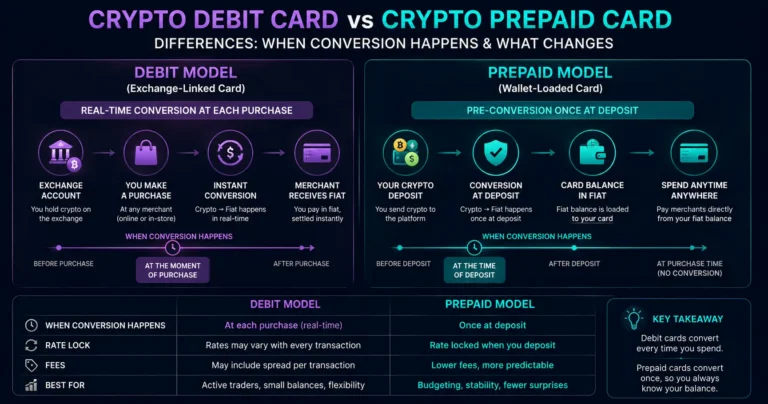
Quick answer: A crypto debit card draws from a linked account balance in real time — when you make a purchase, crypto in your exchange account is automatically converted to fiat and the transaction completes. A crypto prepaid card is loaded in advance and draws from the stored fiat value. The practical differences are significant: debit cards can auto-convert any supported asset at any time with nothing to top up in advance, while prepaid cards require loading in advance with a fee but offer tighter spending control, isolated balances, and predictable dollar amounts. Rivocard is a prepaid model: deposit crypto to your wallet (free), fund a virtual card with a dollar balance (5% fee), spend from that balance. Most exchange-linked cards (Bybit, Crypto.com, Coinbase) use the debit model.
The Core Distinction
The essential difference comes down to when the crypto converts to fiat:
Debit model: Crypto converts at the moment of purchase. You hold crypto in your exchange account. When you tap or swipe, the card provider sells exactly the required amount of crypto at the current market price and pays the merchant in fiat. You never pre-convert anything.
Prepaid model: Crypto converts before the purchase. You deposit crypto to the card platform, it converts to a fiat balance, you fund a card from that balance, and spending deducts from the pre-converted fiat on the card.
Prepaid cards shift the conversion moment earlier. You load value, then spend from that balance. This can separate your spending money from your main holdings, but adds steps and sometimes top-up fees.
Neither model is universally better — they have genuinely different trade-offs.
Model 1: Crypto Debit Cards (Real-Time Conversion)
How it works:
- You hold cryptocurrency in your exchange account (Bybit, Coinbase, Crypto.com)
- You tap or swipe your linked card at a merchant
- The card provider calculates the fiat amount needed for the transaction
- The provider sells that amount of your crypto at the current market rate
- The merchant receives fiat; your exchange balance decreases by the equivalent crypto amount
Examples: Bybit Card, Coinbase Card, Crypto.com Visa, MetaMask Card
Advantages:
- No advance loading required — spend from your existing exchange balance
- No separate top-up fee at the card loading step
- The crypto stays in your portfolio longer, capturing any appreciation before the conversion moment
- If you hold a diversified portfolio, any supported asset can fund a purchase
Disadvantages:
- Conversion spread applied at each transaction (0.5-2% embedded in the rate)
- Volatile asset price at the moment of transaction determines how much crypto you spend
- Every purchase potentially creates a taxable event in most jurisdictions
- Spending control is harder — any balance in your exchange is potentially accessible
- If your exchange account is compromised, your entire balance is at risk
Model 2: Crypto Prepaid Cards (Pre-Conversion)
How it works:
- You deposit cryptocurrency to the card platform’s wallet (free)
- The platform converts your deposit to a fiat balance at the live rate
- You fund a virtual card from that wallet balance (fee applies at this step — 5% on Rivocard)
- Your card now holds a specific dollar amount
- Spending deducts from that pre-loaded fiat balance — no crypto is sold at transaction time
Examples: Rivocard, some privacy-focused prepaid platforms
Advantages:
- Spending control: the card has exactly the balance you chose to put on it
- No per-transaction conversion — spending does not trigger a crypto sale event
- If the card is compromised, only the card’s loaded balance is at risk (not your wallet or main holdings)
- Predictable dollar amounts — no price volatility between loading and spending
- Multiple isolated cards: each card holds exactly what you funded it with
- For stablecoin funding (USDT): the full conversion happens at deposit, with no ongoing price risk
Disadvantages:
- Top-up fee at the wallet-to-card funding step (5% on Rivocard)
- Requires advance planning — you cannot spend more than what is on the card
- Funds sitting in card balance do not earn yield or appreciate
- Requires an additional deposit step when card balance runs low
The Tax Difference
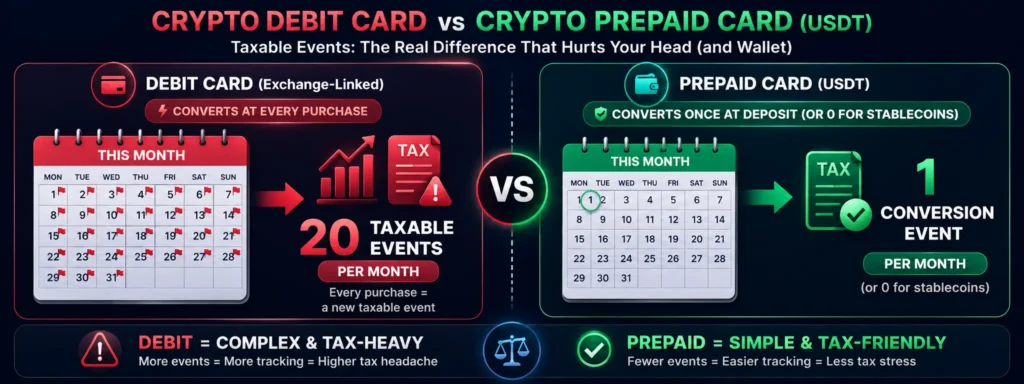
This is one of the most significant practical differences between the two models, and the one most users overlook when choosing.
Crypto debit card (real-time conversion): Every purchase is a taxable disposal event in most jurisdictions. When the debit card converts your Bitcoin at checkout to pay for a $50 purchase, that is a sale of Bitcoin. If you purchased that Bitcoin at $30,000 and it is now worth $60,000, you have realized a taxable capital gain on the appreciation. This happens on every transaction — every coffee, every subscription, every online purchase.
Short-term capital gains on crypto held less than one year are taxed at ordinary income rates of 10-37% in the US. Long-term rates are 0-20%. A debit card that auto-sells crypto at every transaction creates a taxable event at each sale.
Crypto prepaid card (pre-conversion with stablecoins): The taxable event (conversion) occurs at the deposit step, not at each spending transaction. For stablecoin deposits (USDT, USDC): since the asset is pegged to $1 and was acquired at $1, there is typically no capital gain at conversion. For volatile asset deposits (BTC, ETH): the gain is recognized once at deposit, not spread across potentially hundreds of transactions.
The practical implication for record keeping: A debit card user who makes 150 purchases per month must track 150 potential taxable events. A prepaid card user who deposits once per month has one conversion event to track. For users with appreciated volatile asset holdings who want to manage their tax exposure, the prepaid model concentrates disposal events rather than spreading them across every transaction.
This is not tax advice — the actual tax treatment depends on your jurisdiction, asset type, holding period, and specific circumstances. Consult a qualified tax professional.
The Security Difference
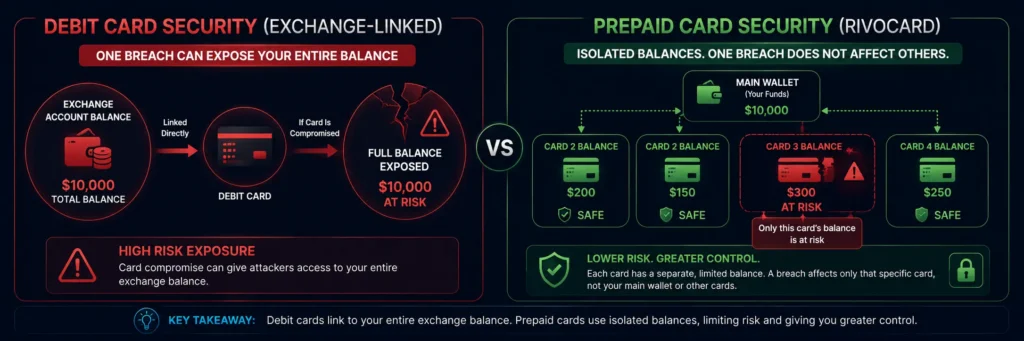
Crypto debit card: The card is linked to your exchange account. A compromised card or card credentials potentially exposes your entire exchange balance — everything in that account. Some exchanges implement spending limits per card, but the underlying exposure is the full account balance unless specifically ring-fenced.
Crypto prepaid card (Rivocard): Each virtual card holds only its specifically loaded balance. If card credentials are stolen and used fraudulently, the maximum loss is the balance on that specific card — your wallet balance and other cards are unaffected. On Rivocard specifically: unlimited virtual cards means you can isolate each merchant or use case onto its own card with its own balance. A compromised card for one subscription does not affect your ad spend card, your shopping card, or your wallet balance.
The Control Difference
Crypto debit card: Spending is drawn from your exchange balance with the liquidity of your entire holdings. Useful for users who want seamless spending without thinking about pre-loading. Less useful for users who want precise spending control or budget management.
Crypto prepaid card: You decide exactly how much each card has. A card funded with $100 can only spend $100. This forced pre-commitment is a feature for budget-conscious users, controlled business expense management, and per-merchant isolation. For digital advertisers running multiple campaigns, the per-card balance represents a hard cap on that campaign’s spend.
The Fee Comparison
Debit model (exchange-linked):
| Platform | Fee model | Effective cost per $100 in purchases |
|---|---|---|
| Bybit Card | 0.9% conversion + 0.5% FX (EEA) | ~$1.40 (domestic), ~$2.20 (international) |
| Coinbase Card | 2.49% conversion | ~$2.49 |
| Crypto.com Basic | ~0.5% conversion spread | ~$0.50 |
| MetaMask Card | Varies by tier | Check current terms |
Prepaid model:
| Platform | Fee model | Effective cost per $100 in purchases |
|---|---|---|
| Rivocard | 5% at card funding (once), 0% per purchase | $5 paid at loading, then $0 per transaction |
The key comparison: If you fund a Rivocard card with $1,000 (5% fee = $50) and make 20 purchases totaling $1,000, the average cost per purchase is $2.50. If a debit card charges 0.9% per transaction on $1,000 of purchases, the fee is $9. At lower purchase frequency relative to loading size, Rivocard’s prepaid model can be cheaper. At high purchase frequency with continuous exchange balance, debit models with low conversion spreads can be cheaper.
The Spending Pattern That Determines Which Model Wins

Prepaid model wins for:
- Users who deposit in bulk and spend down over time (fewer conversion events)
- Users who want hard spending limits on specific cards (budget control)
- Stablecoin holders (USDT, USDC) where no tax event occurs at deposit
- Digital advertisers who need per-account spending isolation
- Users outside exchange-linked card coverage areas
Debit model wins for:
- Users who want to spend from their exchange balance without advance loading
- Users whose conversion fee is very low (sub-1%) and who spend frequently
- Users who want their crypto to potentially appreciate longer before conversion
- Active traders who already have exchange balances they want to make spendable
Where Rivocard Fits: Prepaid, Virtual-First, Global
Rivocard is a dedicated prepaid model — not an exchange-linked debit card. This means:
- Crypto deposits convert to a wallet balance (free, at deposit)
- Cards are funded from that wallet balance (5% fee, charged once per funding)
- Purchases draw from the specific card’s fiat balance (0% per transaction)
- Multiple isolated virtual cards with independent balances
- No exchange account required — funds from any external wallet or exchange
The prepaid model suits Rivocard’s target users: people who want predictable spending control, per-card isolation, no exchange dependency, and global access from email-only entry.
FAQs
What is the difference between a crypto debit card and a crypto prepaid card?
A crypto debit card draws from a linked exchange account in real time – when you make a purchase, crypto is automatically converted to fiat at that moment. A crypto prepaid card is loaded in advance with a fiat balance that is spent down over time. Rivocard is a prepaid card. Bybit, Coinbase, and Crypto.com cards use the debit model.
Which is better – a crypto debit or prepaid card?
Neither is universally better. Debit cards require no advance loading and can spend directly from exchange balances. Prepaid cards offer tighter spending control, isolated card balances, and concentrated rather than per-transaction taxable events. The better choice depends on how you hold your crypto, your spending patterns, and whether per-card balance isolation matters to you.
Does a crypto debit card create taxable events at every purchase?
Yes, in most jurisdictions. When a debit card auto-converts crypto at the point of sale, that constitutes a taxable disposal. Prepaid cards loaded with stablecoins can avoid this – the conversion happens once at deposit with no capital gain (since USDT is pegged at $1). Consult a qualified tax professional for your specific situation.
Is Rivocard a debit card or a prepaid card?
Rivocard is a prepaid card. You deposit crypto to your Rivocard wallet (free conversion to a dollar balance), fund a virtual card from that balance (5% fee), and spend from the card’s specific fiat balance at 0% per transaction.
Can a prepaid crypto card be more expensive than a debit model?
It depends on spending frequency and volume. Rivocard’s 5% upfront fee on a large deposit spread across many purchases can be lower per transaction than a 0.9-2.49% debit card fee on every individual transaction. The math depends on the specific amounts and frequency.
What happens if my crypto prepaid card is compromised?
On Rivocard, only the compromised card’s loaded balance is at risk – your wallet balance and other virtual cards are completely unaffected. Freeze the card immediately from your dashboard, create a new card with a new number, and continue spending. The maximum loss is the specific card’s balance.
Do both debit and prepaid crypto cards support Apple Pay and Google Pay?
Yes. Both models support Apple Pay and Google Pay when the specific card provider has enabled digital wallet integration. Rivocard supports both, enabling contactless in-person payments via NFC terminals globally.
Which model is better for digital advertisers running multiple ad accounts?
Prepaid (Rivocard). Unlimited free virtual card creation means one card per ad account with a hard spending limit. If an ad platform flags one card, other accounts continue running. The debit model typically issues one card per exchange account with access to the full balance – not isolated per-account.
Can I use a prepaid card for recurring subscriptions like Netflix?
Yes. Once a prepaid card is saved at a subscription service, it handles recurring charges from its loaded balance automatically. Ensure the card is funded before each billing cycle. Rivocard’s model works well for subscriptions – see the dedicated subscription guide for the per-service card strategy.
Which model is easier to set up?
Both are similarly fast for the card number itself. Rivocard’s prepaid model has a slightly longer path to first purchase – deposit crypto, wait for confirmation, fund card – but the total time using TRC-20 USDT is under 5 minutes. Exchange-linked debit cards require having an exchange account already funded – if you already do, they can be even faster.
Get Started
Rivocard’s prepaid model gives you isolated card balances, unlimited virtual cards, and no exchange required. Create your Rivocard account