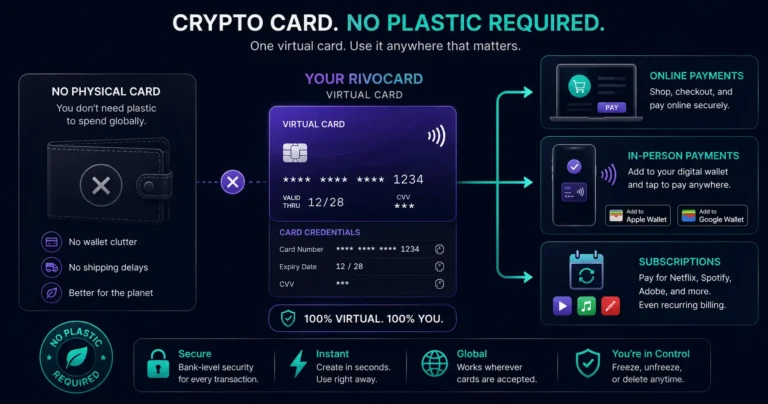
Quick answer: For most modern spending, a virtual crypto card without a physical card is entirely sufficient. Rivocard issues virtual Visa cards only — no plastic, no postal delivery. A virtual card works for all online purchases, all subscription services, digital advertising platforms, in-person payments via Apple Pay or Google Pay at any NFC contactless terminal, and international purchases at 0% FX fee. What a virtual-only card cannot do: ATM cash withdrawals (require physical chip or magnetic stripe) and chip-and-PIN-only terminals without NFC capability (rare in 2026). For users who primarily spend online and via contactless mobile payments — which covers the vast majority of everyday spending — a virtual card without a physical card is sufficient for 90-95% of transactions.
What ‘Virtual Only’ Means in Practice
A virtual Visa card is a set of credentials — 16-digit card number, expiry date, CVV — that exist only as data. There is no plastic card. No chip. No magnetic stripe. No postal delivery.
This means:
- No waiting 5-10 business days for a card to arrive in the mail
- No risk of a card being intercepted in the post or stolen from a mailbox
- No physical wear and tear, no magnetic stripe demagnetization
- No visiting a branch, calling a number, or filling out an application form
- Card is available within seconds of creation and funding
From a merchant’s perspective at checkout, a virtual card is functionally identical to a physical card — both present a 16-digit Visa number that the payment network processes.
Where a Virtual-Only Crypto Card Works Perfectly
All online purchases: Any e-commerce site accepting Visa accepts a virtual card. Enter the card number, expiry, and CVV at checkout. Amazon, eBay, AliExpress, ASOS, Booking.com, Google Play, Apple App Store (via Apple Pay), Steam, any Shopify store — everything that accepts online Visa card payments works.
All subscriptions and recurring billing: Netflix, Spotify, Disney+, Adobe Creative Cloud, Microsoft 365, Google Workspace, ChatGPT Plus, SaaS tools — save the card once, recurring charges process automatically. No physical card needed for subscription billing.
Digital advertising: Google Ads, Meta Ads, TikTok Ads, LinkedIn Ads — all billing platforms save your card number for automated billing. Virtual card works identically to a physical card for ad platform billing.
In-person purchases via Apple Pay: Add your Rivocard virtual card to Apple Pay or Google Pay. Tap your phone at any NFC contactless terminal. Grocery stores, pharmacies, restaurants, coffee shops, transport, convenience stores — all accessible without a physical card in your wallet.
International online purchases: Any online merchant in any country. Rivocard’s 0% FX fee applies. Purchase from a UK retailer, a European SaaS, a Japanese gaming platform — all work with the virtual card number at 0% surcharge.
In-app purchases: App Store, Google Play, food delivery apps, rideshare apps, ticketing apps — any app where you can enter card details or where Apple Pay/Google Pay is the payment method.
The Two Gaps: What Virtual-Only Cannot Do
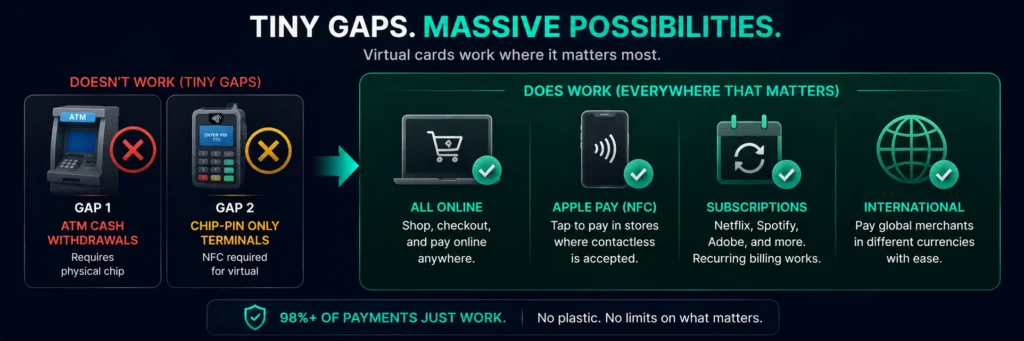
ATM Cash Withdrawals
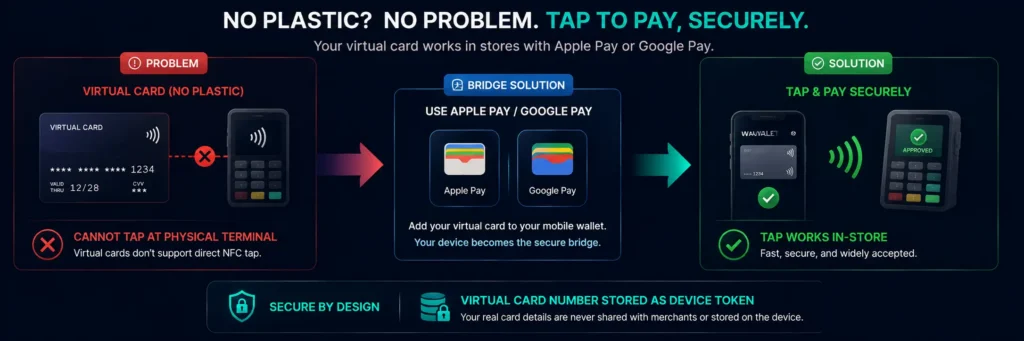
ATMs require a physical card with a chip (for chip-and-PIN ATMs) or a magnetic stripe (for older ATMs). A virtual card number has neither — it cannot be inserted into or swiped at an ATM.
The practical impact: If you need cash during travel or for merchants that require cash, you cannot use Rivocard for ATM withdrawals. You need a separate physical bank card for this purpose.
How most Rivocard users handle this: Maintain a traditional bank debit card or a physical crypto card (from another provider) specifically for ATM access. Use Rivocard for all card-based spending, and the physical card only for cash.
How significant is this gap in 2026? Decreasing significantly. Contactless and digital payments have replaced cash in most developed markets for the majority of everyday spending. Most grocery stores, restaurants, and retail shops in North America, Europe, and major Asia-Pacific cities accept contactless. Cash is primarily needed in: local markets and informal vendors in some countries, some public transport (though most modern transit systems have tap-to-pay), and certain rural or cash-dominant economies.
For users who travel frequently to cash-dominant destinations, a backup physical card for ATM access is a practical necessity. For primarily urban users in developed markets, cash needs may be minimal.
Chip-and-PIN-Only Terminals Without NFC
Some in-person payment terminals — particularly older models and some in specific European and Asian markets — require physical chip insertion with PIN entry and do not have NFC capability. Without a physical card to insert, payment at these terminals is not possible.
How significant is this gap in 2026? Minor and decreasing. Most modern payment terminals deployed in the last 5-7 years include NFC capability alongside chip-and-PIN. Older terminals are being replaced. In the UK, EU, Australia, Canada, and most major Asian markets, NFC contactless acceptance is now standard at the vast majority of merchant locations.
Chip-only-without-NFC terminals are increasingly confined to: older establishments that have not replaced their hardware, some government and utility payment points, and certain markets in Eastern Europe, Africa, and rural areas of developing economies.
For the specific scenario: If you encounter a chip-only terminal while using Rivocard, you have two options: pay cash (requires ATM access beforehand) or use a different payment method at that specific merchant. This scenario is uncommon enough that it does not materially affect Rivocard’s usability for most users.
The Apple Pay and Google Pay Coverage Gap Fix
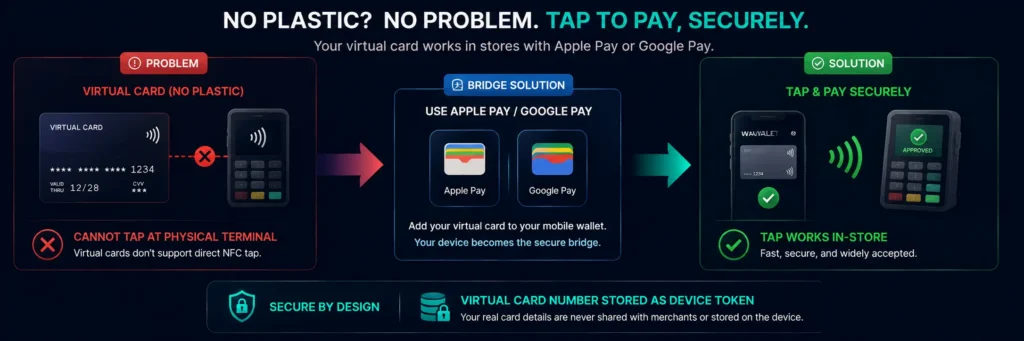
The most significant gap that virtual-only cards face — in-person spending without a physical card — is closed by Apple Pay and Google Pay.
Adding your Rivocard virtual card to Apple Pay or Google Pay converts your phone into a contactless payment device that works at any NFC terminal. From the merchant’s terminal perspective, this is functionally identical to tapping a physical Visa card:
- The terminal receives a device token (not your real card number)
- The Visa network authorizes the transaction
- The merchant receives payment
- Your card balance is deducted
The user experience: tap phone, authenticate with Face ID or fingerprint, done. Identical to physical card tap-to-pay, except the card is on the phone rather than in your wallet.
Coverage: Any NFC terminal globally. In 2026, this covers the majority of in-person payment scenarios in developed markets.
The combined practical coverage of virtual card + Apple Pay:
- All online: 100% covered
- In-person with NFC terminal: covered via Apple Pay/Google Pay
- In-person chip-PIN-only without NFC: not covered (rare)
- ATM: not covered (needs physical card)
Estimated share of transactions covered by virtual + Apple Pay in a typical developed-market user: 90-97%, depending on lifestyle and location.
Security Advantages of Virtual-Only Cards
A physical card carries physical risks:
- Card can be stolen from your wallet
- Magnetic stripe can be skimmed at compromised terminals
- Card details can be photographed
- Card can be lost while traveling
- Replacement requires waiting days for a new card
A virtual-only card eliminates all of these:
- No physical card to steal
- No magnetic stripe to skim
- Card details accessed only through your password-protected dashboard
- No postal delivery that can be intercepted
- Replacement (new card number) takes seconds, available immediately
Via Apple Pay: the physical contactless interaction uses a device token, not your real card number. If your phone is stolen, biometric authentication prevents use. The card can be suspended remotely from your Rivocard dashboard.
For most users, the virtual-only model is actually more secure than carrying a physical card — fewer attack surfaces, faster compromise response, and no physical theft risk.
When You Actually Need a Physical Card
A physical card is needed for:
- ATM cash withdrawals
- Chip-and-PIN-only terminals (rare, decreasing)
- Hotel check-in in some properties that require physical card at desk
- Car rental pickup at companies requiring physical credit card presentation
- Any scenario requiring explicit physical card presentation
The recommended setup for most users: Rivocard virtual card as the primary spending tool for all online, subscription, digital advertising, and contactless (Apple Pay/Google Pay) spending. One traditional bank debit card kept for ATM access and the rare physical-card-required scenario.
This dual-tool approach covers essentially 100% of spending scenarios with Rivocard handling the vast majority.
FAQs
Can I use a crypto card without a physical card?
Yes. A Rivocard virtual Visa card works for all online purchases, subscriptions, digital advertising, and in-person payments via Apple Pay or Google Pay. No physical card is required for these scenarios. Physical cards are only needed for ATM cash withdrawals and chip-and-PIN-only terminals without NFC (rare in 2026).
What can I not do with a virtual-only crypto card?
ATM cash withdrawals – ATMs require a physical card with a chip or magnetic stripe. Chip-and-PIN-only in-person terminals without NFC capability – these cannot process a virtual card. In 2026, both scenarios are relatively uncommon for users in developed markets.
How do I use a virtual crypto card in person?
Add your Rivocard virtual card to Apple Pay or Google Pay. Tap your phone at any NFC contactless terminal to pay. This covers the vast majority of modern in-person merchants globally.
Is a virtual-only crypto card sufficient for travel?
For most travel in developed markets, yes. Apple Pay via Rivocard covers hotels, restaurants, shops, and transit systems with NFC terminals. For destinations where cash is frequently needed or where older payment infrastructure is common, maintaining a physical bank card for ATM access is recommended.
Why does Rivocard not offer a physical card?
Rivocard focuses on the virtual card model, which offers instant issuance, unlimited free card creation, faster replacement, and better security than physical cards. Physical cards require manufacturing, personalization, mailing logistics, and delivery time – adding complexity that virtual-only avoids. For ATM access, users maintain a separate physical bank card.
Is a virtual card more secure than a physical card?
In several ways, yes. No physical theft risk, no magnetic stripe skimming vulnerability, instant card freeze and replacement vs 5-10 day wait for physical replacement, and Apple Pay contactless payments use device tokens rather than your real card number. The main physical security advantage is ATM access, which a virtual card cannot provide.
What percentage of spending can a virtual crypto card handle?
For typical urban users in developed markets: 90-97% of transactions. Online purchases and subscriptions (100% virtual card compatible), in-person NFC contactless via Apple Pay (virtual card compatible), leaving only ATMs and rare chip-only terminals as gaps.
Do hotel check-ins require a physical card?
Some luxury and business hotels require a physical credit card at check-in for incidental holds. Most mid-range hotels accept any Visa card – including presenting the card details for the hold. The Rivocard virtual card details (from your dashboard) can be referenced for hold authorization in many hotel systems. Check with the specific property for their policy.
Can I get a physical version of my Rivocard?
No. Rivocard is a virtual-only card platform. For physical card access, consider maintaining a traditional bank debit card alongside Rivocard, or evaluate physical crypto card platforms (Bybit Card, Crypto.com) where relevant for your region.
What should I do if I need cash while using Rivocard?
Use a separate physical bank card at any ATM to withdraw local currency. Keep a physical debit card specifically for this purpose when traveling or when cash is needed. Use Rivocard for all card-based spending and reserve the physical card for cash access only.
Get Started
Virtual-only, instant issuance – everything you need for modern crypto card spending. Create your Rivocard account – card ready in under 2 minutes