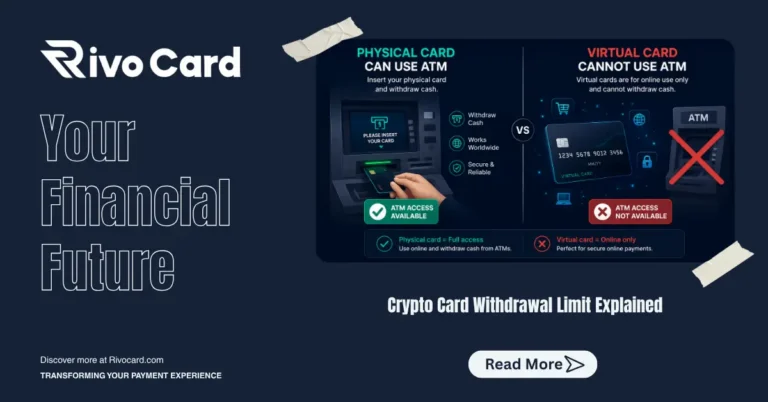
Quick answer: A crypto card withdrawal limit is the maximum amount of cash you can take out at ATMs using your card — separate from your spending limit for purchases. Daily ATM limits range from $200 at entry tier to $2,000 at premium tier, with monthly ATM caps from $5,000 to $10,000 for fully verified accounts at major providers in 2026. On Rivocard, virtual cards cannot be used at ATMs — ATM cash withdrawals require a physical card with a chip and magnetic stripe, which virtual cards do not have. If cash access is a priority for you, this is an important distinction before choosing a card.
This guide explains how crypto card withdrawal limits work across the industry, what they typically cost, and exactly what Rivocard virtual cards can and cannot do when it comes to cash access.
What Is a Crypto Card Withdrawal Limit
A withdrawal limit on a crypto card specifically refers to the maximum amount of cash you can withdraw from ATMs using that card. It is a separate limit from your spending limit (used for purchases at merchants) and operates independently.
Most providers set withdrawal limits at three levels:
Per-transaction ATM limit: The maximum cash you can take from a single ATM transaction. Daily ATM limit: The maximum total cash withdrawals across all ATM uses in one day. Monthly ATM limit: The maximum total cash withdrawals across all ATM uses in one calendar month.
These limits are set at the card network and issuer level — separate from spending limits — because ATM cash withdrawals carry different fraud and AML risk profiles than card purchases.
How ATM Withdrawal Limits Typically Work in the Industry
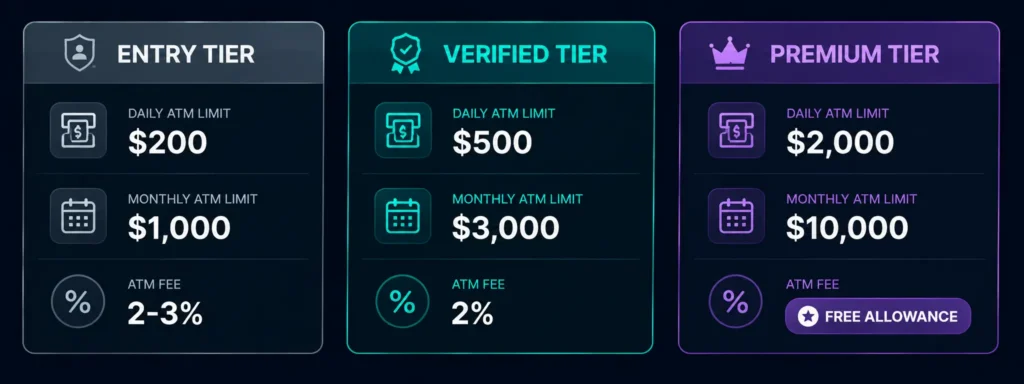
Daily ATM limits range from $200 at entry tier to $2,000 at premium tier, with monthly ATM caps from $5,000 to $10,000 for fully verified accounts — based on limits published by major providers in 2026.
The typical industry structure:
| Tier | Daily ATM limit | Monthly ATM limit | Over-limit fee |
|---|---|---|---|
| Entry / no KYC | $200-$500 | $1,000-$5,000 | 2-3% |
| Verified (basic ID) | $400-$1,000 | $2,000-$5,000 | 2-3% |
| Premium / full KYC | $1,000-$2,000 | $5,000-$10,000 | 2% |
Many providers also offer a free monthly ATM allowance at higher tiers — a set dollar amount of free ATM withdrawals each month, with a 2% fee on amounts above the allowance. Entry tiers typically pay the ATM fee on every withdrawal.
What ATM Withdrawals Cost on Crypto Cards
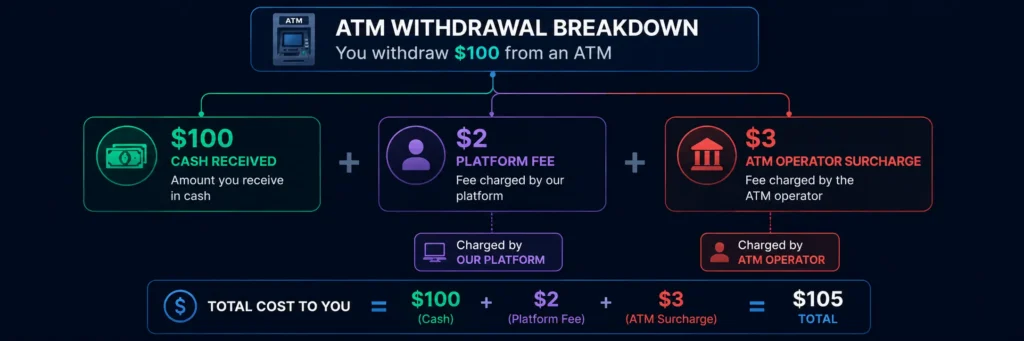
Two types of fees typically apply to ATM cash withdrawals from crypto cards:
1. Card issuer ATM fee Charged by the card platform. This can be:
- A flat fee per withdrawal (e.g., $2-$3 per transaction)
- A percentage of the withdrawn amount (typically 2-3%)
- Free up to a monthly allowance, then 2% above it
2. ATM operator fee (surcharge) Charged by the ATM’s owner — a bank, independent ATM operator, or retailer. This is completely separate from the card platform’s fee and typically ranges from $1.50 to $5.00 per withdrawal in the US, varying by ATM and location. International ATMs typically charge higher fees.
Both fees apply on the same transaction. A $100 ATM withdrawal could cost $2 in platform fees plus $3 in ATM operator fees — a total of $5, making $100 in cash cost $105 to obtain.
Withdrawal Limits vs Spending Limits: Key Differences
| Withdrawal Limit | Spending Limit | |
|---|---|---|
| What it covers | ATM cash withdrawals | Card purchases at merchants |
| Typical daily limit | $200-$2,000 | $500-$10,000+ |
| Reset frequency | Daily and monthly | Daily and monthly |
| Fee structure | Usually 2%+ per withdrawal or allowance | Usually 0% on purchases |
| Physical card required | Yes | No (virtual cards work) |
The two limits are completely independent. Hitting your ATM withdrawal limit does not affect your ability to make purchases. Hitting your spending limit does not affect ATM access.
Can Rivocard Virtual Cards Be Used at ATMs?
No. ATMs require a physical card with a chip (EMV) or magnetic stripe to process cash withdrawal transactions. Virtual cards — which exist only as a 16-digit number, expiry date, and CVV — cannot interface with ATM hardware. There is no chip to insert and no magnetic stripe to swipe.
This is a fundamental limitation of virtual cards across the industry, not a Rivocard-specific restriction. Any virtual card from any provider faces the same constraint.
The practical implication: If you need cash from ATMs, you need a physical crypto card. Virtual cards — including Rivocard virtual cards — handle all payment situations where you enter or tap card details:
- Online purchases
- In-app purchases
- Apple Pay and Google Pay (NFC contactless at merchants)
- Any merchant checkout where you type card details
But they cannot be used at ATMs, chip-and-PIN-only terminals without NFC, or situations where a physical card must be presented.
Getting Cash When Using Rivocard Virtual Cards
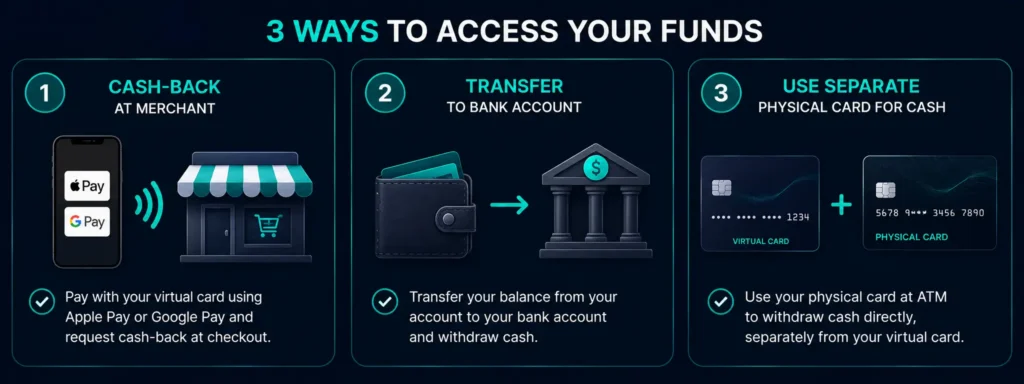
If you need cash and are using a Rivocard virtual card, three practical approaches work:
Option 1: Use Apple Pay or Google Pay at a merchant with cash-back Some retailers (primarily in the US) offer cash-back at point of sale — you make a purchase and request cash back on the same transaction. Adding a Rivocard virtual card to Apple Pay or Google Pay enables NFC tap-to-pay at these merchants. The card processes as a purchase transaction (0% fee) and you receive cash from the merchant. Daily and individual transaction limits are set by the merchant, not by Rivocard.
Option 2: Transfer to a bank account and withdraw Transfer funds from your Rivocard wallet back through a supported withdrawal method to a bank account, then withdraw from a bank ATM. This works but adds several steps and potentially a processing delay.
Option 3: Use a separate physical card for cash needs For users who occasionally need ATM cash, keeping a separate physical bank card or physical crypto card for ATM access — while using Rivocard virtual cards for all other spending — is a practical split.
What Crypto Card Users Need to Know About ATM Limits and Fees
The free ATM allowance trap Several providers advertise free ATM withdrawals as a feature. Read the specific terms carefully:
- “Free ATM withdrawals” often applies only up to a monthly dollar cap ($200-$1,000/month) — above that, 2% fees apply
- The free allowance may only apply to certain ATM networks or regions
- ATM operator surcharges still apply even when the card’s platform fee is zero
Monthly ATM caps reset Calendar resets apply to spending and ATM withdrawal limits — these reset on the 1st at midnight. Your monthly ATM withdrawal allowance renews on the first of each month.
ATM surcharges count against limits at some providers At some platforms, the ATM operator’s surcharge fee is counted toward your withdrawal limit total — meaning a $100 withdrawal with a $3 surcharge counts as $103 against your limit. Check your provider’s specific policy.
International ATM fees are higher Using a crypto card at an ATM outside your home country typically triggers both higher ATM operator fees and sometimes an additional foreign ATM fee from the card platform. Factor this into travel cash planning.
If Cash Access Is Important to You: What to Look For
If ATM cash access is a genuine part of your spending pattern, here are the features that matter when choosing a crypto card:
Physical card availability. A virtual card alone is insufficient for ATM access. You need a physical card.
Monthly free ATM allowance. The higher the free monthly ATM allowance, the better. Aim for at least $400-$800/month free if you withdraw cash regularly.
Per-use fee above the free allowance. Industry standard is 2% above the free tier. Lower is better.
ATM network coverage. Some cards only support domestic ATMs or specific networks. International travelers need global ATM access.
Monthly ATM cap. The maximum monthly withdrawal amount, separate from the free allowance. Premium tier cards on major platforms publish monthly spending limits of $50,000 or more, with ATM monthly caps typically from $5,000 to $10,000 for fully verified users.
Rivocard’s Position on ATM Access
Rivocard’s current product focuses on virtual cards. ATM cash access is not a current feature. This makes Rivocard the right choice for users whose spending is primarily:
- Online purchases and subscriptions
- Digital services and SaaS tools
- Digital advertising (Google Ads, Meta Ads)
- Travel bookings made online
- In-person contactless payments via Apple Pay or Google Pay
For users who need regular ATM cash access, Rivocard virtual cards are best used alongside a separate physical card or bank account for cash needs. Check Rivocard’s current product page for the latest on physical card availability — product offerings evolve and a physical card option may be added in the future.
FAQs
What is a crypto card withdrawal limit?
A crypto card withdrawal limit is the maximum cash you can take from ATMs using your card. It operates separately from your spending limit (used for merchant purchases). Withdrawal limits have per-transaction, daily, and monthly tiers.
Can I use a Rivocard virtual card at an ATM?
No. ATMs require a physical card with a chip or magnetic stripe. Virtual cards exist only as a card number, expiry date, and CVV — they cannot interface with ATM hardware. This is a characteristic of all virtual cards across the industry, not a Rivocard-specific limitation.
What is the typical ATM withdrawal limit on crypto cards in 2026?
Daily ATM limits typically range from $200 at entry tier to $2,000 at premium tier, with monthly ATM caps from $5,000 to $10,000 for fully verified accounts at major providers. Limits vary significantly by provider and tier.
How much does it cost to withdraw cash from a crypto card ATM?
Two fees apply: the card platform fee (typically 2-3% per withdrawal, or free up to a monthly allowance) and the ATM operator surcharge (typically $1.50-$5.00 per transaction, charged by the ATM owner regardless of your card). Both apply simultaneously.
Is there a free ATM withdrawal allowance on crypto cards?
Many providers offer a monthly free ATM withdrawal allowance at mid-to-premium tiers — typically $200-$1,000/month free, with 2% charged on withdrawals above the allowance. Entry tiers typically pay the fee on all withdrawals. Always check the specific policy for your tier.
What is the difference between an ATM withdrawal limit and a spending limit?
ATM withdrawal limits control cash withdrawals from ATMs. Spending limits control purchases at merchants. They operate independently — reaching one does not affect the other. ATM limits are typically much lower than spending limits and usually carry fees per use.
How do I get cash if I only have a Rivocard virtual card?
Options include: (1) use Apple Pay or Google Pay at a retail merchant that offers cash-back at point of sale, (2) transfer wallet funds back to a bank account and withdraw from a bank ATM, or (3) use a separate physical card for cash needs. Rivocard virtual cards are designed for digital and contactless spending, not ATM cash access.
Do withdrawal limits reset monthly?
Yes. Monthly ATM withdrawal limits reset on the first of each calendar month at midnight UTC — the same reset schedule as monthly spending limits.
Are ATM withdrawal fees covered by Rivocard?
Rivocard virtual cards cannot be used at ATMs, so ATM fees are not applicable. If Rivocard introduces a physical card in the future, check the specific fee schedule at that time for ATM withdrawal terms.
Do ATM operator surcharges count toward my withdrawal limit?
This varies by provider. At some platforms, the ATM operator’s surcharge is included in the withdrawal limit total; at others, only the actual cash amount withdrawn counts. Check your specific provider’s terms.
Get Started
Need a card for online spending and contactless payments without ATM complexity? Create your Rivocard virtual card in under 2 minutes →