Quick answer: Crypto card top-up fees in 2026 range from 0% to 5%+ depending on the provider and tier. However, the advertised top-up fee is rarely the only cost — most cards layer in conversion spreads (0.5-2.5%), foreign transaction fees (0-3%), monthly subscription fees ($0-$50+), and staking requirements worth hundreds or thousands of dollars. On Rivocard, the fee model is a single 5% deducted when you fund a card, with 0% on purchases, 0% international transactions, no monthly fee, and no staking required. Understanding the total all-in cost — not just the headline top-up fee — is what matters for comparison.
This guide explains every fee type that appears across crypto cards, how to calculate your real annual cost, and what Rivocard’s fee structure means in practice relative to industry patterns.
The Fee Types You Need to Know
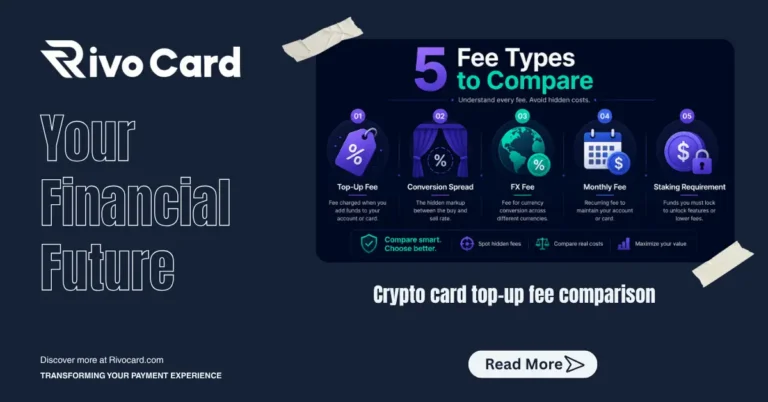
Most discussions of crypto card fees focus on the top-up fee percentage. In practice, there are five separate fee categories that determine your actual cost:
1. Top-up fee (loading fee) The percentage charged when you add funds to the card. Ranges from 0% to 5%+ across the industry. On Rivocard: 5%, deducted from the funded amount (fund $100, card gets $95).
2. Conversion spread A hidden markup added to the exchange rate when crypto is converted to fiat. A card advertising “0% conversion fee” may still apply a 1-2.5% spread on the exchange rate — effectively charging you more per dollar of spending power without disclosing it as a named fee. Many crypto cards operating on exchange infrastructure apply a spread at the point of conversion.
3. Foreign transaction fee (FX fee) Charged when you spend in a currency different from your card’s base currency. Ranges from 0% to 3% per transaction. On Rivocard: 0%.
4. Monthly or annual subscription fee Recurring fees charged regardless of usage. Some cards charge $0 per month; others charge $5-$50/month for the tiers with competitive top-up rates — meaning you pay the subscription to access lower transaction fees. On Rivocard: $0 — no subscription or monthly fee at any tier.
5. Staking requirement Some exchange-linked crypto cards require you to purchase and lock up a specific amount of the platform’s native token for a fixed period (often 180 days) to access certain tiers or fee structures. Staking amounts range from a few hundred dollars to $400,000 for premium tiers. This is not a direct fee — but it is capital tied up with price risk on the staked asset. On Rivocard: no staking required at any tier.
The Industry Fee Landscape in 2026
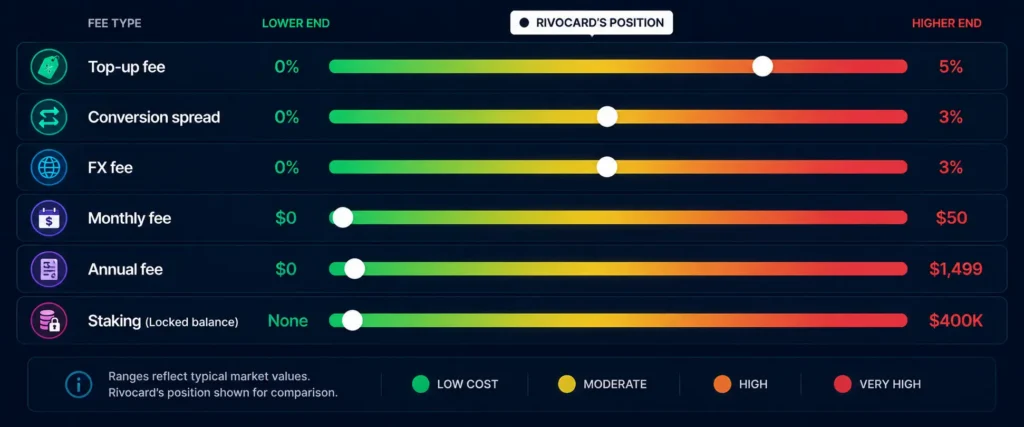
Based on the current market of crypto cards available in 2026, here is the realistic range for each fee type:
| Fee type | Low end | Typical range | High end |
|---|---|---|---|
| Top-up / loading fee | 0% | 1-3% | 5%+ |
| Conversion spread | 0% | 0.5-2.5% | 3%+ |
| Foreign transaction fee | 0% | 0.5-2% | 3% |
| Monthly fee | $0 | $5-$15 | $50+ |
| Annual fee | $0 | $0-$99 | $1,499 |
| Staking requirement | None | $500-$5,000 | $400,000+ |
The important number is the combination. A card with a 1% top-up fee, a 1.5% conversion spread, and a $10/month subscription costs more in practice than a card with a 5% top-up fee, 0% spread, 0% FX, and no monthly fee — depending on volume.
How to Calculate Your Real All-In Cost
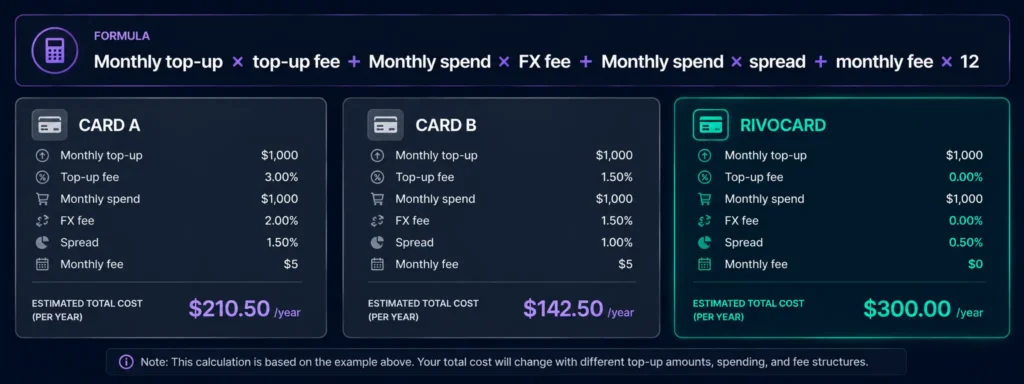
The only meaningful comparison is total annual cost for your specific spending pattern. Here is the formula:
Annual cost = (Monthly top-up × top-up fee%) + (Monthly spend × FX fee%) + (Monthly spend × spread%) + monthly fee × 12 + annual fee
Example: User who tops up $500/month and spends $475/month (after fee)
| Fee structure | Annual cost calculation | Total annual cost |
|---|---|---|
| Card A: 1% top-up, 1.5% spread, 0% FX, $10/month | ($500 × 1%) + ($475 × 1.5%) + 0 + ($10 × 12) | $5 + $85.50 + $120 = $210.50 |
| Card B: 0% top-up, 0% spread, 2.5% FX, $0/month | 0 + 0 + ($475 × 2.5%) + 0 | $0 + $0 + $142.50 = $142.50 |
| Card C (Rivocard): 5% top-up, 0% spread, 0% FX, $0/month | ($500 × 5%) + 0 + 0 + 0 | $25/month × 12 = $300/year |
In this example, Card C (Rivocard) costs more annually at $500/month of top-ups. But the calculation changes significantly at different volumes and spending patterns — especially when spread and FX fees compound on every transaction.
Where Rivocard’s model wins:
- Users who make frequent international purchases (0% FX vs 1-3% on each transaction)
- Users who want zero ongoing costs (no monthly fee, no subscription)
- Users who want no staking capital at risk
- Users who need no-KYC spending up to $5,000/month
Where lower top-up fee cards may win:
- High-volume users who primarily spend domestically (minimal FX fee exposure)
- Users willing to pay a monthly subscription or stake tokens for lower per-use fees
- Users who qualify for premium tiers with reduced top-up rates
The Staking Calculation: A Hidden Cost Often Ignored
Several major crypto cards require staking the platform’s native token to access competitive rates. The staking amount is not charged as a fee directly, but it has real cost implications:
- Opportunity cost: Capital locked in a staked token cannot be used for other investments
- Price risk: If the staked token drops in value during the lock-up period, the real cost of staking increases
- Lock-up periods: Most staking requirements run 180 days — your capital is illiquid for that period
Example: A card requiring $5,000 in staked tokens for a 1% top-up tier (vs 3% without staking):
- At $500/month in top-ups: saving 2% = $120/year vs 0% staking
- But $5,000 locked at risk for 12+ months
- Break-even requires the staked token to not lose significant value
Rivocard requires no staking at any tier. All spending tiers are unlocked purely through KYC verification, not capital lock-up.
The Spread: The Fee That Hides in Plain Sight
Conversion spreads deserve special attention because they are the least transparent fee type. Here is how they work:
When a crypto card converts your deposit to fiat, it applies an exchange rate. If the market rate for 1 USDT is exactly $1.000, a card with a 1.5% spread credits you at $0.985 per USDT — effectively charging 1.5% without calling it a fee.
This spread applies to every single dollar you convert, not just deposits above a threshold. On $500 worth of crypto, a 1.5% spread costs $7.50 — silently.
Cards that use a conversion model (convert crypto to fiat at the point of spending, not at deposit) often apply the spread at that moment — meaning each purchase carries a hidden spread cost in addition to any stated transaction fee.
Rivocard’s approach: The deposit converts at the live market rate with no added spread markup. The 5% fee is a separate, named charge applied when you fund a card — not a hidden spread baked into the exchange rate.
What the 5% Rivocard Fee Covers
Understanding what the 5% covers helps contextualize it:
- Crypto-to-fiat conversion infrastructure
- Regulated card issuance under card network rules
- Virtual card generation and delivery
- Payment processing and Visa network settlement
- Platform maintenance, customer support, and fraud protection
This is bundled into one number. Most competitors charge these costs through a combination of spreads, monthly fees, and transaction percentages — making the true cost harder to calculate but sometimes comparable or higher.
The No-KYC Fee Context
Several crypto cards charge higher fees specifically for no-KYC tiers. In 2026, 5% is the common benchmark for no-KYC or minimal-KYC card funding — reflecting the higher operational cost of serving unverified users within regulatory frameworks. Rivocard’s 5% fee at the Basic KYC tier (email-only) is consistent with this market standard.
The full-KYC tiers at some providers offer lower top-up fees (sometimes 0-2%), typically offset by higher monthly subscription costs or staking requirements.
Rivocard’s Complete Fee Picture
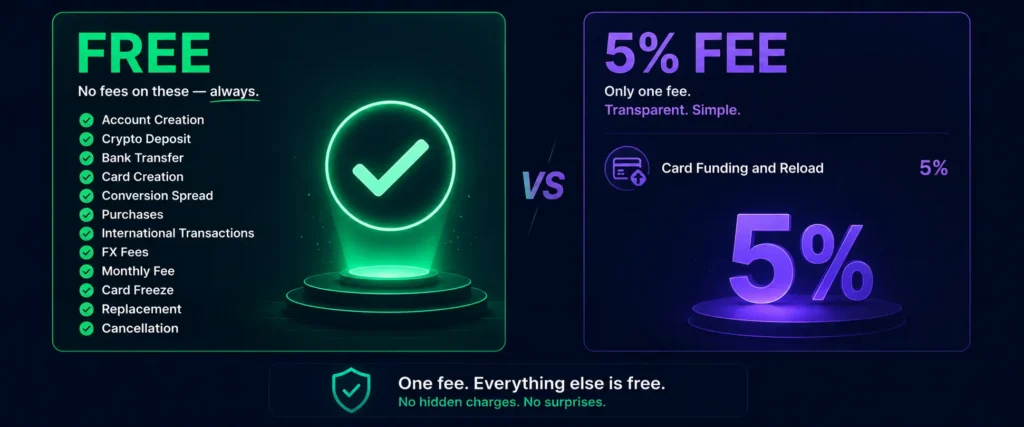
For direct reference, every fee on Rivocard in one place:
| Fee | Amount |
|---|---|
| Account creation | Free |
| Crypto deposit to wallet | Free (+ network fee to blockchain) |
| Bank transfer to wallet | Free |
| Card creation | Free (unlimited cards) |
| Card funding / reload fee | 5% (deducted from funded amount) |
| Conversion spread | 0% |
| Purchase fee | 0% |
| International transaction fee | 0% |
| Foreign exchange fee | 0% |
| Monthly subscription | $0 |
| Annual fee | $0 |
| Staking requirement | None |
| Card freeze / unfreeze | Free |
| Card replacement | Free |
| Account cancellation | Free |
One fee, everything else free. For the detailed breakdown, see our Rivocard fees breakdown.
How to Compare Crypto Card Fees Accurately
When evaluating any crypto card’s fee structure:
Step 1: Identify all five fee types. Ask specifically about: top-up fee, conversion spread, FX fee, monthly/annual fee, and staking requirement.
Step 2: Calculate total annual cost for your usage. Use the formula above with your actual expected monthly top-up amount and spending patterns.
Step 3: Account for staking capital. If a card requires staking, add the opportunity cost and price risk of that capital to your calculation.
Step 4: Check for fee exemptions and conditions. Some providers advertise low fees that only apply above minimum monthly spend thresholds, or only in specific currencies, or only for limited time periods.
Step 5: Read the terms for rate changes. Some providers reserve the right to change their fee structure with short notice. A fee structure that seems attractive today may not persist.
Step 6: Consider non-fee factors. Deposit speed, supported cryptocurrencies, card limits, customer support quality, and platform reliability matter alongside fees.
RivoCard keeps top-up fees transparent — see the full breakdown on our crypto virtual card page.
FAQs
What is the typical top-up fee for a crypto card?
Top-up fees range from 0% to 5%+ across the industry in 2026. However, the advertised top-up fee is rarely the only cost — most cards also apply conversion spreads (0.5-2.5%), foreign transaction fees (0-3%), and monthly subscription fees. The real comparison is total all-in annual cost.
What is Rivocard’s top-up fee?
Rivocard charges a 5% fee deducted when you fund a virtual card from your wallet balance. Depositing crypto to your wallet is free. All purchases are 0%. There are no monthly fees, subscription fees, conversion spreads, FX fees, or staking requirements.
Is a lower top-up fee always better?
Not always. A card with a 1% top-up fee but a 2% conversion spread and a $10/month subscription may cost more annually than a card with a 5% top-up fee and no other charges — depending on your usage volume and patterns. Calculate total annual cost rather than comparing top-up percentages in isolation.
What is a conversion spread on a crypto card?
A conversion spread is a hidden markup on the exchange rate applied when crypto converts to fiat. A card advertising “0% conversion fee” may still apply a 1-2.5% spread — charging you more per dollar of spending power without disclosing it as a named fee. Not all cards are transparent about this.
Does Rivocard charge a conversion spread?
No. Rivocard converts at the live market rate with no spread markup. The 5% card funding fee is a separate, named charge — not hidden in the exchange rate.
What is a staking requirement for a crypto card?
Some exchange-linked cards require you to purchase and lock up a specific amount of the platform’s native token for a fixed period (often 180 days) to access certain tiers or lower fees. Staking requirements range from hundreds to hundreds of thousands of dollars, with price risk on the locked capital. Rivocard has no staking requirement at any tier.
How do I calculate my real annual cost for a crypto card?
Multiply your monthly top-up amount by the top-up fee percentage, add monthly spend multiplied by FX fee and spread percentages, then add monthly subscription times 12 and any annual fee. Compare this total annual cost — not headline percentages — across providers.
What fees should I watch for that are not always disclosed?
The most commonly undisclosed fees are: conversion spreads on the exchange rate, foreign transaction fees buried in terms, inactivity fees for periods of non-use, ATM withdrawal fees, and card issuance or replacement fees.
Get Started
Ready to use a card with one transparent fee and no hidden costs? Get started with Rivocard →