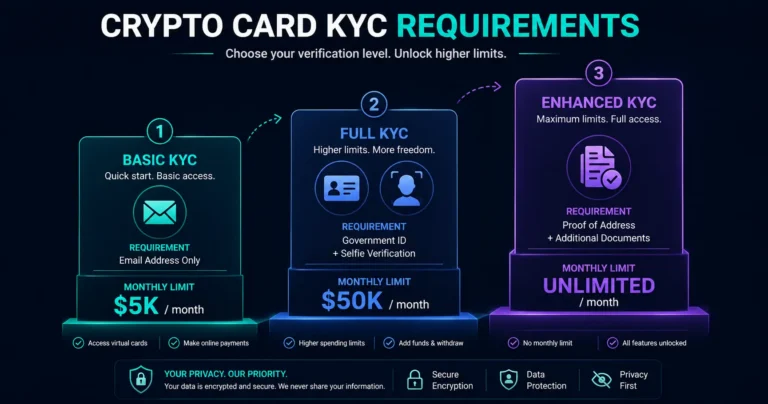
Quick answer: KYC (Know Your Customer) on a crypto card verifies your identity so the platform can comply with anti-money laundering regulations and unlock higher spending limits. On Rivocard, KYC works in three tiers: Basic KYC requires only an email address — no ID documents — and gives you a $500 per-transaction limit, $1,000 daily, and $5,000 monthly. Full KYC requires a government-issued photo ID plus a real-time selfie, raising limits to $5,000 per transaction, $10,000 daily, and $50,000 monthly. Enhanced KYC requires additional documentation for limits up to $100,000 per card and unlimited monthly spending. You can start using Rivocard immediately at Basic KYC with no documents submitted.
What Is KYC and Why Does It Exist on Crypto Cards
KYC — Know Your Customer — is the process by which financial institutions verify the identity of their users. It is not optional for regulated card platforms. AML laws, MiCA (the EU’s Markets in Crypto-Assets regulation), and Visa and Mastercard network rules require identity verification for all card issuers in regulated markets.
The legal framework behind KYC on crypto cards operates at multiple levels:
FATF (Financial Action Task Force): The global standard-setter for anti-money laundering (AML) and counter-terrorist financing (CTF) rules. FATF Recommendation 10 requires financial institutions to identify and verify customers before establishing business relationships. The regulatory stack is FATF as the global floor, with FinCEN (US), MiCA (EU), and FCA (UK) building on top of it.
MiCA (EU): Any crypto-asset service provider operating in the European Union must hold MiCA authorization by July 1, 2026. MiCA mandates full KYC and AML processes including customer identification, document verification, and ongoing monitoring.
Visa and Mastercard: Card network rules require that card-issuing programs maintain KYC compliance for cardholders above certain spending thresholds. This is a condition of using the Visa or Mastercard network — not just a regulatory requirement.
The practical result for users: You cannot legally obtain a fully functional, unlimited crypto card without any KYC in 2026. What you can do — on Rivocard specifically — is start using a card immediately with email-only verification up to defined spending limits, and upgrade KYC only when you need higher limits.
The Tiered KYC Model: How It Works
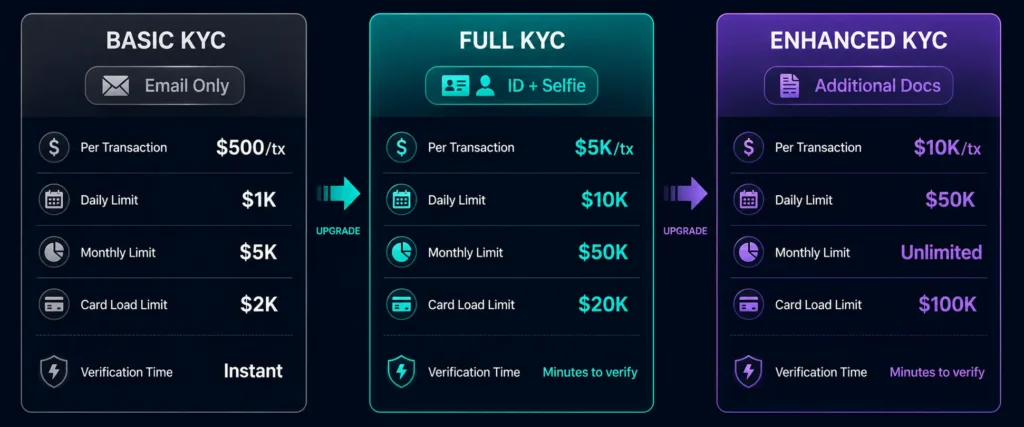
The major crypto card platforms converged on a tiered KYC model in 2026. The first tier opens the account and lets the user operate up to modest limits. Higher tiers unlock larger limits and require additional documentation.
This tiered approach balances regulatory compliance with accessibility. Low-risk spending (small amounts, individual users) can proceed with minimal verification. Higher-risk activity (large volumes, business-scale spending) requires full identity verification.
Rivocard’s three-tier structure:
| Tier | What It Requires | What It Unlocks |
|---|---|---|
| Basic KYC | Email verification only | $500/tx, $1,000/day, $5,000/month, $2,000 card load |
| Full KYC | Government ID + real-time selfie | $5,000/tx, $10,000/day, $50,000/month, $20,000 card load |
| Enhanced KYC | Additional documentation | $10,000/tx, $50,000/day, Unlimited/month, $100,000 card load |
Basic KYC: Email Verification Only
Rivocard’s Basic KYC tier is the most accessible legally compliant starting point available. Requirements:
- A working email address
- Email verification (click the link sent to your inbox)
That is the complete requirement. No government ID. No selfie. No proof of address. No phone number verification.
Why this is legally possible: Regulators permit simplified due diligence for low-value prepaid card programs operating below defined thresholds. At $5,000/month in spending, the AML risk profile is considered low enough that full identity verification is not mandated in most regulatory frameworks. The platform can operate under simplified customer due diligence (SCDD) rules for this tier.
What Basic KYC gives you:
- Immediate account access after email verification
- Virtual card creation (unlimited, free)
- Crypto deposits to your wallet (12+ supported coins)
- Spending up to $500 per transaction
- Spending up to $1,000 per day
- Spending up to $5,000 per month
- Card load up to $2,000 per card
For most personal use cases — subscriptions, online shopping, moderate digital advertising — Basic KYC limits are sufficient. The majority of Rivocard users operate comfortably within these limits.
Full KYC: Government ID + Selfie
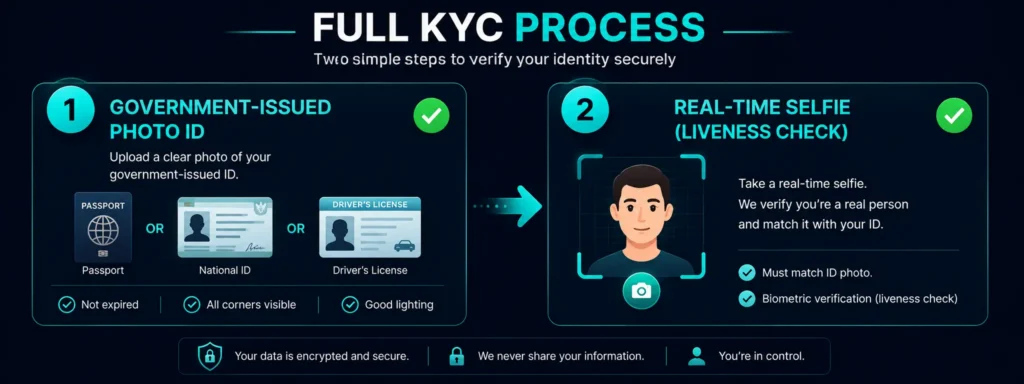
Full KYC on Rivocard requires two things:
1. Government-issued photo ID Accepted documents typically include:
- Passport (most universally accepted)
- National identity card (EU and many other countries)
- Driver’s license (with photo, issued by recognized authority)
The ID must be:
- Valid and not expired
- Clearly photographed — full document visible, no cutoff edges
- Legible — name, date of birth, document number readable
- In good lighting — no glare on laminate surfaces
2. Real-time selfie (liveness check) A photo of your face taken at the time of verification — not a stored photo. The platform’s identity verification system compares the selfie against the ID photo using biometric matching. The liveness check also confirms the selfie is of a real person present at verification (not a photo of a photo).
Standard KYC requirements include a government-issued photo ID, and a selfie or live video for biometric verification.
Verification timeline: Most Full KYC submissions are processed automatically by identity verification software. For clear, well-lit documents with matching selfies, verification typically completes in minutes. Manual review cases (triggered by image quality issues, name discrepancies, or flagged accounts) take longer — typically up to 24 hours.
What Full KYC unlocks:
- $5,000 per transaction (10x Basic)
- $10,000 daily spending (10x Basic)
- $50,000 monthly spending (10x Basic)
- $20,000 card load limit (10x Basic)
Enhanced KYC: Additional Documentation
Enhanced KYC applies to users who need limits beyond Full KYC thresholds. Requirements vary and may include:
- Proof of address (utility bill, bank statement, or government letter dated within 3 months)
- Source of funds declaration (documentation showing the origin of deposited funds)
- Additional identity verification steps
- In some cases, video verification
Enhanced KYC is primarily relevant for:
- High-volume digital advertisers spending $50,000+/month
- Businesses using Rivocard as primary payment infrastructure
- Enterprise users requiring $100,000+ card loads
What Enhanced KYC unlocks:
- $10,000 per transaction
- $50,000 daily spending
- Unlimited monthly spending
- $100,000 card load limit
The KYC Process: Step by Step on Rivocard
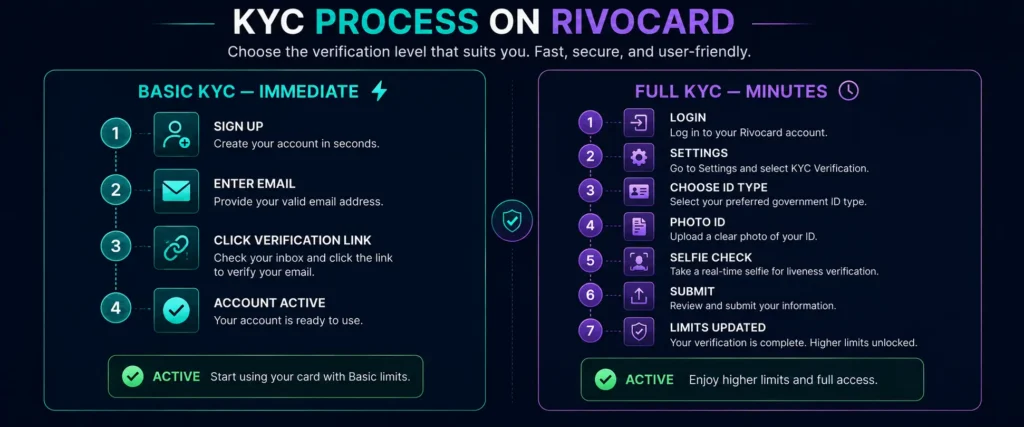
For Basic KYC (immediate):
- Go to rivocard.com → Sign up
- Enter email address and password
- Open the verification email → click the confirmation link
- Account active — Basic KYC limits apply immediately
For Full KYC (when you need higher limits):
- Log into your Rivocard dashboard
- Navigate to account settings → Verification
- Select “Upgrade to Full KYC”
- Choose your ID document type
- Photograph or scan the front (and back if applicable) of your ID
- Complete the selfie/liveness check using your device camera
- Submit — automated verification typically completes in minutes
- Limits update immediately upon approval
Tips for Fast Full KYC Approval:
- Take ID photos in natural daylight, not artificial light
- Place the ID on a plain contrasting surface (white card on dark table, or vice versa)
- Ensure all four corners of the ID are visible — no cutoffs
- Remove any protective sleeves or laminates that cause glare
- The selfie should be taken in good lighting, facing directly at the camera
What Happens to Your KYC Data
For individual customers: a government-issued photo ID, proof of address where required, and a liveness verification are collected. This data is subject to regulatory retention requirements.
Key points about KYC data handling on Rivocard:
- Identity verification data is processed for the purpose of AML/KYC compliance
- Data is retained as required by applicable financial regulations (typically 5+ years after account closure)
- Data is protected under Rivocard’s privacy policy and applicable data protection law (GDPR in the EU, and equivalent regulations in other jurisdictions)
- KYC data is not sold to third parties
For the complete data handling disclosure, check Rivocard’s current privacy policy at rivocard.com.
“No-KYC” Crypto Cards in 2026: The Reality
Users sometimes search for crypto cards with zero KYC. It is worth being direct about the current landscape:
Fully anonymous and legally compliant crypto cards no longer exist in 2026. Cards marketed as “no-KYC” rely on tiered limits, grey-area resell schemes, or offshore structures — and frequently shut down, freezing user funds.
What does exist is Rivocard’s Basic KYC tier — email verification only, no ID required — which is the most permissive legally compliant starting point available. This is not a loophole or a grey area. It is a legitimately structured simplified due diligence tier under applicable AML regulations, operating within defined spend limits that make it regulatorily appropriate.
The distinction matters because cards claiming “truly no KYC” may:
- Operate outside regulatory frameworks, risking account freezes
- Be shut down by Visa or Mastercard for non-compliance
- Have unclear fund protection
- Be subject to enforcement action that freezes user balances
Rivocard’s email-only Basic tier gives you immediate access to a real, functional, regulated Visa card — with the option to upgrade verification when you need higher limits.
FAQs
Get Started
Ready to create your account with email-only verification? Start with Basic KYC — no ID required →