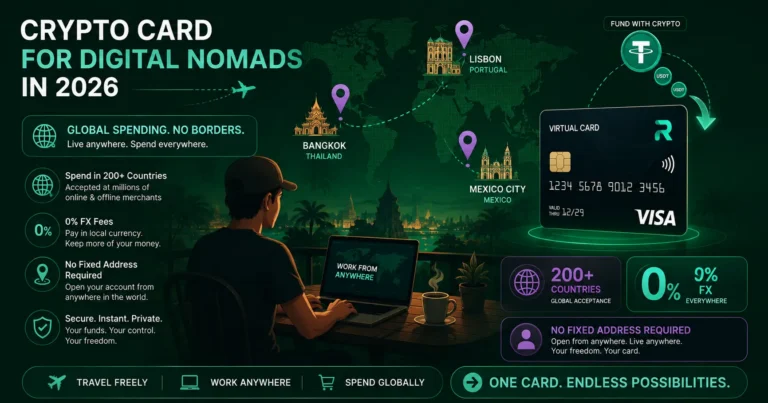
Quick answer: Digital nomads need a crypto card that works everywhere without a fixed address, charges minimal FX fees across dozens of currencies, handles subscriptions across different billing regions, and does not require proof of address at signup. (cite index=”7-1″>When every purchase you make is technically a foreign transaction, FX fees stop being a minor nuisance and become a lifestyle tax. For a nomad earning $5,000-$10,000 per month, the card choice is worth more than most subscription optimizations or cost-cutting measures combined. Rivocard addresses the core nomad requirements: global registration with email only (no fixed address), 0% FX on every transaction in every currency, unlimited free virtual cards for subscription and expense management, and instant virtual card issuance that works from anywhere. This guide covers how to structure crypto card usage for a nomadic lifestyle, the multi-card strategy, and what to watch for in the fee structures of competing cards.
The Nomad’s Unique Financial Situation
A digital nomad’s payment needs differ from both regular travelers and static remote workers:
Multi-currency daily reality. (cite index=”8-1″>For nomads, every purchase is technically a foreign transaction. A 2.5% FX fee on $5,000 of monthly spending is $125 per month — $1,500 per year — paid solely to the bank for processing currency conversion.
No fixed address. Traditional bank cards and many financial products require proof of address in a specific country. Nomads move between countries frequently. Many have no permanent address. Rivocard’s email-only Basic KYC requires no proof of address — you can sign up and use the card without a fixed residential address.
Crypto income is common. A significant portion of digital nomads receive payment in crypto — from clients paying in USDT, DAO contributor payments, freelance platforms with crypto payout options, or crypto-native employer compensation. A card funded directly from crypto eliminates the bank-to-crypto-to-bank conversion cycle.
Subscription chaos across billing regions. VPN subscriptions (often US-billed), cloud storage (US or EU-billed), project management tools (various), coworking memberships (local currency), streaming services (regional pricing) — nomads manage subscriptions across more billing regions than static users. Multi-card setup simplifies this.
No single country’s financial system. Traditional banks are tied to one country’s infrastructure. A UK bank card works poorly as a primary card for someone spending 3 months in Asia, 3 months in Latin America, and 3 months in Eastern Europe.
What a Good Nomad Crypto Card Must Do
(cite index=”1-1″>Digital nomads need a crypto card that works everywhere, charges minimal FX fees, does not require proof of address, and ideally does not ask for identity documents at all.
The five nomad-specific requirements:
1. Zero (or near-zero) FX fees: Every transaction in a foreign currency is a cost. At 2.5%, a $5,000 monthly spend costs $125/month in FX alone. The gap between a 0% card and a 2.5% card is $1,500/year on that spend volume.
2. No fixed address required: Registration should work without proof of current address. Rivocard’s email-only Basic KYC has no address requirement.
3. Works globally without per-country restrictions: Some cards restrict registration to specific countries. A nomad cannot rely on a card that requires residency in EEA or the US.
4. Virtual card capability with multiple cards: Online spending is heavy in nomad life. Multiple virtual cards for different purposes (subscriptions, work tools, local spending, client-billed expenses) is more valuable than a physical card.
5. Stablecoin funding for tax clarity: (cite index=”7-1″>Every crypto-to-fiat conversion is potentially a taxable event in most jurisdictions. Spending stablecoins simplifies this because USDT and USDC rarely generate capital gains. Most countries claim tax jurisdiction after 183 days of presence.
Rivocard’s Nomad-Specific Fit
| Nomad requirement | Rivocard response |
|---|---|
| 0% FX fees | Yes — 0% on all international transactions |
| No fixed address at signup | Yes — email only at Basic KYC |
| Global registration | Yes — no stated country restriction |
| Works in 200+ countries | Yes — Visa network |
| Multiple free virtual cards | Yes — unlimited, free |
| Stablecoin funding (USDT) | Yes — primary recommended asset |
| No bank account required | Yes |
| Instant card issuance | Yes — under 5 minutes |
Where Rivocard is not ideal for nomads:
- No ATM access (virtual only) — physical backup card needed for cash
- 5% card funding fee (one-time at load, not per transaction)
- No cashback rewards (Bybit or other platforms may offer 1-2% for EEA-based nomads)
The Tiered Nomad Card Strategy
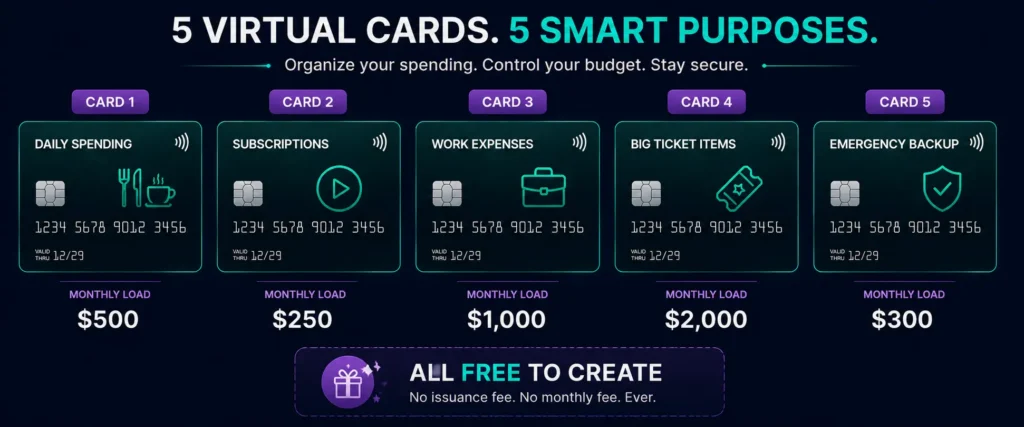
(cite index=”7-1″>The most effective approach for full-time nomads is a tiered card system: Card 1 as a zero-FX daily driver loaded with stablecoins handles 80% of transactions — restaurants, groceries, coworking, transport, online subscriptions. Additional cards handle specific purposes.
The recommended nomad setup with Rivocard:
Card 1 — Daily spending (reloadable, $200-500/month): The card you tap at cafes, restaurants, groceries, transport, and local services. Loaded with USDT at the start of each month or week. 0% FX means every local currency purchase is at the Visa interbank rate.
Card 2 — Subscriptions (reloadable, $80-200/month): All recurring subscriptions: VPN, cloud storage, creative tools, project management, AI tools. Loaded monthly with enough to cover all renewals. Subscriptions charge automatically from the saved card number. If a subscription raises its price, you see the change in this card’s statement only.
Card 3 — Work expenses (reloadable, variable): Client-related tools, advertising spend for freelance business promotion, domain and hosting fees. Separate from personal spending for cleaner accounting.
Card 4 — Local coworking and big-ticket items (specific funding): Fund when needed. Coworking day passes, occasional flights booked at destination, special experiences. Fund specifically for the purchase with a buffer.
Card 5 — Emergency and backup (small balance, $100-200): Kept funded in case primary cards have issues. Not used for regular spending.
Total Rivocard card creation cost: $0 (all five cards free to create). Total funding fee: 5% of whatever total amount is loaded across all cards.
The Real FX Fee Calculation for Nomads
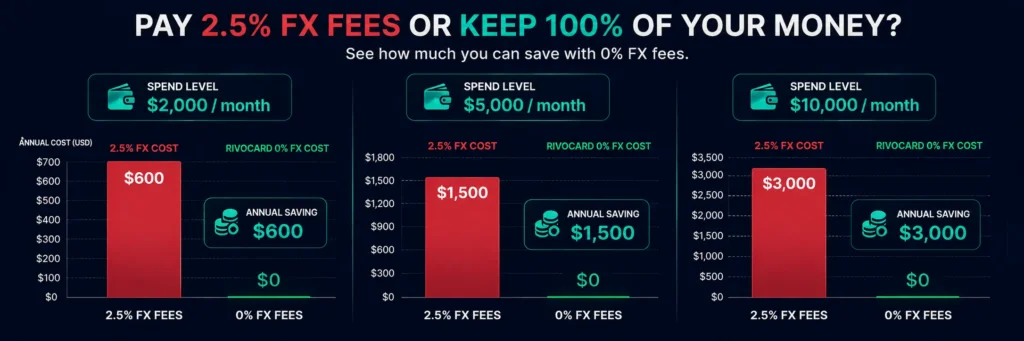
At different spending levels, the annual impact of FX fees:
| Monthly spend | FX fee at 2.5% | FX fee at 0% (Rivocard) | Annual saving |
|---|---|---|---|
| $2,000 | $50/month | $0 | $600 |
| $5,000 | $125/month | $0 | $1,500 |
| $10,000 | $250/month | $0 | $3,000 |
(cite index=”8-1″>Some crypto cards advertise zero FX fees while hiding costs in conversion spreads. Others offer genuinely transparent pricing that can save nomads $1,000 to $2,500 per year compared to traditional banking.
Rivocard’s 5% card funding fee is a one-time cost per reload, not a per-transaction FX fee. For a nomad spending $3,000/month who reloads monthly:
- Monthly Rivocard funding fee: $157.89 (5% on $3,157.89 deposit for $3,000 on card)
- Monthly FX saving vs 2.5% bank card: $75
- Net cost vs 0% FX bank card with no load fee: Rivocard costs $157.89 more per month
This means Rivocard’s 5% load fee costs more per month than a traditional 0% FX travel card with a free bank account. The value proposition for nomads is:
- No fixed address required at signup (traditional 0% FX cards require bank accounts tied to a country)
- No bank account needed
- Available in countries where no-fee travel cards are not accessible
- Multiple free virtual cards for spending isolation
- Crypto income direct to card (no bank intermediary)
For nomads who cannot access traditional 0% FX bank cards due to residency requirements, Rivocard’s 5% is the cost of accessibility.
Subscription Management for Nomads
Nomad subscription complexity is unique: a US Netflix subscription billed in USD, a Dutch cloud storage billed in EUR, an Australian VPN billed in AUD, a global SaaS tool billed in USD from Ireland. Managing these across a single card means every renewal hits the same statement in a mix of currencies.
Rivocard multi-card solution:
- One dedicated subscription card per billing region (or per major service)
- Each card’s statement shows only that service’s charges
- Cancelling a subscription: freeze the card — no navigation required
- Subscription price increase visible immediately on that specific card
For nomads who also run a business: Separate work-related subscriptions (project management, cloud infrastructure, domains) from personal subscriptions (streaming, VPN, storage) on separate cards. At tax time, the work card’s statement is a clean expense log.
The No-Fixed-Address Advantage
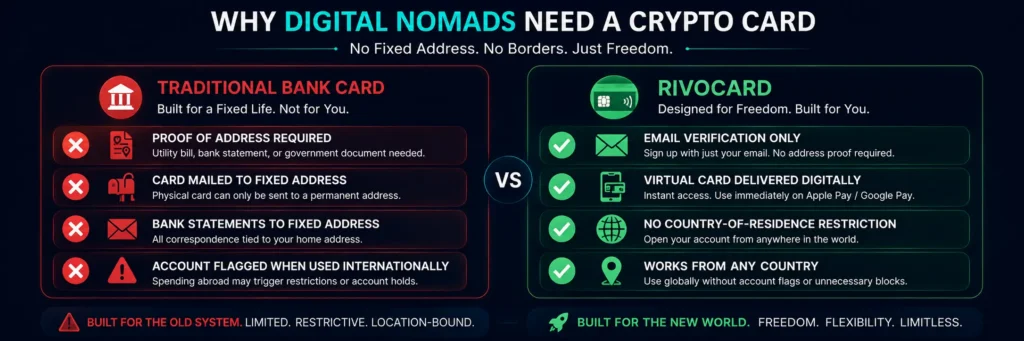
Traditional bank cards are fundamentally tied to a country’s address infrastructure:
- Proof of address required to open account
- Cards mailed to a residential address
- Bank statements sent to a fixed address
- Account potentially flagged or frozen when used from unexpected countries
Rivocard’s email-only Basic KYC eliminates the address dependency:
- No proof of address at signup
- Virtual card delivered digitally (no physical mailing address needed)
- No country-of-residence restriction stated at Basic KYC
- Account accessible from any country
For a nomad who moves between Thailand, Portugal, and Colombia in a single year, a card that requires residency in any specific country is problematic. Rivocard’s model removes this friction.
Handling Crypto Income as a Nomad
(cite index=”3-1″>Digital nomads and freelancers often get paid in USDT or USDC but still need to spend in local fiat wherever they happen to be. That gap between receiving crypto and paying for groceries, rent, and flights creates real friction.
Rivocard closes this gap directly:
- Client pays in USDT to your wallet
- Transfer USDT to Rivocard wallet (free, under a minute on TRC-20)
- Fund your spending cards (5% fee)
- Spend in any local currency at 0% FX
No bank account required. No exchange conversion to fiat. No bank wire to a country you may not reside in. The flow from USDT income to spending is completely banking-independent.
Tax consideration for nomads: Using USDT (stable at $1) through Rivocard typically involves no capital gains at the deposit step (since USDT value has not changed). Volatile asset (BTC, ETH) deposits may trigger taxable events. USDT funding is the most tax-simple approach for nomads who want to minimize transaction-by-transaction tax events. Consult a tax professional familiar with nomad residency rules in your citizenship and destination countries.
Backup Card for Cash Access
Rivocard virtual cards cannot access ATMs. For nomads in destinations where cash is needed (local markets, some accommodation, transport), maintain one physical card:
- A traditional bank debit card from your home country
- Or a physical crypto card (Bybit if you are EEA/AU-based; Crypto.com in 95+ countries)
Use the physical card exclusively for ATM withdrawals. Use Rivocard for everything else. This two-card system covers essentially 100% of nomad payment scenarios.
FAQs
What is the best crypto card for digital nomads in 2026?
For nomads prioritizing global access and no fixed address: Rivocard (email-only, global, 0% FX, unlimited virtual cards). For EEA and Australian nomads already on Bybit: Bybit Card (0% FX plus cashback). For nomads wanting premium perks and physical card: Crypto.com mid-tier. The best card depends on your region and whether you have access to exchange-linked platforms.
Can I get a crypto card as a digital nomad without a fixed address?
Yes. Rivocard requires only email verification at the Basic KYC tier – no proof of address, no utility bill, no country-of-residence verification. This makes it one of the most accessible cards for nomads who move between countries and have no permanent address.
How much do FX fees cost a digital nomad annually?
At $3,000/month in international spending, a 2.5% FX fee costs $900/year. At $5,000/month: $1,500/year. Rivocard charges 0% FX, though its 5% card funding fee creates a different upfront cost structure. The net comparison depends on your monthly spending volume and how often you reload.
How should a digital nomad structure multiple crypto cards?
The recommended nomad setup: Card 1 daily spending (restaurants, groceries, transport), Card 2 subscriptions (all recurring services), Card 3 work expenses (business tools, advertising, client-related), Card 4 big-ticket items, Card 5 emergency backup. All five cost $0 to create on Rivocard.
Does a digital nomad need a crypto card with ATM access?
Yes, as a backup. Rivocard virtual cards cannot access ATMs. Maintain one physical bank card or physical crypto card for ATM access in cash-dependent destinations. Rivocard handles all card-based and contactless spending; the physical card handles cash only.
How does USDT income work with a Rivocard for nomads?
Send USDT from clients directly to your wallet, or transfer from your holding wallet to Rivocard. Free at the deposit step, 5% fee when funding cards. This creates a banking-independent path from crypto income to local currency spending in any country.
Are crypto card transactions taxable events for nomads?
Every crypto-to-fiat conversion is potentially taxable in many jurisdictions. Spending USDT (stable at $1, typically no capital gain) through Rivocard is simpler for tax purposes than spending appreciated BTC or ETH. Consult a tax professional familiar with nomad residency rules – jurisdiction depends on your citizenship and length of stay in each country.
Does Rivocard work in Southeast Asia for digital nomads?
Yes. Thailand, Vietnam, Bali, Malaysia, Philippines, and Singapore all have strong Visa acceptance in tourist and commercial areas. Singapore has near-universal contactless acceptance. Other Southeast Asian destinations work well in tourist areas; rural areas may be cash-preferred.
What is the multi-card nomad strategy and why does it matter?
Using multiple virtual cards – one per purpose (subscriptions, daily spending, work expenses, etc.) – isolates each spending category, creates clean accounting records, enables instant cancellation of specific spending streams by freezing one card, and limits breach exposure (a compromised subscription card does not affect your daily spending card).
Is Rivocard better than a traditional 0% FX bank card for digital nomads?
For nomads who can access traditional 0% FX bank accounts (e.g., Starling UK, Charles Schwab US, N26 EU): those cards have lower total cost for pure spending since there is no load fee. Rivocard’s advantage is accessibility: it works where no address or country-specific bank account is available, requires only email, and accepts direct crypto income. Choose based on your access to traditional banking infrastructure.
Get Started
Fund from crypto income, spend in 200+ countries, manage with unlimited virtual cards. Create your Rivocard account – no fixed address required