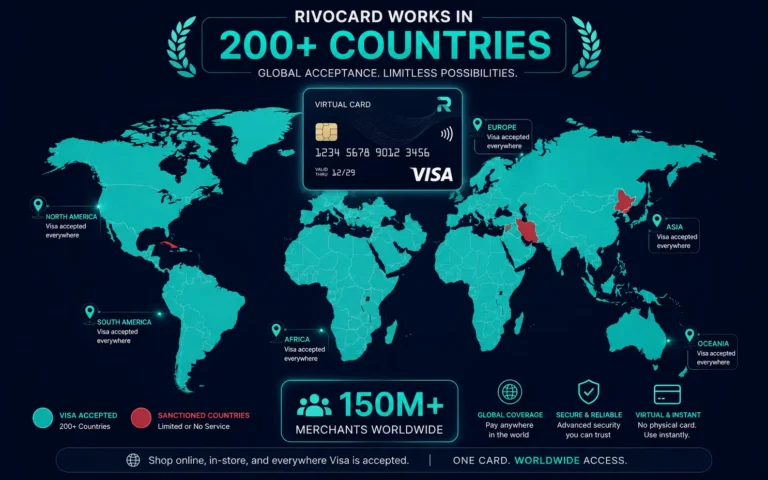
Quick answer: When a crypto card says it is “supported in 150+ countries,” it typically refers to where the card can be used for spending — specifically, the Visa or Mastercard network’s merchant acceptance footprint. Rivocard issues virtual Visa cards accepted at over 150 million merchant locations in 200+ countries and territories. The “150 countries” figure in many card descriptions refers to either merchant acceptance countries (almost everywhere) or, for some cards, the number of registration-eligible countries. These are two different things: you can spend a Rivocard at a Visa merchant in 200+ countries, but some competing cards restrict which countries can sign up. This guide explains exactly where a Rivocard works, country by country, and what the actual limits are.
The Two Country Questions for Crypto Cards
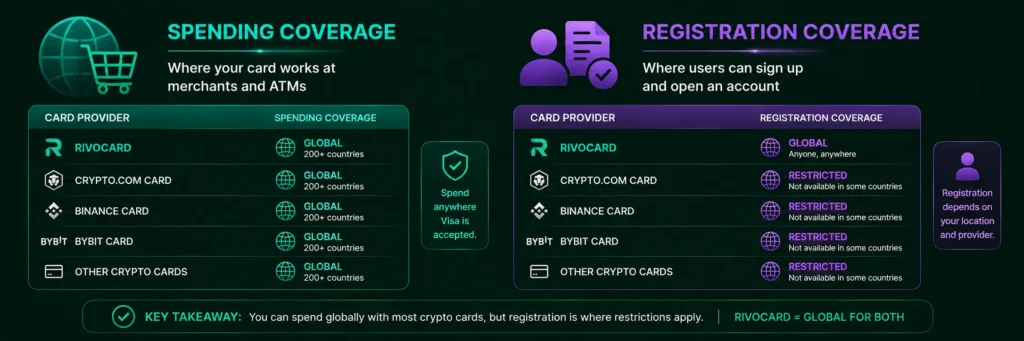
“Supported in X countries” conflates two separate concepts:
1. Spending coverage: The countries where the card network (Visa or Mastercard) is accepted and where you can make purchases. For Visa cards: 200+ countries and territories. For Mastercard: similar but slightly fewer merchant locations. This is the network’s footprint.
2. Registration coverage: The countries from which users can create accounts. Some card platforms restrict registration to specific countries (e.g., Bybit Card: EEA, AU, select markets; Coinbase Card: US only). Rivocard has no stated country-of-residence restriction at the email-only Basic KYC tier.
Rivocard’s position:
- Spending: 200+ countries (Visa network)
- Registration: Global (no stated restriction at Basic KYC, excluding sanctioned countries)
This makes Rivocard one of the most globally accessible crypto card options — you can both register and spend without geographic restrictions (outside of sanctioned countries).
Visa Network Coverage: 200+ Countries
The Visa payment network is one of the most extensive financial infrastructure networks on earth. Coverage as of 2026:
200+ countries and territories accept Visa transactions. This includes virtually every country with a functioning commercial banking and merchant payment infrastructure.
150 million+ merchant locations globally. This covers:
- Major online retailers in every country
- Physical merchants at point-of-sale terminals
- Mobile payment systems (Apple Pay, Google Pay)
- Transit systems (where contactless payment is enabled)
- ATM networks (for cards with ATM access — Rivocard virtual cards cannot use ATMs)
The countries where Visa is NOT accepted: A small number of countries are excluded from Visa network operations due to comprehensive international sanctions:
- North Korea
- Iran
- Cuba
- Syria
- Russia (for new card programs and services since 2022; some existing cards may have continued limited function)
- Belarus (partial restrictions)
- Myanmar (partial restrictions for some programs)
Outside these sanctioned countries, Visa works in essentially every country with any modern payment infrastructure.
Regional Breakdown: Where Your Rivocard Works
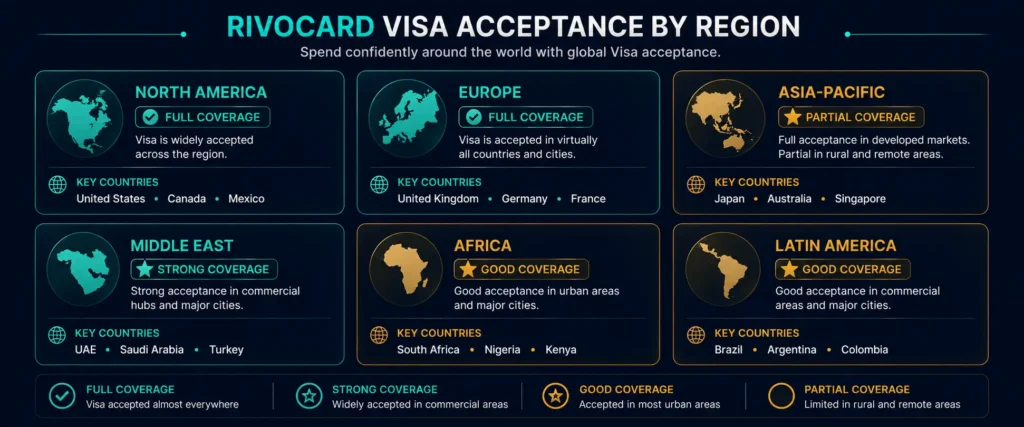
North America
United States: Full Visa acceptance at virtually all merchants. Apple Pay and Google Pay widely supported at major retailers and restaurants. Contactless NFC is standard at most modern POS terminals.
Canada: Full Visa acceptance. Contactless is ubiquitous in major cities. Both chip-and-PIN and contactless at most merchants.
Mexico: Visa widely accepted in commercial areas, hotels, and tourist destinations. Cash still common in markets and smaller towns. Major cities have strong Visa coverage.
Europe (EU and EEA)
All 27 EU member states plus Norway, Iceland, Switzerland, and Liechtenstein — comprehensive Visa acceptance.
UK: One of the world’s most contactless-developed markets. London Transit (TfL) fully accepts contactless Visa including Apple Pay. Contactless at virtually all retailers, restaurants, and cafes.
Germany, France, Netherlands, Sweden, Denmark: Very high contactless penetration. Most POS terminals support NFC. Apple Pay and Google Pay widely used.
Eastern Europe (Poland, Czech Republic, Hungary, Romania, Bulgaria): Visa accepted at major merchants. Some older terminals in rural areas may be chip-only without NFC.
Balkans (Serbia, Croatia, Bosnia, Kosovo): Visa accepted in tourist areas and commercial centers. Cash more common in rural areas.
Asia-Pacific
Japan: Visa accepted at major retailers, convenience stores (7-Eleven, Lawson, FamilyMart), hotels, and tourist areas. Apple Pay widely accepted. Suica/IC card transit system supports Apple Pay. Some smaller restaurants and rural vendors are cash-only.
South Korea: Visa accepted at all major merchants. High contactless adoption in cities.
Singapore: Outstanding Visa and contactless acceptance throughout the city-state. One of the most cashless societies globally.
Australia: Excellent Visa coverage and one of the world’s highest rates of contactless payment adoption. Apple Pay and Google Pay accepted essentially everywhere.
Hong Kong and Taiwan: Strong Visa acceptance in commercial and tourist areas. High mobile payment penetration.
China: Domestic payments dominated by UnionPay, WeChat Pay, and Alipay. Visa acceptance exists at international hotels, major retailers, and tourist venues but is not ubiquitous for local spending. International online merchants accept Visa.
India: Growing Visa acceptance, particularly in cities. UPI (local payment system) dominant for local transactions. Visa widely accepted at hotels, malls, and online merchants.
Thailand, Vietnam, Malaysia, Indonesia, Philippines: Tourist-area commercial establishments accept Visa widely. Rural areas and local markets may be cash-dominant. Online merchant acceptance is strong.
New Zealand: Excellent Visa coverage. High contactless adoption similar to Australia.
Middle East
UAE (Dubai, Abu Dhabi): Strong Visa acceptance in commercial and tourist areas. Contactless is standard at malls, hotels, and restaurants.
Saudi Arabia: Growing contactless adoption. Visa accepted at major merchants.
Qatar, Bahrain, Kuwait, Oman: Good Visa acceptance in commercial areas. Tourism infrastructure well-served by Visa.
Israel: Excellent Visa coverage and high card payment penetration.
Turkey: Visa accepted at major merchants and tourist venues. High inflation environment but Visa transactions process at market rates.
Jordan, Lebanon, Egypt: Visa accepted at hotels and commercial establishments. Cash more common at local markets.
Africa
South Africa: Best-developed financial infrastructure in sub-Saharan Africa. Visa accepted widely in urban commercial areas.
Nigeria: Growing Visa acceptance in cities. Cash still dominant in many contexts. Online Visa acceptance improving.
Kenya: Strong mobile money (M-Pesa) ecosystem alongside Visa. Commercial areas and tourist venues accept Visa.
Ghana, Tanzania, Uganda, Rwanda: Growing Visa acceptance in capital cities and commercial centers. Rural areas cash-dependent.
Morocco, Tunisia, Algeria: Visa accepted at hotels, tourist venues, and major retailers. Cash common elsewhere.
Ethiopia, Egypt: Growing card infrastructure. Tourist venues and international hotels accept Visa.
Latin America
Brazil: Visa widely accepted in commercial areas, malls, restaurants. Contactless growing rapidly. Pix (local payment system) popular for local transfers.
Argentina: Visa accepted but complex economic environment affects international card use. Tourist and commercial venues accept Visa.
Chile, Colombia, Peru, Ecuador, Uruguay: Visa accepted in commercial areas and tourist destinations.
Mexico: Covered under North America above.
Central America (Costa Rica, Panama, Guatemala): Visa accepted in tourist areas and commercial centers.
Caribbean: Tourist destinations have strong Visa acceptance at hotels, restaurants, and merchants.
Central Asia and Caucasus
Georgia, Armenia, Azerbaijan: Growing Visa acceptance, particularly in capitals. Tourist-friendly.
Kazakhstan, Uzbekistan: Visa accepted in capitals and major cities. Growing commercial acceptance.
The 200 Countries Spending vs Registration Reality
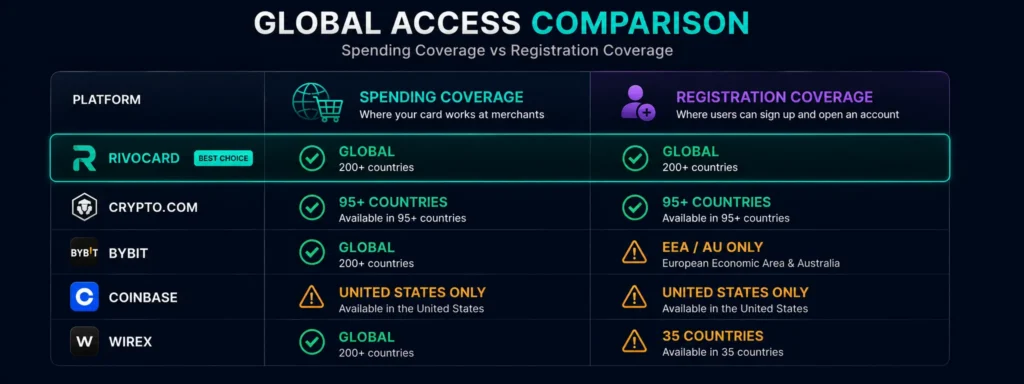
For most cards, the “200 countries supported” claim refers to Visa network spending coverage. Registration (who can sign up) is different:
| Platform | Spending countries | Registration countries |
|---|---|---|
| Rivocard | 200+ (Visa) | Global (no stated restriction at Basic KYC) |
| Crypto.com | 95+ | 95+ |
| Bybit Card | 90M+ Mastercard merchants | EEA, AU, select markets |
| Coinbase Card | US primarily | US primarily |
| Wirex | Visa/MC global | ~35 countries |
Rivocard’s global registration availability is its key advantage for users in markets underserved by other crypto card platforms.
Countries Where Rivocard Does Not Work
Registration restricted: Countries subject to comprehensive international sanctions where Rivocard cannot provide financial services:
- North Korea
- Iran
- Cuba
- Syria
- Russia (new accounts/services restricted since 2022)
- Belarus (partially restricted)
- And any other country on current OFAC, EU, or UN comprehensive sanctions lists
Spending restricted: Visa network operations are blocked in the same sanctioned countries. A Rivocard card cannot be used for any transaction at merchants in these territories.
No other restrictions: Outside sanctioned countries, no country-of-residence restrictions apply to Rivocard at the Basic KYC (email-only) tier. Users in Bangladesh, Nigeria, Vietnam, Peru, Morocco, and any other non-sanctioned country can register and use Rivocard for spending globally.
Online vs In-Person Coverage by Country
Online (anywhere): If you can access a website and the merchant accepts Visa, a Rivocard card works. Country of the buyer’s internet connection is irrelevant for online purchases — what matters is whether the merchant’s payment processor accepts international Visa cards.
In-person (via Apple Pay or Google Pay): Works wherever NFC contactless terminals accept Visa. In 2026, this covers the majority of modern merchants in developed markets and growing portions of emerging markets.
In-person (without NFC): Not applicable for Rivocard — virtual cards cannot be inserted at chip-only terminals. Apple Pay or Google Pay is the only in-person path.
FAQs
How many countries does a Rivocard work in?
A Rivocard virtual Visa card works for spending in 200+ countries and territories – anywhere the Visa network operates and merchants accept Visa. This covers 150+ million merchant locations globally. For registration (creating an account), Rivocard has no stated country-of-residence restriction at the email-only Basic KYC tier.
What does ‘150 countries supported’ mean for a crypto card?
This typically refers to the Visa or Mastercard network’s merchant acceptance coverage – the countries where you can use the card for spending. Visa’s network covers 200+ countries. The number varies by which “countries” are being counted (unique countries vs all territories). For Rivocard specifically, spending works in all Visa-accepting countries globally.
Can I use a Rivocard in Japan?
Yes. Japan has excellent Visa acceptance at major retailers, convenience stores, hotels, and tourist venues. Apple Pay is widely supported. Suica IC transit cards can be loaded via Apple Pay for seamless subway travel. Some smaller local restaurants are cash-only.
Does a Rivocard work in Asia, Africa, and Latin America?
Yes. In all three regions, Visa is accepted at commercial establishments, hotels, international retailers, and online merchants. Rural areas and local markets in developing economies may still prefer cash. Urban commercial areas and tourist destinations have strong Visa coverage.
Are there countries where a Rivocard cannot be used?
Yes. Countries subject to comprehensive international sanctions: North Korea, Iran, Cuba, Syria, Russia (new services restricted), Belarus (partially restricted). Visa network operations are legally blocked in these territories. Outside sanctioned countries, spending works globally.
Can I register for Rivocard from any country?
At the email-only Basic KYC tier, Rivocard does not state a country-of-residence restriction. Users in Southeast Asia, Africa, Latin America, the Middle East, and elsewhere can register. Sanctioned countries are excluded. Full KYC (government ID) is required for higher spending limits, and the ID must be from a country with acceptable documents.
Does a Rivocard work in China?
Online purchases from Chinese merchants: Visa is accepted for international transactions. For local spending in China: UnionPay dominates domestic payments; Visa acceptance varies by merchant. Major tourist venues, international hotels, and Western chain restaurants typically accept Visa. Local street vendors, mobile payment apps (WeChat Pay, Alipay), and smaller local merchants may not.
Is a Rivocard accepted on London Underground?
Yes. TfL (Transport for London) accepts contactless Visa cards at all Underground, Overground, Elizabeth line, DLR, and bus fare gates. Add your Rivocard to Apple Pay and tap in and out as normal.
Get Started
Your Rivocard works in 200+ countries – create your account today. Create your Rivocard account