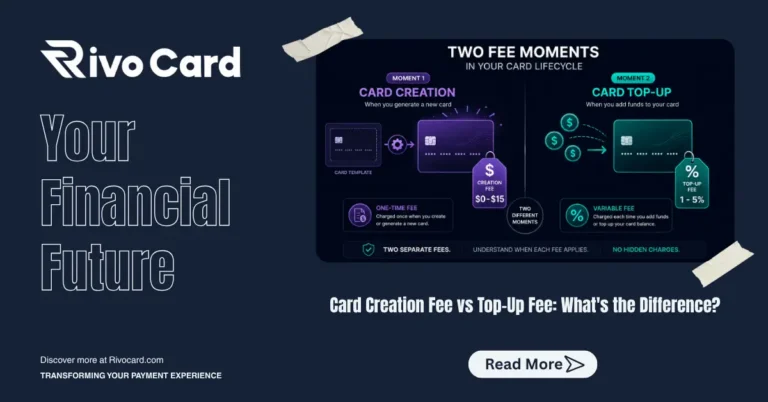
Quick answer: A card creation fee is charged when you generate a new virtual card — typically $1 to $15 per card depending on the platform. A top-up fee is charged when you add funds to that card — typically 1% to 5% of the loaded amount. These are two entirely separate fees that many platforms apply simultaneously: you pay once to create the card, then pay again on every top-up. On Rivocard, card creation is always free and unlimited. The only fee is 5% deducted when you fund a card from your wallet — no separate creation charge, regardless of how many cards you create.
Understanding the difference matters most for users who need multiple cards — digital advertisers, businesses, anyone managing several spending buckets. A $10 card creation fee on 50 cards is $500 before you have funded a single one.
What Is a Card Creation Fee?
A card creation fee is a one-time charge applied when you generate a new virtual card. The fee covers the administrative and technical cost of issuing a unique card number, expiry date, and CVV in the card platform’s system.
When it applies: At the moment the card is created — before any funds are loaded, before any purchases are made.
Industry range in 2026: $0 to $15 per virtual card. Some platforms offer the first card free and charge for additional cards. Others charge per card on all creations. During media buyer comparisons in April 2026, card creation fees ranged from $9.99 per card (standard) to free during promotional periods, with some platforms charging $10 per card as a standard rate.
Who it affects most: Users who need many cards simultaneously — digital advertisers running multiple ad accounts, businesses with multiple vendors, users who separate spending by category with dedicated cards.
Example: A digital advertiser creating 20 virtual cards to run 20 separate ad campaigns at a platform charging $10/card pays $200 in card creation fees before loading a single dollar.
What Is a Top-Up Fee?
A top-up fee (also called a loading fee or card funding fee) is charged when you add balance to a card. On platforms using a wallet model (like Rivocard), this applies when you move funds from your internal wallet balance to a specific card. On direct-load platforms, it applies when you send crypto directly to a card.
When it applies: Each time you add funds to a card — either at initial creation or when reloading an existing card.
Industry range in 2026: 0% to 5%+ of the funded amount, deducted from the loaded amount or charged on top.
On Rivocard: 5%, deducted from the funded amount. Fund a card with $100, the card receives $95.
How the Two Fees Stack — And Why It Matters
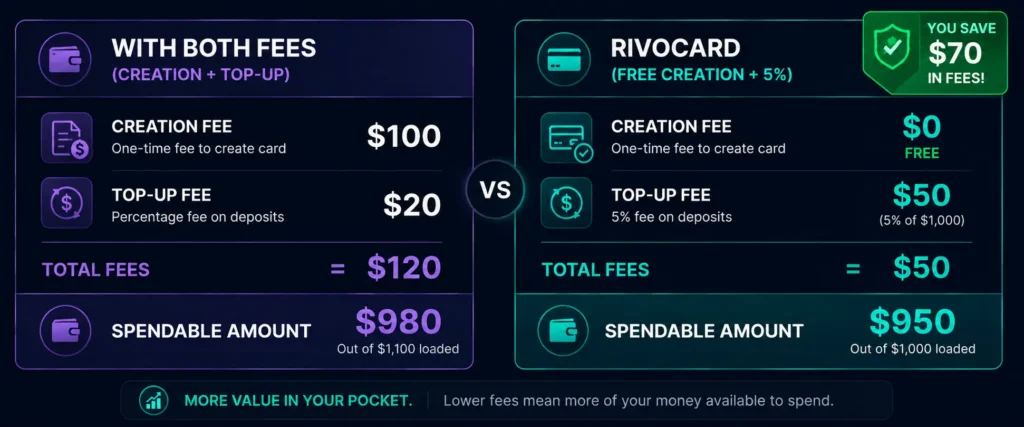
On platforms that charge both fees, you pay twice for a working card: once to create it and again to fund it.
Example scenario: Media buyer creates 10 cards, funds each with $100
| Fee type | Platform with both fees | Rivocard |
|---|---|---|
| Card creation (10 cards × $10) | $100 | $0 |
| Top-up fee (10 × $100 × 2%) | $20 | $50 (5% × $100 each) |
| Total fees paid | $120 | $50 |
| Spendable balance per card | $98 | $95 |
| Total spendable across 10 cards | $980 | $950 |
In this scenario, Rivocard costs more in total fees ($50 vs $20 in top-up fees alone), but the competitor’s card creation fees flip the total to their disadvantage ($120 vs $50 total).
The comparison changes at higher card counts. With 50 cards funded at $100 each:
| Platform with both fees (2% top-up + $10/card) | Rivocard (5% top-up, free creation) | |
|---|---|---|
| Creation fees | $500 | $0 |
| Top-up fees | $100 | $250 |
| Total fees | $600 | $250 |
At 50 cards, Rivocard’s model costs $350 less despite the higher top-up percentage — because the absence of creation fees compounds significantly at scale.
This is why the card creation fee vs top-up fee distinction matters: the headline top-up percentage does not tell you the full cost for multi-card users.
When Card Creation Fees Hurt Most
Digital advertisers and media buyers. Running ads on Google, Meta, TikTok, or other platforms often requires multiple cards — one per ad account, one per campaign, one per client. A $10 creation fee on 100 cards is $1,000 before any ad spend starts. This is a real and significant cost that platforms targeting advertisers rarely highlight in their main pricing.
Businesses managing multiple vendors. Assigning a separate virtual card to each recurring vendor (hosting, software subscriptions, team tools) is a common security and accounting practice. A $5-$10 creation fee per card makes this impractical at any scale.
Users who frequently replace cards. Creating a new card after a security compromise, for a new spending category, or after a card expires all trigger creation fees on platforms that charge them.
High-turnover card strategies. Some users create single-use or short-duration cards for specific purchases — maximizing them and closing them. Platforms with creation fees make this strategy expensive.
When the Top-Up Fee Matters More Than Creation Fee
Low card count, high volume. If you use one or two cards with large funded amounts, the top-up percentage dominates total cost. A user funding a single card with $5,000 pays $250 at 5% top-up (Rivocard) vs $50 at 1% top-up plus $10 creation fee = $60 at a competitor. Here, the lower top-up rate at the competitor costs significantly less.
Frequent reloads. Top-up fees apply on every reload, not just initial creation. A card reloaded 12 times a year at $500 each pays the top-up fee 12 times. The creation fee is only paid once (at the start).
The break-even calculation:
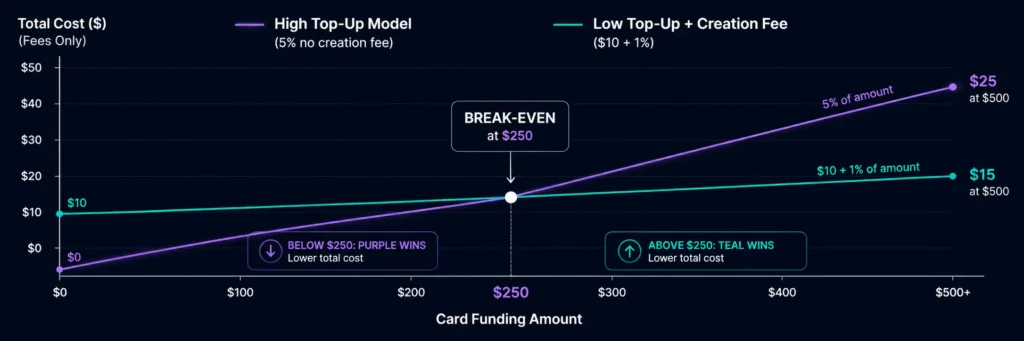
For a single card funded once:
Cost at competitor (1% top-up + $10 creation) on $X funded: = $10 + (X × 0.01)
Cost at Rivocard (5% top-up, free creation) on $X funded: = X × 0.05
Break-even point: $10 + 0.01X = 0.05X → $10 = 0.04X → X = $250
Below $250 in card funding, Rivocard’s model is cheaper (creation fee savings outweigh top-up difference). Above $250, the competitor’s lower top-up rate saves more. At exactly $250: both cost $12.50.
This break-even shifts with different fee structures, but the principle holds: card creation fees matter more for frequently-created cards with smaller balances; top-up fees matter more for larger, less frequently created cards.
The “Free Card” Marketing Pattern
Some platforms advertise “free virtual cards” — meaning no card creation fee. This is only meaningful if the rest of the fee structure is competitive. A “free card” with a 3% top-up fee, 1.5% FX fee, and $10/month subscription is not genuinely free.
On the other end, some platforms offer the first card free and charge for subsequent cards — a structure that works for users who only need one card but creates friction for multi-card users.
The complete picture always requires knowing both the card creation fee and the top-up fee together, not just one or the other.
How Rivocard Handles Both Fees
On Rivocard:
- Card creation fee: $0, always, for unlimited cards
- Top-up fee (card funding): 5%, deducted from the funded amount
- Reload fee: Same 5% on every reload
- No minimum to create a card — you can create a card with zero balance and fund it later
- No limit on card count — create 1 card or 100 cards, the creation fee is $0 either way
The 5% is higher than some competitors’ per-top-up rates. The trade-off is zero creation fee regardless of how many cards you create. For multi-card users or users who create cards frequently, this model is often more cost-efficient in total.
Comparison Table: Fee Models Across the Industry
| Fee model | Card creation | Top-up fee | Best for |
|---|---|---|---|
| Rivocard model | $0 | 5% | Multi-card users, frequent card creation |
| Low top-up, creation fee | $5-$10 | 1-2% | Single card, high funding volume |
| Subscription + low fees | $0 | 0-1% | High-volume users who justify the subscription cost |
| Exchange-linked model | $0 | 0-3% spread | Users already on that exchange |
| No-KYC with creation fee | $1-$3 | 3-5% | Privacy-focused, low usage |
There is no universally best model — the right choice depends on how many cards you create and how much you fund each one.
Practical Guide: Which Fee Matters More for You?
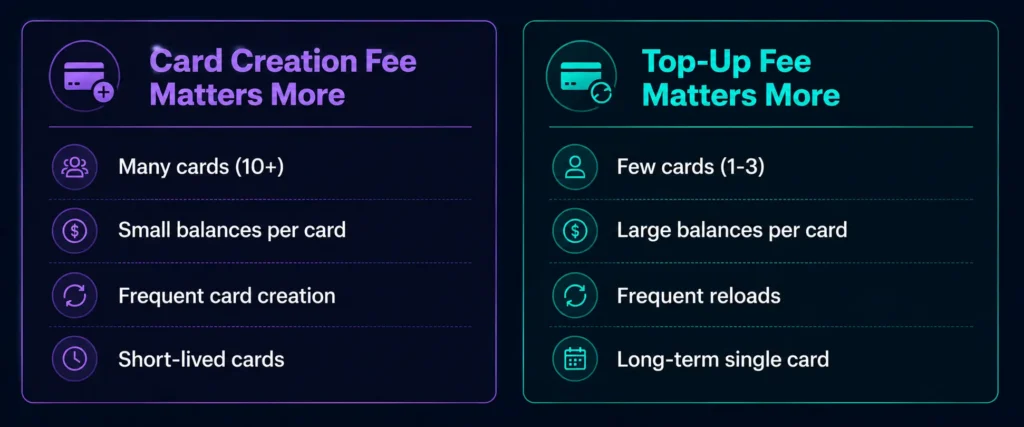
If you create many cards (10+): Card creation fee dominates. Every dollar charged per card creation multiplies by your card count. Platforms with free card creation save significantly at scale.
If you fund large amounts per card ($500+): Top-up fee dominates. Small creation fees become insignificant compared to the percentage on large loads. Lower top-up rates save more.
If you reload frequently: Top-up fee dominates. Creation fee is paid once; top-up fee is paid every reload.
If you create cards and quickly abandon them: Card creation fee dominates. Abandoned cards that are never reloaded make any creation fee pure cost with no benefit.
If you use one card for everything: Top-up fee dominates. One creation fee is a small one-time cost; all subsequent fees come from top-ups.
FAQs
What is a card creation fee on a crypto card?
A card creation fee is a one-time charge when you generate a new virtual card. It ranges from $0 to $15 per card depending on the platform. On Rivocard, card creation is always free and unlimited — no fee regardless of how many cards you create.
What is a top-up fee on a crypto card?
A top-up fee (also called a loading or funding fee) is charged when you add balance to a card. It is typically a percentage of the funded amount, ranging from 0% to 5%+ across the industry. On Rivocard, the top-up fee is 5%, deducted from the funded amount — fund a card with $100, the card receives $95.
Can a platform charge both a card creation fee and a top-up fee?
Yes. Many platforms charge both simultaneously. You pay the creation fee when generating the card, then pay the top-up fee when adding funds. These are two separate charges on the same card.
Is a card creation fee charged every time I reload a card?
No. The creation fee is a one-time charge at the moment the card is created. The top-up fee applies on every funding or reload. If you reload the same card 10 times, you pay 10 top-up fees but only 1 creation fee.
Does Rivocard charge a card creation fee?
Digital advertisers often need many cards — one per ad account, campaign, or client. At $10 per card, creating 50 cards costs $500 in creation fees alone, before any ad spend is loaded. Platforms with free card creation eliminate this cost entirely, which can represent significant savings at scale.
At what funding amount does a higher top-up fee become more expensive than a creation fee?
This depends on both fee structures. As a general example: with a $10 creation fee and 1% top-up vs 0% creation and 5% top-up, the break-even point is approximately $250 in card funding. Below $250 funded per card, the 5% model may be cheaper due to no creation fee. Above $250, the 1% model saves more.
What does “free card creation” mean on a crypto card?
It means no per-card charge is applied when you generate a new virtual card. Note: “free card creation” does not mean the top-up fee is waived — you may still pay a percentage when funding the card. Always check both fees independently.
Is it better to have a lower creation fee or a lower top-up fee?
It depends on your usage. High card count with small balances: free creation saves more. Low card count with large balances: lower top-up rate saves more. The math is specific to your situation — calculate total cost for both structures at your expected card count and funding amounts.
How do I compare total costs between card platforms?
Calculate: (number of cards × creation fee per card) + (total funded amount × top-up fee %). This gives your total fee cost. Repeat for each platform with your actual expected values, and compare the totals — not the individual percentage or creation fee in isolation.
Get Started
Want to create unlimited cards with no creation fee? See how Rivocard’s card model works →