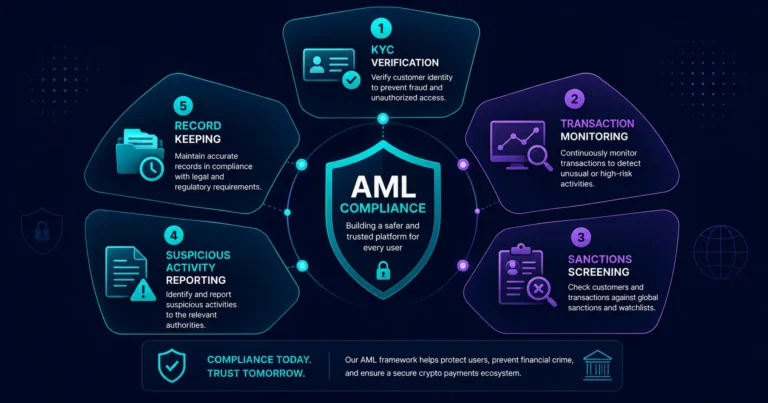
Quick answer: AML (Anti-Money Laundering) compliance on crypto prepaid cards means the card platform operates under legally mandated frameworks designed to detect, prevent, and report financial crime. For users, AML compliance translates into three visible things: KYC verification requirements tied to spending tiers, transaction monitoring that flags unusual patterns, and spending limits calibrated to risk levels. On Rivocard, AML compliance is embedded in the platform’s design — KYC tiers set spend limits appropriate to each verification level, transactions are monitored against AML red flags, and the platform operates under the regulatory frameworks of its licensing jurisdiction. For legitimate users, AML compliance is what makes Rivocard a safe, regulated platform rather than an unregulated service at risk of sudden shutdown.
What AML Compliance Actually Means
Anti-Money Laundering (AML) refers to the set of laws, regulations, and operational procedures that financial institutions must implement to prevent criminals from using legitimate financial services to conceal illegally obtained funds.
Money laundering involves three stages:
- Placement: Introducing illegally obtained funds into the financial system
- Layering: Moving funds through multiple transactions to obscure their origin
- Integration: Reintroducing cleaned funds into the legitimate economy
Crypto prepaid cards are relevant to money launderers because they convert crypto to a spendable card balance — creating a potential bridge between crypto and the traditional financial system. Regulators and financial institutions implement AML compliance measures to monitor prepaid card transactions and detect suspicious activity, since prepaid cards provide access to accounts worth thousands of dollars that can move money quickly.
AML compliance requirements are not new and are not crypto-specific — they predate cryptocurrency by decades. What is new is how AML frameworks have been extended to explicitly cover crypto-asset service providers (VASPs) and crypto prepaid card platforms.
The Global AML Framework for Crypto Cards in 2026
The global crypto industry is undergoing a profound transformation driven by the rapid evolution of AML and sanctions compliance requirements. The era of regulatory leniency is behind us.
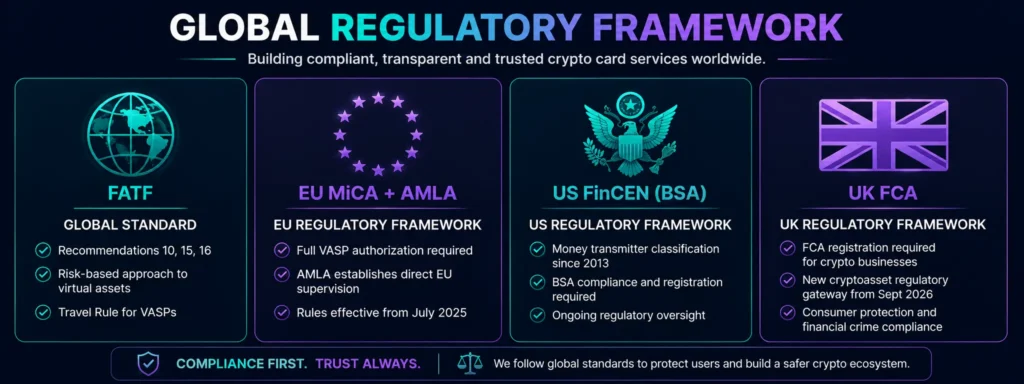
The key regulatory bodies and frameworks that govern AML compliance for crypto prepaid cards:
FATF (Financial Action Task Force) The global standard-setter. FATF Recommendations set the baseline requirements that national regulators implement. FATF Recommendation 10 requires customer identity verification. FATF Recommendation 15 explicitly extends AML obligations to virtual asset service providers (VASPs). FATF’s Recommendation 16 (the Travel Rule) requires platforms to share sender and receiver information for transfers above defined thresholds.
EU — MiCA and AMLA With the launch of its powers in July 2025, the new EU Anti-Money Laundering Authority (AMLA) made clear that firms engaging in cryptoasset activities in the EU need strong protections against money laundering and terrorist financing. MiCA (Markets in Crypto-Assets Regulation) requires all crypto-asset service providers operating in the EU to hold authorization and implement full KYC/AML programs.
US — FinCEN and BSA Crypto and digital asset platforms have been classified as money transmitters by FinCEN since 2013. Stored value and prepaid card issuers are classified as money services businesses (MSBs). Even if a platform operates under a sponsor bank’s charter, it shares compliance responsibility and is not exempt from AML obligations.
UK — FCA The Financial Conduct Authority requires all crypto businesses serving UK customers to register and maintain documented AML/KYC procedures. The FCA’s new cryptoasset authorization gateway application period runs from September 30, 2026 to February 2027 for newly defined regulated activities.
What AML Compliance Requires of Crypto Card Platforms
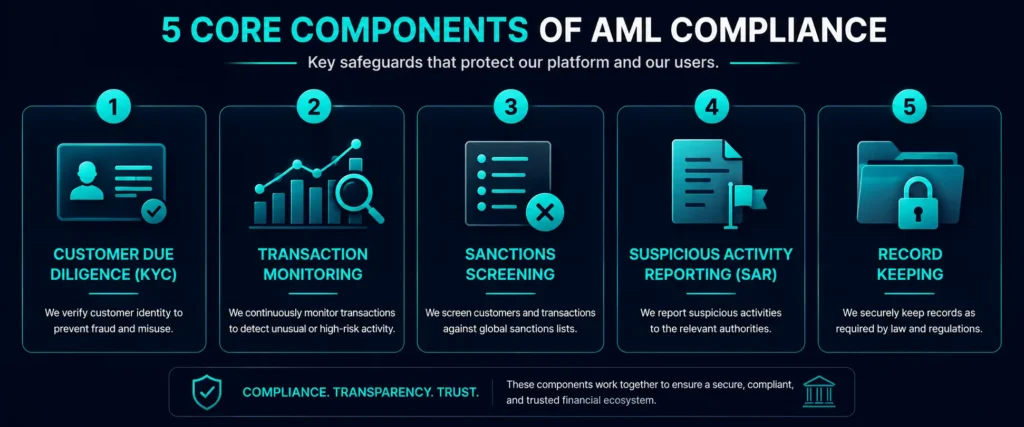
For a crypto prepaid card platform like Rivocard, AML compliance involves five operational components:
1. Customer Due Diligence (CDD) — the KYC component Verifying the identity of customers at onboarding and at defined spending thresholds. This is the visible, user-facing part of AML: the email verification at Basic KYC, the ID + selfie at Full KYC, and the additional documentation at Enhanced KYC. Each tier corresponds to a risk-appropriate due diligence level.
2. Transaction Monitoring Automated monitoring of transaction patterns against AML red flags. AML red flags include unusual or inconsistent transaction volumes given the customer’s profile, structured transactions (breaking large sums into smaller amounts to avoid detection thresholds), rapid movement of funds across multiple accounts with no economic rationale, and use of privacy-obscuring tools.
Rivocard’s transaction monitoring systems analyze purchase patterns, deposit frequency, and amounts against expected behavioral profiles. Unusual activity triggers review processes.
3. Sanctions Screening Checking users and transactions against global sanctions lists — OFAC (US), EU consolidated list, UN sanctions, and other jurisdiction-specific lists. A match against a sanctioned entity or country results in the transaction being declined and the case reviewed.
4. Suspicious Activity Reporting (SAR) When transaction monitoring identifies activity that cannot be explained by legitimate use, platforms are legally required to file Suspicious Activity Reports with the relevant financial intelligence unit. This is done confidentially — the customer is typically not informed a SAR has been filed.
5. Record Keeping Maintaining transaction records, KYC documentation, and SAR filings for regulatory-mandated periods — typically 5 years or more after account closure.
Why AML Compliance Is Good for Legitimate Users
This point is often missed: AML compliance primarily benefits legitimate users of crypto card platforms.
It protects fund safety. Platforms that operate outside AML frameworks are not just non-compliant — they are at risk of shutdown by payment networks (Visa, Mastercard), banking partners, or regulators. When unregulated “no-KYC” platforms get shut down, user funds are frequently frozen or lost. “No-KYC” crypto cards typically mean low spending caps, no consumer protection, and high shutdown risk.
It enables banking relationships. A crypto card platform must maintain relationships with banking partners and payment networks to operate. Banks will not maintain accounts for platforms without functioning AML programs. Rivocard’s AML compliance is what enables it to issue Visa cards through legitimate banking infrastructure.
It protects the card network. Visa and Mastercard’s brand and network integrity depend on fraud and money laundering not flowing through their rails. Their network rules mandate AML compliance from every card-issuing program. A platform without AML compliance cannot issue Visa cards — it is simply not possible to be an unregulated issuer of Visa prepaid cards.
It keeps the platform operating. AML crypto compliance has evolved from a regulatory formality into a gatekeeper: it decides who gains market access, who secures institutional backing, and who avoids regulatory takedown. A compliant platform is a stable platform.
What AML Compliance Means for Your Rivocard Account
For a normal user making legitimate purchases, AML compliance is largely invisible — it runs in the background without affecting the user experience. Here is how it manifests:
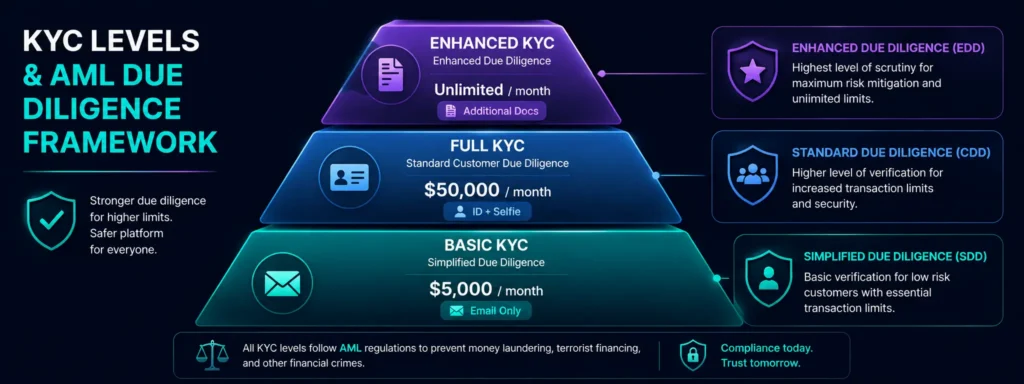
Spending limits by KYC tier The tiered spending limits ($5K/month at Basic KYC, $50K/month at Full KYC, unlimited at Enhanced KYC) are calibrated to AML risk levels. Simplified Due Diligence (SDD) applies at the lowest tier — low spend limits mean low risk, so email verification is sufficient. As limits increase, the risk profile increases and more rigorous Customer Due Diligence (CDD) is required.
Transaction declines for sanctions matches If a transaction involves a sanctioned merchant, country, or counterparty, it will be declined. For legitimate users making normal purchases, this is unlikely to affect them. Sanctions lists primarily cover designated entities, countries under comprehensive sanctions (like North Korea and Iran), and specific high-risk individuals.
Requests for additional documentation In rare cases, a platform may request additional information about the source of funds or the purpose of a large transaction. This is Enhanced Due Diligence (EDD) triggered by risk-based monitoring. For legitimate users, providing this documentation is straightforward.
Account review or temporary holds If a transaction pattern triggers monitoring systems — for example, rapid large deposits followed by immediate card funding and high-value spending — an account may be temporarily flagged for review. For users with legitimate activity, these reviews typically resolve quickly.
AML Red Flags: What Triggers Monitoring
AML/CFT laws identify specific red flag indicators to stop suspicious transactions. These include: clients buying many prepaid cards or making a bulk of transactions, a single person holding multiple prepaid accounts, frequent loading of the card by a third party, loading funds more than the threshold, transferring funds soon after loading, and abnormal purchasing power and pattern.
For legitimate Rivocard users, understanding these red flags helps contextualize why certain behaviors might trigger additional verification:
| Behavior | AML concern | For legitimate users |
|---|---|---|
| Many small deposits in quick succession | Structuring (breaking amounts to avoid thresholds) | Batch deposits reduce network fees — but very rapid micro-deposits may trigger review |
| Large deposits immediately followed by card funding and full spending | Layering | Normal if explained by legitimate use case (ad spend, travel) |
| Multiple accounts at same platform | Multiple accounts to exceed limits | Rivocard permits one account per user |
| Deposits from multiple sources to one account | Complex fund aggregation | Normal for crypto holders with multiple wallets |
Most legitimate user behaviors do not intersect with these red flags. The flags are designed to catch patterns that make no economic sense for normal spending — not to catch regular users who deposit and spend in predictable ways.
The FATF Travel Rule and What It Means for Deposits
The FATF Travel Rule (Recommendation 16) requires crypto platforms to share information about senders and recipients of crypto transfers above defined thresholds. In the EU, the threshold is €0 (all transactions). In the US, the threshold is $3,000.
What this means when you deposit to Rivocard: When you send crypto from an exchange to your Rivocard wallet, the sending exchange may be required to share your identity information with Rivocard as the receiving VASP. This is a platform-to-platform data sharing requirement — it does not affect how you make the deposit or how quickly it arrives.
For users sending from self-hosted wallets (hardware wallets, software wallets), the Travel Rule applies differently — platforms may request information about the source wallet to verify it is self-custodied rather than a third-party exchange.
FAQs
What is AML compliance on a crypto prepaid card?
AML (Anti-Money Laundering) compliance on a crypto prepaid card means the platform operates under legally mandated frameworks to prevent financial crime. For users, it means KYC verification requirements, spending limits calibrated to risk levels, transaction monitoring, and sanctions screening. Rivocard operates under AML compliance frameworks applicable to its licensing jurisdiction.
Why do crypto cards have spending limits at all?
Spending limits are directly tied to AML compliance. Regulators permit simplified due diligence (minimal KYC) for low-value accounts, and require enhanced due diligence as spending volumes increase. Rivocard’s tiered limits — $5,000/month at Basic KYC, $50,000/month at Full KYC — reflect the AML risk threshold at each verification level.
What is transaction monitoring on a crypto card?
Transaction monitoring is automated analysis of account activity against AML red flags — unusual volumes, structuring patterns, rapid fund movement, and spending inconsistent with the user’s profile. It runs in the background and is invisible to legitimate users making normal purchases.
Can my Rivocard account be flagged for AML review?
Yes, if transaction patterns trigger monitoring systems — such as very rapid large deposits followed by immediate full spend. For legitimate users, providing context or documentation when asked typically resolves reviews quickly. Accounts used for normal spending at predictable volumes are unlikely to be flagged.
What is the FATF Travel Rule and does it affect my deposits?
The FATF Travel Rule requires crypto platforms to share sender/receiver information for transfers above certain thresholds (€0 in the EU, $3,000 in the US). When depositing from an exchange, the exchange may share your identity information with Rivocard. This is platform-to-platform data sharing and does not affect your deposit process or timing.
Is Rivocard’s AML compliance why my card limits are what they are?
Yes. The $500 per-transaction and $5,000 monthly limits at Basic KYC correspond to the AML risk threshold for simplified due diligence (email-only verification). Full KYC raises limits by 10x because full identity verification reduces the AML risk profile. Enhanced KYC unlocks unlimited monthly spending because comprehensive due diligence has been completed.
What happens to my account if a transaction matches a sanctions list?
The specific transaction is declined. The case is reviewed by Rivocard’s compliance team. For most legitimate users, this scenario does not arise — sanctions lists primarily cover designated entities, countries under comprehensive sanctions, and specific high-risk individuals. If a decline occurs and you believe it is an error, contact Rivocard support.
What are AML red flags on prepaid cards?
Common AML red flags include: structured deposits (many small amounts to stay below thresholds), rapid loading followed by immediate full spending, loading by third parties rather than the account holder, and spending patterns inconsistent with the user’s known profile. These patterns indicate potential money laundering — they are designed to catch illegal activity, not normal user behavior.
Does Rivocard report suspicious activity to authorities?
Like all regulated financial institutions, Rivocard is legally required to file Suspicious Activity Reports (SARs) when transaction monitoring identifies activity that cannot be explained by legitimate use. SARs are filed confidentially with the relevant financial intelligence unit. The customer is typically not informed a SAR has been filed.
Why is AML compliance good for me as a Rivocard user?
AML compliance means Rivocard operates within a regulated framework — maintaining banking relationships, Visa network access, and fund protection. Platforms without functioning AML programs are at high risk of sudden shutdown, banking partner termination, or card network revocation — which freezes user funds. Rivocard’s compliance is what makes it a stable, long-term platform.
Get Started
Rivocard is built on a compliant, regulated foundation — start spending with email verification only. Create your account →