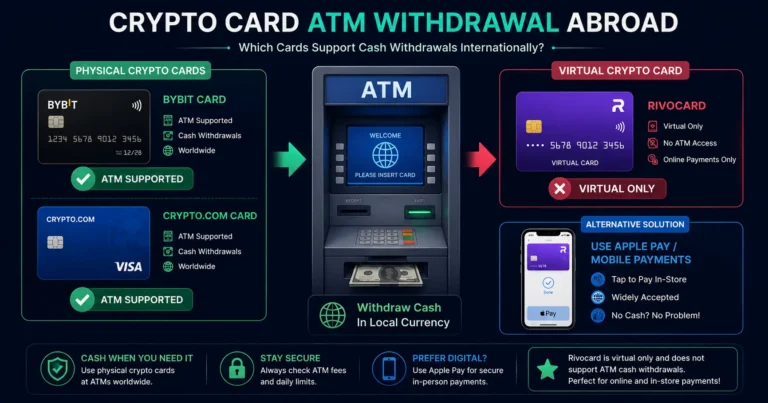
Quick answer: Whether you can withdraw cash at an international ATM depends entirely on which crypto card you have. Cards issued as physical cards (Bybit Card, Crypto.com Visa, Nexo, Wirex) support ATM withdrawals — typically free up to a monthly limit, then a fee applies. Virtual-only cards like Rivocard do not support ATM withdrawals — ATMs require a physical card with a chip or magnetic stripe. If you use Rivocard as your primary crypto card and need cash abroad, the solution is to maintain a separate physical bank card specifically for ATM access. This guide explains how ATM withdrawals work on crypto cards that support them, what the fees look like, and the best strategy for Rivocard users who need cash during travel.
Which Crypto Cards Support ATM Withdrawals Abroad
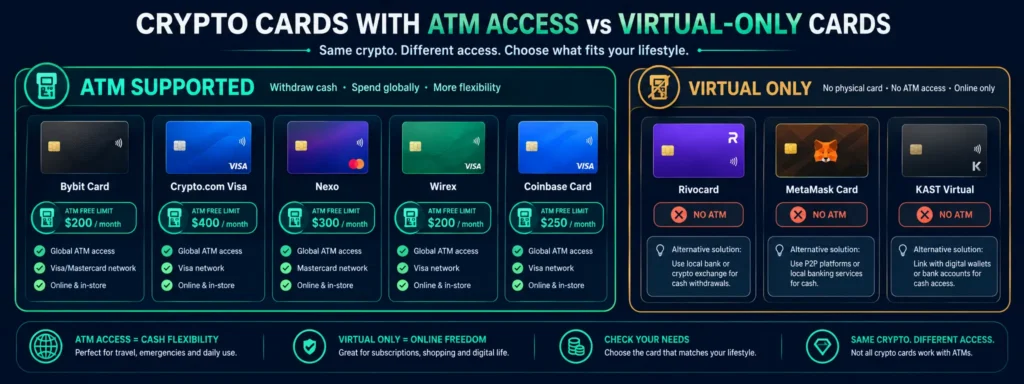
Cards that support international ATM withdrawals:
| Card | ATM free monthly limit | Fee above limit | Network | Coverage |
|---|---|---|---|---|
| Bybit Card | ~200 EUR/month free | 2% above limit | Mastercard | EEA, AU, select markets |
| Crypto.com Visa | $200-$1,000/month (tier-dependent) | 2% above limit | Visa | 95+ countries |
| Nexo Card | Varies by tier | Varies | Mastercard | EEA, UK, select US |
| Wirex | Varies by plan | Varies | Visa/Mastercard | UK, select APAC |
| Coinbase Card | Varies | Network fee | Visa | US primarily |
Cards that do NOT support ATM withdrawals:
| Card | Reason |
|---|---|
| Rivocard | Virtual-only card — no physical chip or magnetic stripe |
| MetaMask Card | Virtual-only |
| KAST (virtual) | Virtual-only tier |
How ATM Withdrawals Work on Physical Crypto Cards
When a physical crypto card is used at an international ATM, the process works as follows:
Step 1: Insert the physical card or tap (some ATMs support contactless withdrawal) Step 2: Enter your PIN (set when the card was activated) Step 3: Select the withdrawal amount in local currency Step 4: The card network (Visa or Mastercard) converts the local currency amount to the card’s settlement currency at the interbank rate Step 5: The converted amount is deducted from your card balance Step 6: Cash is dispensed
Currency conversion at ATMs: The same principle applies as for purchases — always choose to withdraw in local currency when offered a choice. Accepting “withdrawal in your home currency” activates DCC (Dynamic Currency Conversion), where the ATM operator applies their own exchange rate (typically 3-8% worse). Choose local currency for ATM withdrawals exactly as you would for in-person purchases.
Two fees may apply:
- Your card issuer’s ATM fee (typically 0% within monthly free limit, 2% above limit)
- The ATM operator’s own fee ($2-$5 per withdrawal, set by the ATM owner and displayed before you confirm)
Minimizing ATM fees:
- Withdraw larger amounts less frequently (the operator fee is per-withdrawal, not per-dollar)
- Use ATMs attached to major banks rather than standalone ATMs in tourist areas (tourist-area ATMs have higher operator fees)
- Stay within your card’s monthly free ATM limit
Bybit Card: ATM Withdrawal Details
For EEA and Australian users with a Bybit Card:
Free monthly limit: Approximately 200 EUR equivalent per month at Standard tier Fee above limit: 2% of the withdrawal amount Daily limit: Varies by account tier International ATM acceptance: Any ATM on the Mastercard network globally
How Bybit card ATM withdrawal works: Your Bybit Card is linked to your Bybit exchange balance. When you withdraw cash, the card converts the appropriate amount from your balance at the point of withdrawal. Currency conversion uses the Mastercard network rate.
Practical for EEA/AU nomads: The 200 EUR/month free ATM limit covers typical cash needs for destinations where some cash is necessary. Above this, the 2% fee is lower than most hotel lobby cash exchanges.
Crypto.com Visa: ATM Withdrawal Details
For users with a Crypto.com Visa card:
Free monthly ATM limit by tier:
- Basic (free tier): $200/month
- Ruby: $400/month
- Jade/Indigo: $800/month
- Royal Indigo/Jade: $800/month
- Icy White: $1,000/month
Fee above limit: 2% of excess amount Network: Visa — works at any Visa ATM globally
How Crypto.com card ATM withdrawal works: The card draws from your Crypto.com balance and converts to local currency at Visa’s rate. The ATM withdrawal process is standard — insert card, enter PIN, select amount.
How Rivocard Users Access Cash Abroad
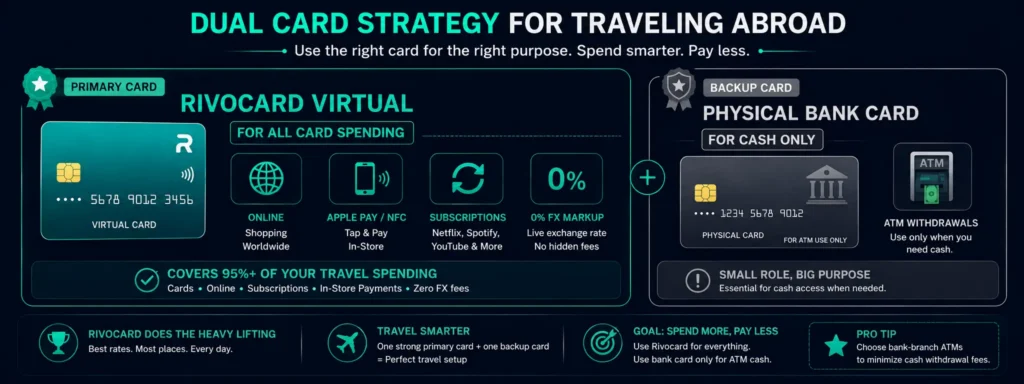
Rivocard virtual cards cannot be used at ATMs. This is the primary limitation of the virtual-only model for travel. The practical solutions:
Solution 1: Maintain a Physical Bank Debit Card for ATM Access
The simplest approach: keep one physical bank debit card from your home country specifically for ATM access during travel.
Best physical cards for ATM withdrawals abroad:
- Charles Schwab (US): Refunds all ATM fees globally — no foreign transaction fee, no ATM operator fee reimbursed. Best US option for travelers.
- Starling Bank (UK): 0% overseas ATM withdrawals. Strong UK option.
- Wise debit card: Competitive ATM withdrawal rates with good global coverage.
- N26 (EU): 0% ATM withdrawals in EUR area; standard fees in other currencies.
The dual-card approach for Rivocard users:
- Rivocard: all card-based spending (online, contactless via Apple Pay, subscriptions) at 0% FX
- Physical bank card: ATM withdrawals only when cash is needed
This combination covers essentially 100% of travel payment scenarios.
Solution 2: Use P2P Crypto Cash Services
In some cities and countries, P2P (peer-to-peer) crypto exchange services allow you to exchange crypto for local cash directly from another person. Platforms like LocalBitcoins (though its availability varies) or in-person crypto meetups enable this.
This is less reliable and more variable than ATM access — it depends on finding a counterparty in your current location. Not a primary cash solution for most travelers.
Solution 3: Merchants With Cash Back at Point of Sale
Some countries (particularly the UK and US) offer cash back at point of sale — you pay with your card at a grocery store or pharmacy and request up to $50-$100 back in cash, which the merchant adds to your card transaction.
This works with Rivocard via Apple Pay or Google Pay at participating merchants. In the UK, most major supermarkets (Tesco, Sainsbury’s, ASDA) offer this. Effectively converts a card transaction into cash access without an ATM.
Solution 4: Plan Around Cash-Free Spending
In many 2026 destinations, cash is increasingly optional:
- Most urban restaurants, cafes, and shops accept contactless
- Transit systems accept Apple Pay or Google Pay
- Accommodation typically billable by card
Plan itineraries in destinations where contactless payment is well-developed (Singapore, UK, Australia, Scandinavia, major EU cities) and cash needs are genuinely minimal. Save the physical bank card for truly cash-necessary situations rather than daily use.
ATM Fees: What You Actually Pay
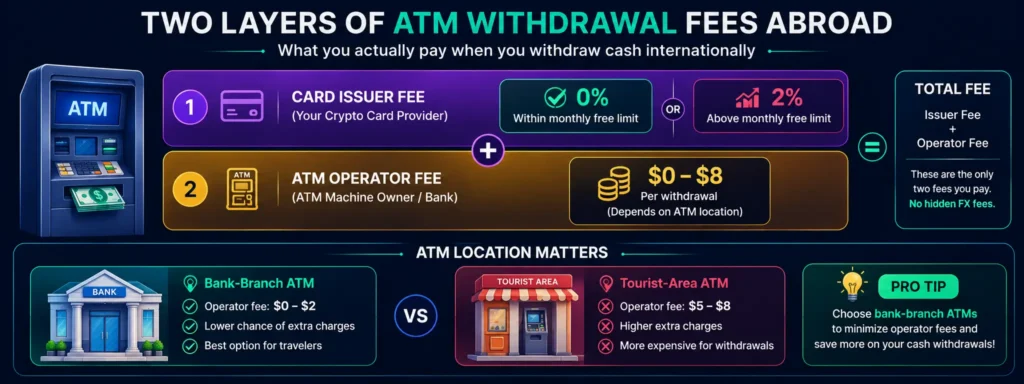
When using any card at an international ATM, expect two layers of fees:
Layer 1: Card issuer fee Set by your card provider. For crypto cards with ATM access: typically 0% within monthly free limit, 2% above. For traditional bank cards: 1-3% or flat fee per withdrawal. Some premium cards: 0% with no limit.
Layer 2: ATM operator fee Set by the ATM machine’s owner, displayed before you confirm the withdrawal. Ranges from $0 at bank-owned ATMs to $5-$8 at tourist-area or airport standalone ATMs. You can decline and walk to a different ATM.
The combined cost example: Withdraw $200 at a Thai ATM:
- Bybit Card fee (within monthly limit): $0
- ATM operator fee (typical Bangkok ATM): approximately $6 (220 THB at current rates)
- Total additional cost: $6 (3% of $200)
- Compared to: airport bureau de change fee for $200 cash: approximately $10-$20 (5-10% spread)
ATM withdrawal remains cheaper than cash exchange in most scenarios, even accounting for operator fees.
The Practical Cash Strategy for International Travel
For users with physical crypto cards (Bybit, Crypto.com):
- Use the card’s free monthly ATM allowance first
- Withdraw larger amounts less frequently to minimize per-withdrawal operator fees
- Go to bank-branch ATMs rather than tourist-area standalone ATMs
- Always choose local currency when withdrawing
For Rivocard users (virtual-only):
- Carry one physical bank card for ATM access
- Use Rivocard for all card-based spending (the majority of transactions)
- Reserve ATM use for situations where cash is genuinely necessary
- Withdraw sufficient cash for expected cash needs in one visit rather than multiple small withdrawals
For all travelers:
- Research cash usage at your specific destinations before departing
- Japan, Morocco, rural Southeast Asia, and some Latin American destinations still rely heavily on cash
- Singapore, UK, Scandinavia, Australia, and most major EU cities are largely contactless-sufficient
- Budget a small cash reserve (50-100 USD equivalent) for genuine emergencies
FAQs
Can I withdraw cash from an ATM with a Rivocard?
No. Rivocard issues virtual cards only – these have no physical chip or magnetic stripe, which ATMs require. For ATM cash access while using Rivocard as your primary crypto card, maintain a separate physical bank card specifically for ATM withdrawals.
Which crypto cards support ATM withdrawals abroad?
Physical crypto cards support ATM withdrawals. Major options: Bybit Card (EEA/AU, ~200 EUR/month free, then 2%), Crypto.com Visa ($200-$1,000/month free by tier), Nexo Card (EEA/UK, varies by tier), Wirex (UK/select APAC). Virtual-only cards (Rivocard, MetaMask Card) do not support ATM withdrawals.
How much does an ATM withdrawal cost with a crypto card abroad?
Two fees apply: (1) your card issuer’s ATM fee (typically 0% within monthly free limit, 2% above for most crypto cards), and (2) the ATM operator’s own fee ($0-$8 per withdrawal, displayed before you confirm). You can decline and find a cheaper ATM if the operator fee is high.
How should Rivocard users access cash internationally?
Maintain a separate physical bank card for ATM access during travel. Recommended: Charles Schwab (US) refunds all ATM fees globally; Starling Bank (UK) offers 0% overseas ATM withdrawals; Wise debit card has good global ATM coverage. Use Rivocard for all card-based spending and the physical card only for ATM access.
What is the DCC risk at international ATMs?
DCC (Dynamic Currency Conversion) occurs when an ATM offers to dispense cash in your home currency rather than local currency and applies its own exchange rate. Always choose local currency. The local currency option uses the Visa or Mastercard interbank rate – significantly better than the ATM operator’s DCC rate (typically 3-8% worse).
How do I minimize ATM fees when traveling?
Use bank-branch ATMs rather than tourist-area standalone ATMs (lower operator fees). Withdraw larger amounts less frequently (operator fee is per-withdrawal, not per-dollar). Stay within your card’s free monthly ATM limit. Choose local currency to avoid DCC. Use contactless card payment wherever accepted to reduce ATM visits.
What is the monthly free ATM limit on Bybit Card?
Approximately 200 EUR equivalent per month on the Standard (free) tier. Above this, a 2% fee applies. Higher VIP tiers may have increased limits – check current Bybit Card terms for your tier.
How does currency conversion work when withdrawing from an international ATM?
Your card’s settlement currency (typically USD or EUR) is converted to local currency at the Visa or Mastercard interbank rate when you withdraw. No spread is added by Rivocard (for purchases) or by most card issuers beyond disclosed fees. The ATM operator does not influence the exchange rate if you choose local currency.
Is cash back at point of sale an option for Rivocard users?
Yes, in countries where this service is offered (primarily UK and US). At participating supermarkets and pharmacies, you can pay for a small purchase via Apple Pay (Rivocard) and receive up to $50-$100 back in cash, which is added to your card transaction. In the UK, this is widely available at Tesco, Sainsbury’s, and ASDA.
Should I get a crypto card with ATM access or just use a bank card?
If you need frequent cash access during travel, a physical crypto card with a generous ATM allowance (Bybit for EEA/AU, Crypto.com for broader coverage) handles this within a single card. If your cash needs are minimal, a Rivocard paired with a physical bank card (kept specifically for ATM use) achieves the same result with potentially lower overall fees.
Get Started
Rivocard handles all card-based international spending at 0% FX – pair it with a physical card for ATM access. Create your Rivocard account