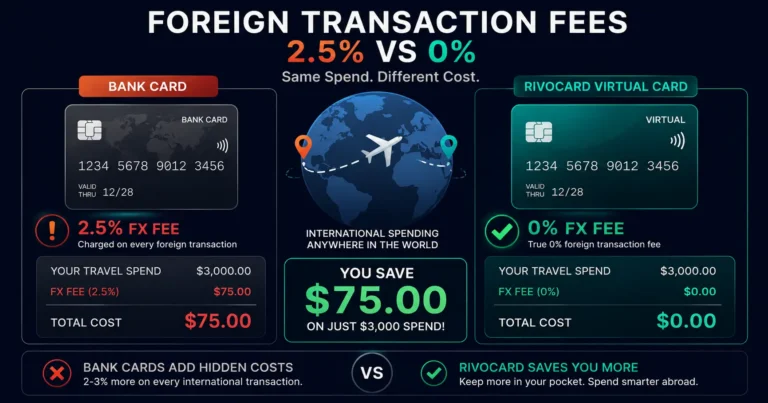
Quick answer: A foreign transaction fee (also called an FX fee or international transaction fee) is a surcharge applied by card issuers when you make a purchase in a foreign currency or from a merchant based in another country. Traditional bank cards typically charge 1.5-3% per international transaction. Rivocard charges 0% on all international transactions — every purchase in every foreign currency carries no additional fee beyond the standard Visa network rate. < cite index=”35-1″>Use a standard bank card abroad and you pay up to 3% on every transaction. On $5,000 of international spending, that is $150 in fees charged solely for the privilege of paying in a foreign currency. This guide explains exactly how foreign transaction fees work, how Rivocard’s 0% applies, and the hidden costs to watch for even on cards that claim “no FX fee.”
What Is a Foreign Transaction Fee?
A foreign transaction fee is a surcharge applied at the card issuer level when a purchase is processed in a currency other than the card’s settlement currency, or when a transaction crosses international borders.
The fee applies in these situations:
- Buying something from an international online store (even if the merchant charges in USD)
- Using a card in a foreign country at any merchant
- Subscribing to an international service that bills in a foreign currency (e.g., a UK service billing in GBP)
- Any transaction where the merchant’s bank is in a different country than the card issuer
Where the fee comes from: Traditional card issuers (banks) charge FX fees because processing cross-border transactions involves additional currency settlement costs. The fee covers the issuer’s cost to participate in international currency exchange networks and historically included a profit margin on top of actual costs.
Why it still exists: Despite interchange networks making cross-currency settlement increasingly cheap, many banks still charge FX fees as a significant revenue source. For travelers who spend $5,000 internationally, a 2.5% FX fee represents $125 in pure fee revenue for the bank — with minimal corresponding cost to justify it.
How Rivocard’s 0% Foreign Transaction Fee Works
Rivocard charges 0% on all international transactions. This means:
When you use your Rivocard virtual Visa card at an international merchant — whether online or via Apple Pay in person — the Visa network converts the local currency amount to dollars at the current interbank exchange rate. Rivocard applies no additional markup or surcharge on top of that conversion.
The Visa interbank rate: Visa’s network uses the wholesale interbank exchange rate — the rate at which banks trade currencies with each other. This rate is typically better than (or very close to) the mid-market rate you see on Google. It is not the rate bureaux de change or airport kiosks use — those typically add 3-10% spreads.
The Rivocard chain of events for an international purchase:
- You tap your phone (Apple Pay/Rivocard) at a merchant in Japan. The purchase is 5,000 JPY.
- The Visa network converts 5,000 JPY to USD at the current interbank rate (say, $33.33 at today’s rate)
- Rivocard charges your card balance $33.33
- No additional fee applied by Rivocard on top of this
The merchant receives their yen. You pay the accurate dollar equivalent at the interbank rate with no surcharge.
Comparing Foreign Transaction Fees Across Card Types
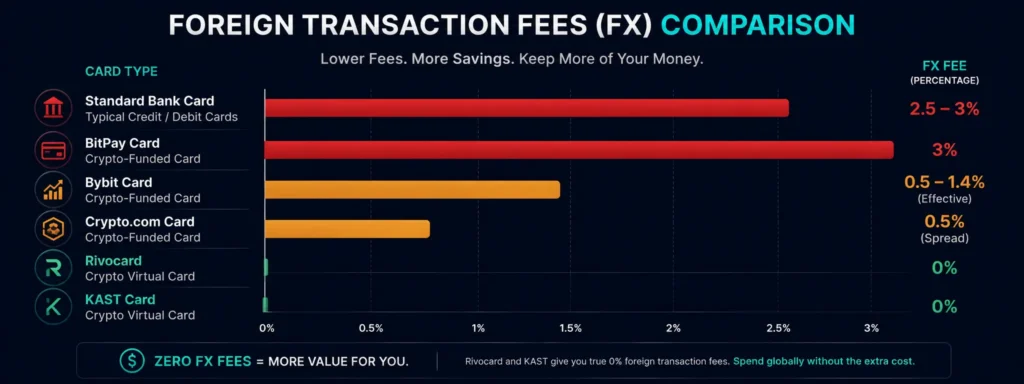
| Card type | Typical FX fee | On $5,000 international spend |
|---|---|---|
| Standard bank debit card | 2.5-3% | $125-$150 |
| Premium travel credit card (no FX) | 0% | $0 |
| Crypto.com Visa | 0% + ~0.5% spread | ~$25 |
| Bybit Card (EEA) | 0.5% card-level + 0.9% spread | ~$70 |
| Rivocard | 0% | $0 |
| BitPay | 3% | $150 |
| KAST | 0% | $0 |
Note: “FX fee” and “conversion spread” are different things — see the section below on hidden costs.
The Real Dollar Savings: Examples
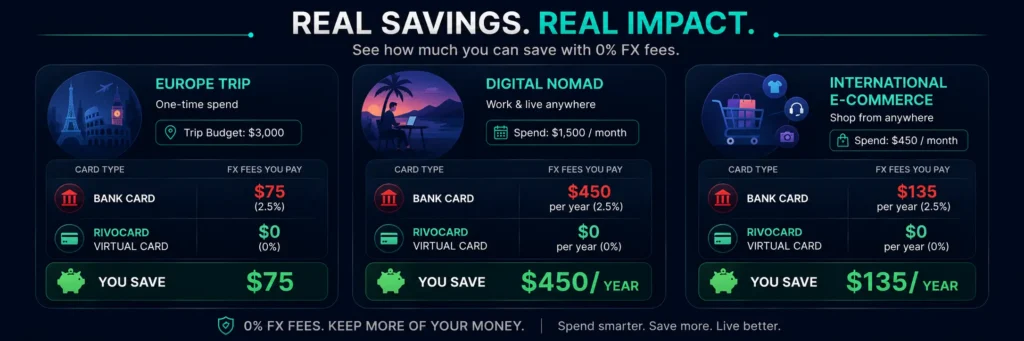
Example 1: Two-week European trip, $3,000 in spending
- Standard bank card at 2.5% FX: $75 in fees
- Rivocard at 0% FX: $0 in fees
- Saving: $75
Example 2: Digital nomad with $1,500/month in international tool subscriptions
- Adobe (US-billed to EU bank): $1.38/month in FX fees at 2.5%
- Google Workspace (US-billed): $0.45/month
- Various SaaS tools: $4.17/month in aggregate
- Total monthly FX fees on $1,500 of subscriptions: $37.50
- Annual FX fees at 2.5%: $450
- Rivocard at 0% FX: $0 annually
Example 3: E-commerce buyer purchasing from international retailers
- $200/month from ASOS (UK-based, GBP billing): $5.00 in FX fees at 2.5%
- $150/month from a European marketplace: $3.75 in FX fees
- $100/month from Asian platforms: $2.50 in FX fees
- Total monthly: $11.25 | Annual: $135
- Rivocard: $0
The Hidden Costs: When ‘0% FX’ Is Not Truly Free
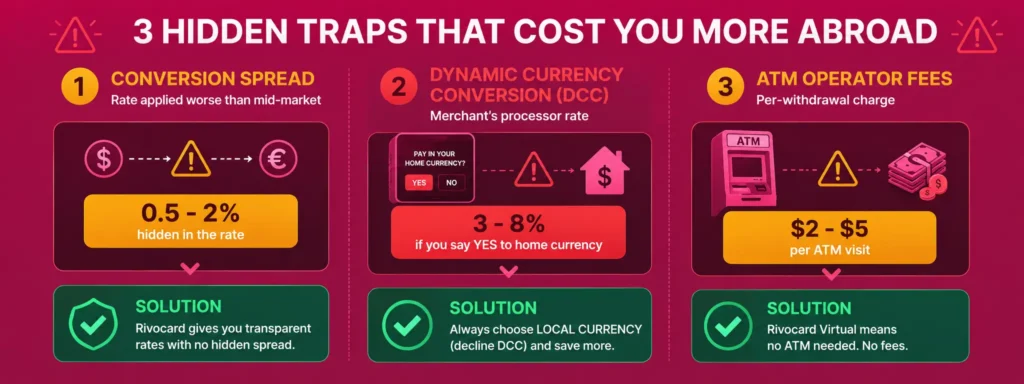
Some cards advertise “0% foreign transaction fee” while still applying costs to international transactions through other mechanisms. Understanding these is essential to comparing cards accurately.
Conversion Spread
A conversion spread is the difference between the mid-market exchange rate and the rate applied to your transaction. If the market rate is USD/EUR 1.0850 but your card converts at 1.0790, the 0.006 difference (approximately 0.55%) is a hidden cost that never appears as a labeled fee.
Which cards apply conversion spreads:
- Crypto.com Visa: ~0.5% spread on crypto-to-fiat conversion
- Bybit Card: 0.9% conversion fee (this one is disclosed, but it is functionally a spread)
- Some crypto exchange-linked cards embed spreads in their stated conversion
Rivocard: No conversion spread. Crypto deposits convert at the live market rate with no Rivocard markup. Card spending uses the Visa network interbank rate with no additional markup.
Dynamic Currency Conversion (DCC)
DCC is the single most common way travelers inadvertently pay more despite using a “0% FX” card. It occurs when:
- An in-person terminal shows you a purchase in your home currency (“$45.67 USD” at a Japanese restaurant) rather than local currency (5,987 JPY)
- An ATM offers “withdrawal in your home currency”
When you accept DCC, the merchant’s payment processor applies their own exchange rate — typically 3-8% worse than the card network’s rate. Your card’s 0% FX fee is irrelevant because you have already paid a worse rate before your card even sees the transaction.
The DCC rule: Always pay in local currency. Always. Without exception.
If a terminal shows you prices in your home currency, decline and ask for local currency. If an ATM offers your home currency, decline. The slight inconvenience of doing mental math is worth the 3-8% savings every time.
ATM Operator Fees
When withdrawing cash at international ATMs, two fees may apply beyond the card issuer’s fee:
- The ATM operator’s own withdrawal fee (often $2-$5 per withdrawal, set by the ATM owner)
- The card issuer’s ATM fee if you exceed free monthly limits
Rivocard virtual cards cannot use ATMs — this fee category does not apply to Rivocard users (ATM access requires a physical card).
For cards with ATM access (Bybit, Crypto.com), minimizing ATM visits and withdrawing larger amounts each time reduces the per-dollar cost of these fees.
The Real Cost of Rivocard for International Spending
Rivocard’s 0% FX fee is genuine — no spread, no surcharge on international transactions. But Rivocard does have one cost that applies to all spending: the 5% card funding fee when moving wallet balance to a virtual card.
Total cost calculation for international spending:
For $1,000 in international purchases:
- Load $1,052.63 from wallet to card (5% fee = $52.63, card has $1,000)
- Spend $1,000 on international purchases: 0% FX fee, $0 surcharge
- Total additional cost: $52.63 (5.26% of the $1,000 in spending)
Compare to standard bank card at 2.5% FX:
- Same $1,000 in international purchases: $25 in FX fees
- No funding fee (bank card funded directly from bank account)
- Total additional cost: $25
The honest comparison: For pure international spending, a traditional “no annual fee” bank card with 2.5% FX costs less per dollar than Rivocard’s 5% funding fee. Rivocard’s 0% FX advantage matters most when:
- You are already holding USDT or other crypto and the 5% is your conversion-to-spending cost regardless
- You benefit from Rivocard’s other advantages (no bank account needed, global access, unlimited virtual cards)
- You make large infrequent loads rather than many small ones (the 5% is a one-time load cost, not a per-transaction cost)
When to Use a Rivocard for International Spending
Best fit:
- You hold USDT or crypto and want to spend it abroad — the 5% is your conversion cost, and 0% FX means no additional surcharge at the spending step
- You are buying international online subscriptions and digital services where no travel credit card is easy to use
- You are outside traditional travel card coverage areas and need a globally accessible card
- You want to spend via Apple Pay in countries that accept contactless (avoiding the need to have a physical card present)
Less optimal:
- You already have a traditional 0% FX credit card (like Starling Bank UK, Charles Schwab US, or Wise) — these provide 0% FX without the 5% crypto conversion cost
- You need frequent ATM cash access (virtual card cannot serve this)
Checking the Visa FX Rate
Visa publishes its current exchange rates at visa.com/en_US/support/consumer/travel-support/exchange-rate-calculator.html
You can check the exact rate that will apply to a specific transaction before you make it. This lets you compare the Visa rate to cash exchange rates or other card rates for a specific destination.
FAQs
What is a foreign transaction fee on a crypto card?
A foreign transaction fee is a surcharge applied when you make a purchase in a foreign currency or from an international merchant. Traditional bank cards charge 1.5-3%. Rivocard charges 0% – no additional fee is applied on top of the Visa network’s interbank exchange rate for any international purchase.
What is the difference between an FX fee and a conversion spread?
An FX fee is a labeled surcharge (e.g., “2.5% foreign transaction fee”). A conversion spread is the difference between the mid-market exchange rate and the rate actually applied – it is a hidden cost that never appears as a labeled fee. Rivocard applies neither. Some cards that advertise “0% FX fee” still apply conversion spreads of 0.5-2%.
What is Dynamic Currency Conversion and why should I avoid it?
DCC is when a merchant terminal or ATM offers to charge you in your home currency instead of local currency. The merchant’s processor applies their own exchange rate, often 3-8% worse than the Visa network rate. Accepting DCC makes your card’s 0% FX fee irrelevant – you have already paid an unfavorable rate. Always choose local currency.
How much do I save using a Rivocard vs a standard bank card for international spending?
On $3,000 of travel spending, a 2.5% FX card costs $75 in fees. Rivocard costs $0 in FX fees. Annual savings on $1,500/month in international subscriptions at 2.5% FX: $450. The savings scale with your international spending volume.
Is the Visa interbank rate a good exchange rate?
Yes. The Visa interbank rate is close to the mid-market rate – the rate banks use to trade currencies with each other. It is typically better than airport bureau de change rates (which add 5-10%), better than many bank branch rates, and comparable to or better than most specialist travel money services.
Get Started
Spend internationally with 0% foreign transaction fees – fund with crypto, spend anywhere Visa is accepted. Create your Rivocard account