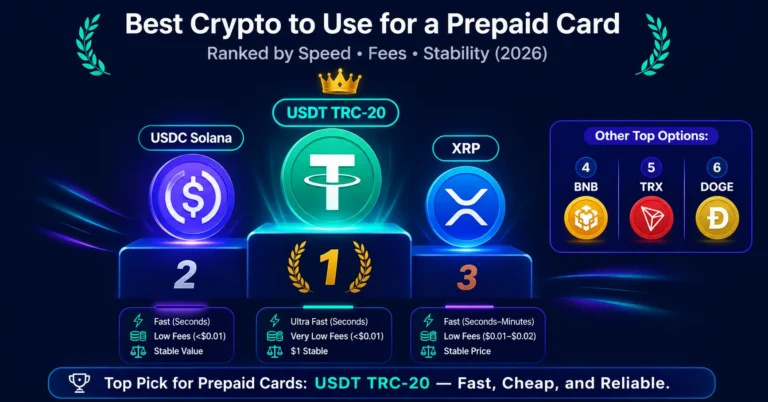
Quick answer: The best cryptocurrency to use for funding a prepaid card in 2026 is USDT on TRC-20 (Tron network). It confirms in seconds, costs fractions of a cent in network fees, maintains a stable $1 value eliminating price risk, and is accepted from every major exchange globally. Second choice is USDC on Solana — equally fast and cheap, with stronger institutional backing. For users who already hold specific coins and prefer not to swap, XRP, DOGE, LTC, and BNB are all practical second-tier options. Bitcoin is the worst choice for regular card top-ups — slowest confirmation, highest and most variable fees, and the most price volatility during the confirmation window.
This guide ranks all 12+ cryptocurrencies accepted on Rivocard by their practical value as card funding assets — not by market cap or popularity, but by the three factors that actually matter: speed, cost, and predictability.
The Three Factors That Determine the Best Deposit Asset
Every cryptocurrency accepted on Rivocard can fund your card — the difference is how efficiently. Three variables determine practical value for card funding:
1. Network speed (confirmation time) How long between sending and your wallet balance appearing. Faster means you can fund a card and spend sooner — critical for time-sensitive purchases.
2. Network fee cost The fee paid to miners or validators per transaction. This is separate from Rivocard’s 5% card funding fee and directly reduces how much arrives in your wallet from a given deposit.
3. Price stability during confirmation For volatile assets, the dollar value credited depends on the price at confirmation time — not when you sent. A 5% price drop during a 30-minute Bitcoin confirmation reduces your credited amount by 5%.
The Full Ranking: All Rivocard-Supported Cryptocurrencies
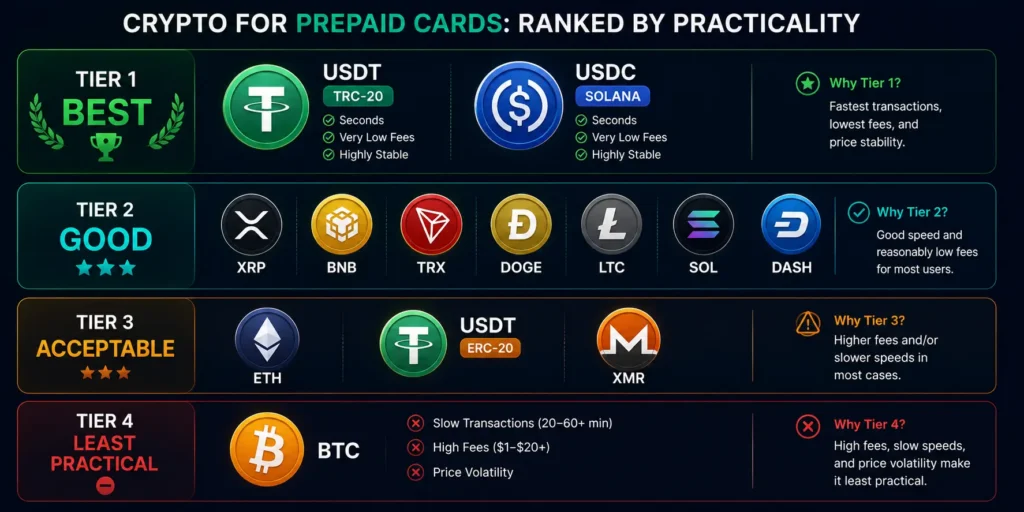
Tier 1 — Best (Use These for All Regular Top-Ups)
1. USDT on TRC-20 (Tron) The clear winner for card funding across all three criteria.
- Confirmation time: 3-30 seconds
- Network fee: Under $0.01 per transaction
- Price stability: Pegged to $1 — zero volatility risk
- Available from: Every major exchange (Binance, OKX, Bybit, Kraken, KuCoin, Coinbase Pro)
- Best for: All deposits, any amount, any urgency level
In 2026, most active crypto card spenders load stablecoins, and card providers optimize around USDC and USDT rails. TRC-20 USDT dominates because it combines stablecoin predictability with Tron’s speed and near-zero fees — the three things card funding needs most.
2. USDC on Solana Functionally equivalent to TRC-20 USDT for card funding purposes.
- Confirmation time: Under 5 seconds
- Network fee: Under $0.01
- Price stability: Pegged to $1
- Best for: USDC holders on Solana, or users preferring Circle’s reserve transparency
USDC is backed by Circle, which publishes detailed monthly reserve attestations. If transparency and institutional trust in the issuer matters to you, USDC on Solana is an equally practical alternative to USDT on Tron.
Tier 2 — Good (Practical With Minor Trade-offs)
3. XRP (Ripple)
- Confirmation time: 3-5 seconds
- Network fee: Under $0.01
- Price stability: Volatile — XRP’s price moves with the market
- Best for: XRP holders wanting to convert directly without swapping to stablecoins
XRP’s settlement speed and fees are on par with TRC-20 USDT. The only trade-off is price volatility — XRP’s price can move significantly in the 3-5 seconds between send and confirmation, though the window is so short that price risk is minimal in practice. For XRP holders, direct deposit is practical.
4. BNB (Binance Smart Chain / BEP-20)
- Confirmation time: 3-15 seconds
- Network fee: Under $0.10
- Price stability: Volatile (BNB price moves)
- Best for: BNB holders, Binance ecosystem users
BNB on the Binance Smart Chain is fast and cheap — comparable to XRP. The short confirmation window minimizes price risk. Binance users who hold BNB balances can deposit directly without converting.
5. TRX (Tron native)
- Confirmation time: Seconds
- Network fee: Fractions of a cent
- Price stability: Volatile
- Best for: TRX holders already on the Tron network
Tron’s native coin shares the same network characteristics as TRC-20 USDT (same speed, same fees) but with TRX’s price volatility. For TRX holders, direct deposit is practical — the short confirmation window limits volatility exposure.
6. DOGE (Dogecoin)
- Confirmation time: 1-3 minutes
- Network fee: Under $0.10 typically
- Price stability: Volatile (DOGE price moves)
- Best for: DOGE holders who want to spend their holdings
DOGE’s 1-minute block time and low fees make it a reasonable card funding option. More volatile than BNB or XRP but with enough community adoption that many users specifically hold DOGE and want to spend it.
7. LTC (Litecoin)
- Confirmation time: 2-5 minutes
- Network fee: Typically under $0.05
- Price stability: Volatile
- Best for: LTC holders, privacy-conscious users (LTC has MWEB privacy features)
Litecoin was designed as “silver to Bitcoin’s gold” — faster confirmations and lower fees than Bitcoin, though not as fast as TRC-20 USDT or XRP. For Litecoin holders, direct deposit is significantly more practical than BTC.
Tier 3 — Acceptable (Use When Necessary, Not as Default)
8. ETH (Ethereum)
- Confirmation time: 1-5 minutes (up to 30+ minutes during congestion)
- Network fee: $1-$20+ (highly variable, spikes during congestion)
- Price stability: Volatile
- Best for: ETH holders who want to spend directly, large deposits where fees are proportionally smaller
ETH is the second largest cryptocurrency and widely held, but Ethereum mainnet fees are the primary weakness for card funding. During congestion, a $5-$20 gas fee on a $100 deposit represents 5-20% cost before Rivocard’s own fee applies. For deposits above $500 during low-fee periods, ETH is practical. For smaller deposits or during congestion, TRC-20 USDT is significantly cheaper. See our full Ethereum prepaid card guide for ETH-specific details.
9. USDT on ERC-20 (Ethereum)
- Confirmation time: 1-5 minutes (up to 30+ during congestion)
- Network fee: $1-$20+ (same as ETH — you still pay gas in ETH)
- Price stability: Pegged to $1 (no price volatility)
- Best for: USDT holders specifically on Ethereum who cannot or will not switch to Tron
ERC-20 USDT has the same speed and fee issues as ETH, but adds stablecoin price certainty. The stablecoin benefit is real, but paying $5-$15 in Ethereum gas fees on a $100 USDT deposit is significantly less efficient than the $0.01 cost on Tron. If your USDT is already on Ethereum and converting to TRC-20 is inconvenient, ERC-20 is acceptable — but switching to Tron for future purchases saves money.
10. SOL (Solana native)
- Confirmation time: Under 5 seconds
- Network fee: Under $0.01
- Price stability: Volatile (SOL price moves)
- Best for: SOL holders on Solana ecosystem
SOL shares the same speed and fee profile as USDC on Solana — the Solana network is fast and cheap. The only weakness is SOL’s price volatility vs the stablecoin option. For SOL holders, direct deposit is practical given the near-instant confirmation window.
11. XMR (Monero)
- Confirmation time: 5-20 minutes
- Network fee: Under $0.05 typically
- Price stability: Volatile
- Best for: Privacy-focused users who specifically hold and use Monero
Monero offers strong on-chain privacy — transactions are private by default. For users who specifically value financial privacy at the blockchain level, XMR deposit enables converting privacy-preserving crypto to a standard Visa card. The 5-20 minute confirmation is longer than Tier 1 and Tier 2 options but manageable for planned deposits.
12. DASH (Dash)
- Confirmation time: Seconds (with InstantSend)
- Network fee: Under $0.01
- Price stability: Volatile
- Best for: DASH holders wanting to spend without converting
DASH with InstantSend is remarkably fast — comparable to TRC-20 USDT in speed. The limiting factor is DASH’s lower liquidity and exchange availability compared to the Tier 1 and 2 options. For DASH holders, direct deposit is practical.
Tier 4 — Least Practical (Use Other Options When Available)
13. BTC (Bitcoin)
- Confirmation time: 20-60 minutes (normal), 1-3+ hours (congestion)
- Network fee: $1-$20+ (normal), $20-$100+ (congestion)
- Price stability: Highly volatile
- Best for: Large planned deposits ($500+) with timing flexibility; BTC holders avoiding a swap
Bitcoin is the least practical choice for routine card top-ups. The combination of slow confirmation, high fees, and significant price volatility during the confirmation window makes it costly and unpredictable for regular use. It makes sense only when you specifically hold BTC, are depositing a larger amount where fees are proportionally manageable, and have time flexibility. See the stablecoin vs Bitcoin comparison for the full analysis.
Quick-Reference Summary Table
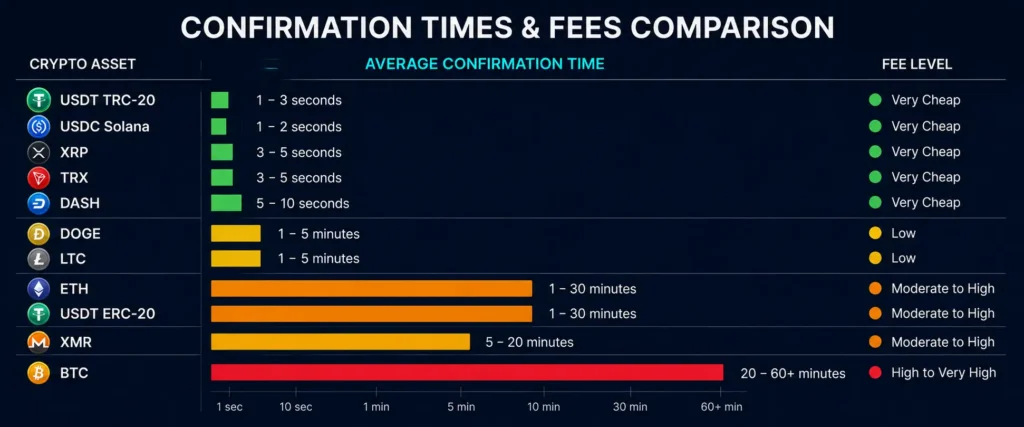
| Rank | Asset | Confirmation | Network Fee | Price Risk | Overall |
|---|---|---|---|---|---|
| 1 | USDT TRC-20 | Seconds | Under $0.01 | None | ⭐⭐⭐⭐⭐ |
| 2 | USDC Solana | Seconds | Under $0.01 | None | ⭐⭐⭐⭐⭐ |
| 3 | XRP | 3-5 seconds | Under $0.01 | Low (fast window) | ⭐⭐⭐⭐ |
| 4 | BNB (BEP-20) | 3-15 seconds | Under $0.10 | Low | ⭐⭐⭐⭐ |
| 5 | TRX | Seconds | Under $0.01 | Low | ⭐⭐⭐⭐ |
| 6 | DOGE | 1-3 minutes | Under $0.10 | Medium | ⭐⭐⭐ |
| 7 | LTC | 2-5 minutes | Under $0.05 | Medium | ⭐⭐⭐ |
| 8 | ETH | 1-30+ minutes | $1-$20+ | Medium-High | ⭐⭐ |
| 9 | USDT ERC-20 | 1-30+ minutes | $1-$20+ | None | ⭐⭐ |
| 10 | SOL | Seconds | Under $0.01 | Medium | ⭐⭐⭐ |
| 11 | XMR | 5-20 minutes | Under $0.05 | Medium | ⭐⭐ |
| 12 | DASH | Seconds (InstantSend) | Under $0.01 | Medium | ⭐⭐⭐ |
| 13 | BTC | 20-60+ minutes | $1-$100+ | High | ⭐ |
The Practical Decision Framework
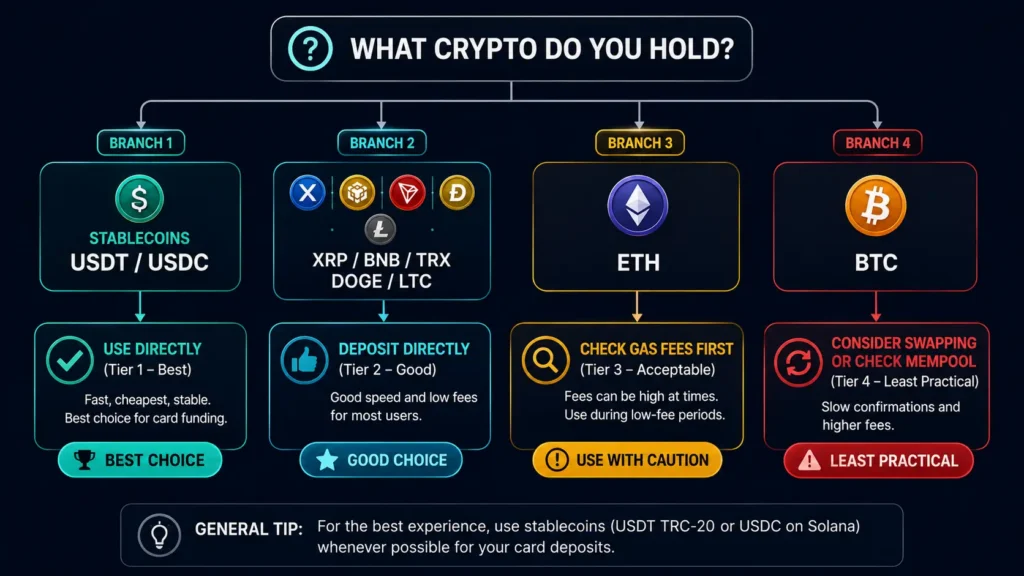
You want the simplest, most cost-efficient top-up: USDT on TRC-20. No other asset comes close on the combination of speed, cost, and predictability.
You already hold a specific coin and don’t want to swap: Use whatever you hold, from the ranking above. XRP, BNB, TRX, DOGE, and LTC are all practical for direct deposit without conversion.
You want stablecoin certainty but prefer USDC over USDT: USDC on Solana is the direct equivalent of TRC-20 USDT for card funding purposes.
You hold ETH on Ethereum mainnet: ETH deposit works — just check gas fees at etherscan.io/gastracker first and avoid depositing during high-congestion periods.
You hold Bitcoin and need to top up today: Check mempool.space for current fees. If fees are under $5 and you have 30-60 minutes, BTC deposit is acceptable. If fees are high or you need balance fast, swap to USDT on TRC-20 first.
FAQs
What is the best cryptocurrency to use for a prepaid card?
USDT on TRC-20 (Tron network) is the best cryptocurrency for funding a prepaid card. It confirms in seconds, costs fractions of a cent in network fees, and maintains a stable $1 value eliminating price volatility during the confirmation window. USDC on Solana is a functionally equivalent second choice.
Is Bitcoin good for funding a crypto prepaid card?
Bitcoin is the least practical option for regular card top-ups. It takes 20-60 minutes to confirm, costs $1-$20+ in network fees under normal conditions, and carries significant price volatility during the confirmation window. Bitcoin makes sense only for large planned deposits with timing flexibility when you already hold BTC.
Why is USDT better than Bitcoin for card funding?
Three reasons: USDT on TRC-20 confirms in seconds vs 20-60 minutes for Bitcoin, costs fractions of a cent vs $1-$20+ in network fees, and maintains a stable $1 value vs Bitcoin’s price volatility during the confirmation window. For regular card top-ups, USDT is faster, cheaper, and more predictable in every dimension.
Can I use any cryptocurrency to fund a Rivocard?
Rivocard supports 12+ cryptocurrencies including BTC, ETH, USDT (TRC-20 and ERC-20), USDC, SOL, LTC, XMR, DASH, XRP, DOGE, BNB, and TRX. All can fund your card — the difference is how efficiently. See the full list at rivocard.com/which-cryptocurrencies-does-rivocard-support.
Is XRP good for crypto card funding?
Yes — XRP is a Tier 2 option. It confirms in 3-5 seconds and costs fractions of a cent in fees, making it comparable to TRC-20 USDT for speed and cost. The only trade-off is XRP’s price volatility, though the 3-5 second confirmation window limits exposure. For XRP holders, direct deposit is practical.
What is the cheapest crypto to deposit for a prepaid card?
USDT on TRC-20, USDC on Solana, XRP, TRX, and DASH all have network fees under $0.01 per transaction — effectively free. These are the cheapest options for card funding network costs. ETH and Bitcoin are the most expensive, especially during congestion.
Should I convert my crypto to USDT before depositing to Rivocard?
For volatile assets like BTC, ETH, or SOL: converting to USDT on TRC-20 before depositing gives you price certainty and lower fees — but adds a conversion step and potentially a conversion fee. Whether it is worth it depends on how much you are depositing and whether timing is critical. For deposits above $500 where BTC fees are proportionally manageable, direct BTC deposit is practical.
Is Ethereum or Litecoin better for card funding?
Litecoin is better for regular card funding: faster confirmations (2-5 minutes vs 1-30+ for ETH), lower and more predictable fees (under $0.05 vs $1-$20+ for ETH). The only advantage Ethereum has is broader availability on exchanges. For card funding specifically, LTC is more practical.
What is USDC and is it the same as USDT?
USDC (USD Coin) and USDT (Tether) are both stablecoins pegged to $1. Both are equally practical for card funding when using efficient networks (Solana for USDC, Tron for USDT). The difference is the issuer: USDC is issued by Circle with regular reserve attestations; USDT is issued by Tether Limited. Both maintain strong pegs and are accepted on Rivocard.
Does the choice of cryptocurrency affect Rivocard’s 5% fee?
No. Rivocard’s 5% card funding fee applies when you move your wallet balance to a virtual card — it is the same regardless of which cryptocurrency funded the wallet. The choice of crypto affects only the network fee (paid to the blockchain) and the speed and price stability of the deposit step.
Get Started
Using USDT on TRC-20 for your first deposit? Here’s the complete guide. How to top up with USDT →