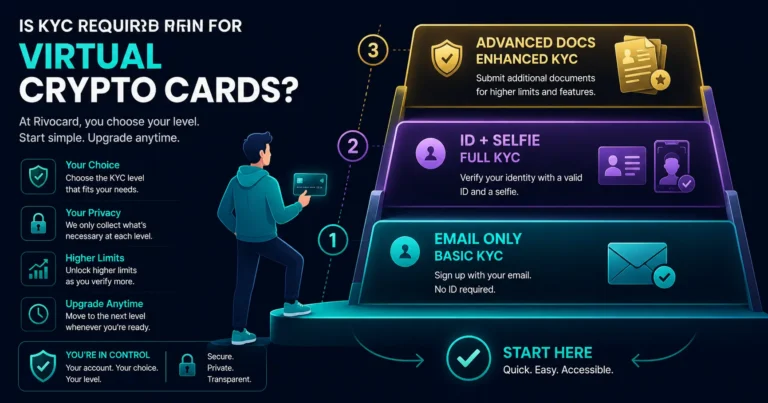
Quick answer: KYC (Know Your Customer) is not always required to start using a virtual crypto card — but it depends on the platform and the spending tier you need. On Rivocard, you can create an account, deposit crypto, and use a virtual Visa card with only email verification — no government ID, no selfie, no proof of address. This email-only access gives you $500 per transaction, $1,000 per day, and $5,000 per month. Full KYC (government ID + selfie) is only required if you need higher spending limits. Fully anonymous crypto cards at bank-grade spending limits are essentially gone in 2026 — every regulated card network now requires issuer-side identity checks at higher tiers. What still exists are instant-issuance virtual cards with minimal KYC for basic spending levels.
The Current Reality: KYC in 2026
The no-KYC crypto card category looked more crowded a few years ago. In 2026, most options have either added full verification requirements, quietly dropped the lighter tier, or moved to a model where the no-KYC label applies only to a narrow base path before restrictions kick in.
The reason is regulatory. AML laws, MiCA in the EU, and Visa/Mastercard network rules have tightened requirements for card issuers serving users without identity verification. Platforms that previously operated with fully anonymous cards have been forced to introduce verification, change payment partners, or exit the market.
What remains in 2026 is a tiered model — and Rivocard’s email-only Basic KYC tier is one of the most permissive compliant entry points available.
Three Scenarios: KYC Status on Virtual Crypto Cards
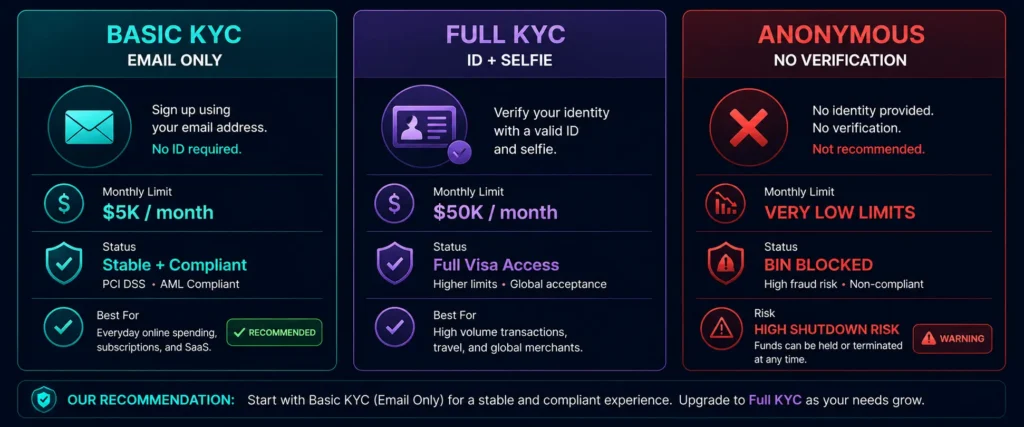
Scenario 1: No KYC Required (Basic Tier — Rivocard)
On Rivocard, the Basic KYC tier requires only:
- A working email address
- Email verification (click the link sent to your inbox)
No government ID. No selfie. No phone number. No address.
What you get at Basic KYC:
- Unlimited virtual card creation (free)
- 12+ cryptocurrencies supported for deposits
- $500 per transaction spending limit
- $1,000 daily spending limit
- $5,000 monthly spending limit
- $2,000 maximum card balance
This is possible because regulators permit Simplified Due Diligence (SDD) for low-value prepaid card programs operating below defined spending thresholds. At $5,000/month, the AML risk profile is considered low enough for email-only verification in most regulatory frameworks.
Who this works for:
- Online subscriptions (Netflix $18/month, Adobe $55/month, cloud hosting $100/month)
- Moderate online shopping
- Entry-level digital advertising ($500-$3,000/month)
- Testing the platform before committing larger amounts
- Users who want to try a crypto card without submitting ID first
Scenario 2: KYC Required for Higher Limits (Full KYC — Rivocard)
If your spending needs exceed Basic KYC limits, Full KYC on Rivocard requires:
- Government-issued photo ID (passport, national ID, or driver’s license)
- Real-time selfie matched against the ID (liveness check)
Verification typically completes in minutes through automated identity systems.
What Full KYC unlocks:
- $5,000 per transaction (10x Basic)
- $10,000 daily spending (10x Basic)
- $50,000 monthly spending (10x Basic)
- $20,000 maximum card balance (10x Basic)
Who needs Full KYC:
- High-volume digital advertisers spending $5,000+/month
- Businesses using crypto cards as primary payment infrastructure
- Users making high-value single purchases (flights, hotels, software licenses)
- Anyone regularly hitting Basic KYC daily or monthly limits
Scenario 3: Truly Anonymous Cards — The Risk Picture
Some platforms claim to offer truly anonymous virtual cards — no email, no verification of any kind. In most cases, cards marketed as no-KYC either rely on grey-area offshore structures or impose such low spending limits that they are impractical for real use.
The risks with genuinely anonymous card platforms:
- Platform stability: Unregulated operators face ongoing risk of shutdown by Visa/Mastercard or banking partners — which freezes user funds without warning
- No consumer protections: Standard card network dispute rights and Zero Liability protections typically require the platform to have an established compliance relationship with Visa/Mastercard — unregulated platforms may not have these
- BIN blocking: Major merchants (Amazon, Google, Meta, Netflix) frequently block card BIN ranges associated with high-risk or unregulated issuers — anonymous cards often cannot be used at the merchants users most want to pay
- Spending limits: No-KYC cards usually have lower daily and monthly spending limits and may not support all features like ATM withdrawals. These limitations exist to comply with financial regulations.
For users who specifically need anonymity for legitimate privacy reasons, Rivocard’s email-only Basic KYC tier provides meaningful privacy while maintaining platform stability and Visa network acceptance.
Why Email-Only Verification Is Not “No KYC”
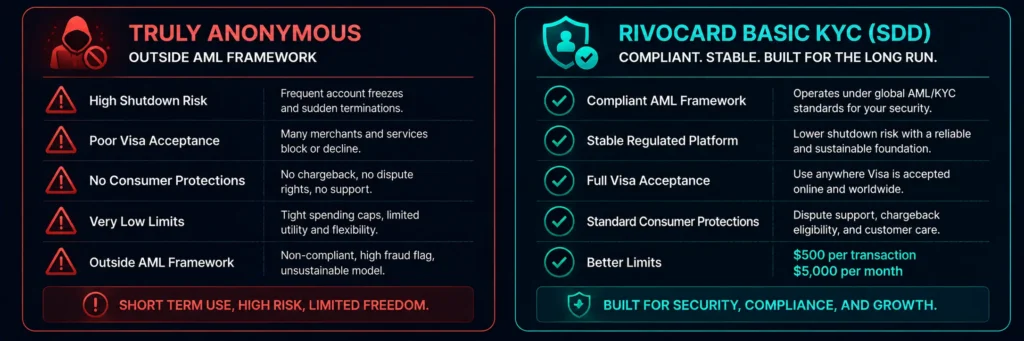
A precise note: Rivocard’s Basic KYC tier is not “no KYC” — it is Simplified Due Diligence (SDD), a formally recognized regulatory category. The distinction matters:
| Truly No KYC | Rivocard Basic KYC (SDD) | |
|---|---|---|
| Identity collected | None | Email address |
| Regulatory status | Outside AML framework | Compliant SDD tier |
| Platform stability | High shutdown risk | Stable, regulated |
| Visa network acceptance | Often poor (BIN blocking) | Full Visa acceptance |
| Consumer protections | Typically none | Standard Visa protections |
| Spending limits | Very low or unclear | $500/tx, $1K/day, $5K/month |
The email address collected at Rivocard’s Basic KYC tier is the minimum information required to maintain a user account — not a government identity document. This qualifies as the lightest permissible compliance tier under applicable AML frameworks, not a bypass of them.
What Triggers Full KYC Requirements
On Rivocard, Full KYC is triggered only when you choose to upgrade — it is not automatically triggered by usage. The situations where upgrading to Full KYC becomes necessary:
- A single purchase exceeds $500 (the Basic KYC per-transaction limit)
- Daily spending exceeds $1,000
- Monthly spending exceeds $5,000
- You want to load more than $2,000 onto a single card
- You want to send more than $2,000 to a single card in a day
Until any of these thresholds are relevant to your usage, Basic KYC (email only) is all you need.
How to Get Started Without KYC on Rivocard
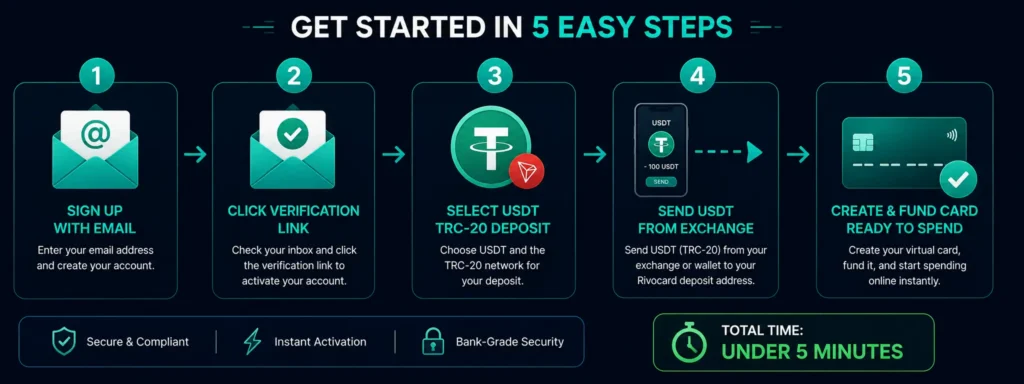
The complete process from zero to spending with email-only verification:
Step 1: Go to rivocard.com and sign up with your email address and a strong unique password. Takes under 1 minute.
Step 2: Check your email inbox and click the verification link. This activates your account — Basic KYC complete.
Step 3: From your dashboard, navigate to deposits. Select a supported cryptocurrency (USDT on TRC-20 recommended for speed and low fees). Copy the deposit address.
Step 4: Send the minimum $10 USDT equivalent from your wallet or exchange to your Rivocard deposit address. On TRC-20, this confirms in seconds.
Step 5: From your wallet balance, create a virtual card (free) and fund it. The 5% card funding fee applies. Your card is ready immediately.
Total time from signup to spendable card: Under 5 minutes using USDT on TRC-20. No ID submitted at any point.
KYC and Privacy: What Rivocard Does and Does Not Collect
At Basic KYC (email only), Rivocard collects:
- Email address
- Hashed password (never stored in plain text)
- Device and session data (IP address, device type) for security monitoring
Rivocard does not collect at Basic KYC:
- Name
- Date of birth
- Government ID number
- Physical address
- Phone number
- Biometric data
At Full KYC, the above identity data is collected and retained as required by AML regulations (typically 5+ years after account closure). At Basic KYC, the privacy footprint is limited to an email address.
Comparing KYC Requirements Across the Market
A no-KYC virtual card is a virtual payment card that does not require identity verification to open and use — you only need an email address or a crypto wallet to register, and you can have a working Visa or Mastercard number within minutes.
The current market in 2026:
| KYC level | What is required | Typical spending limits |
|---|---|---|
| Email only (SDD) | Email + verification | $500-$1,000/tx, $1K-$5K/month |
| Basic identity | Name, email, sometimes phone | $1K-$5K/tx, $5K-$25K/month |
| Standard KYC | Government ID + selfie | $5K-$20K/tx, $25K-$50K/month |
| Enhanced KYC | ID + address proof + source of funds | $20K+/tx, $50K+/month or unlimited |
| Fully anonymous | Nothing | Very low or unpublished limits, high risk |
Rivocard’s email-only Basic KYC tier sits at the top of this table — the lightest compliant verification available — with limits that are practical for most everyday and moderate-business use cases.
FAQs
Is KYC required to use a virtual crypto card?
It depends on the platform and spending tier. On Rivocard, only email verification is required to start — no government ID, no selfie. This Basic KYC tier gives you $500 per transaction, $1,000 daily, and $5,000 monthly. Full KYC (ID + selfie) is only required if you need higher limits.
Can I get a virtual crypto card without ID verification?
Yes — on Rivocard, the Basic KYC tier requires only email verification, not government ID. You can create an account, deposit crypto, create virtual cards, and spend up to Basic KYC limits without submitting any identity documents.
What is the minimum KYC required to use Rivocard?
Email verification only — click the link sent to your email after signup. No name, no ID, no selfie, no address. This is Rivocard’s Basic KYC tier, which qualifies as Simplified Due Diligence under applicable AML regulations.
What spending limits do I get without submitting an ID?
At Rivocard’s email-only Basic KYC tier: $500 per transaction, $1,000 daily spending, $5,000 monthly spending, and a maximum $2,000 balance per virtual card.
When is full identity verification required on Rivocard?
Full KYC (government ID + real-time selfie) is required only when you want to exceed Basic KYC spending limits. It is not automatically triggered — you upgrade voluntarily when your usage needs require it. See our [crypto card KYC requirements guide](https://rivocard.com/crypto-card-kyc-requirements-explained/) for full tier details.
Are truly anonymous crypto cards (no email) available in 2026?
A small number of platforms offer this, but with significant risks: high shutdown risk from Visa/Mastercard or banking partners, no consumer dispute protections, BIN blocking by major merchants, and very low spending limits. Rivocard’s email-only Basic KYC tier provides meaningful privacy with platform stability and full Visa acceptance.
Why does Rivocard require even an email address?
An email address is the minimum required to maintain a user account — for account recovery, security notifications, and maintaining a basic compliance record under Simplified Due Diligence rules. It is not a government identity document and does not compromise meaningful privacy.
Does completing KYC on Rivocard affect my existing cards?
No. Upgrading from Basic to Full KYC updates your spending limits immediately going forward. Existing cards and wallet balances are unaffected. New cards can be funded up to the higher limits immediately after tier upgrade.
Is Rivocard’s email-only tier “no KYC” or something else?
It is Simplified Due Diligence (SDD) — a formally recognized regulatory compliance tier that permits lighter verification for low-value accounts. This is distinct from truly anonymous (outside AML frameworks) platforms. SDD means compliant, regulated, and stable — with the same Visa network access as fully verified accounts.
What information does Rivocard collect at the email-only tier?
Email address and a hashed password (stored without the ability to recover the original password). Device and session data (IP address, device type) for security monitoring. No name, date of birth, government ID, physical address, phone number, or biometric data is collected at Basic KYC.
Get Started
Start spending with email only — no ID required at Basic KYC. Create your Rivocard account in under 2 minutes →