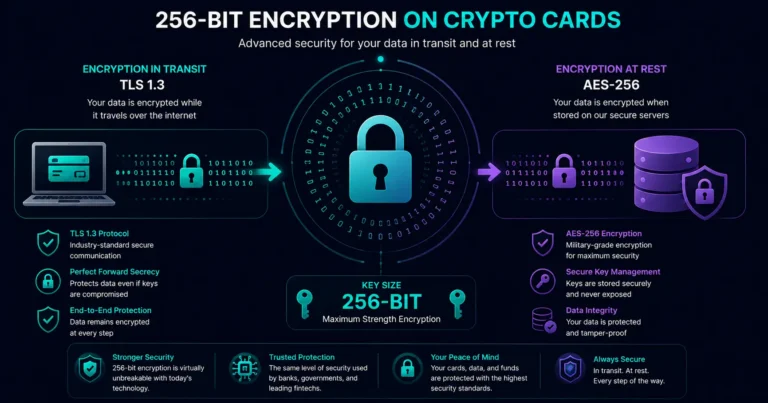
Quick answer: 256-bit encryption — specifically AES-256 — is the global standard for securing sensitive data at rest and in transit. On a crypto card platform like Rivocard, it means your card details, personal information, and transaction data are encrypted with a key so large that brute-force decryption is computationally impossible with any existing or near-future technology. AES encryption secures modern data across TLS connections, Wi-Fi, VPNs, and storage systems — it is the encryption standard used by banks, governments, and the US military. When Rivocard encrypts your data, an attacker who intercepts it sees only random ciphertext. Without the decryption key, the data is unreadable — not difficult to read, but mathematically impossible to read within any practical timeframe.
What Is 256-Bit Encryption
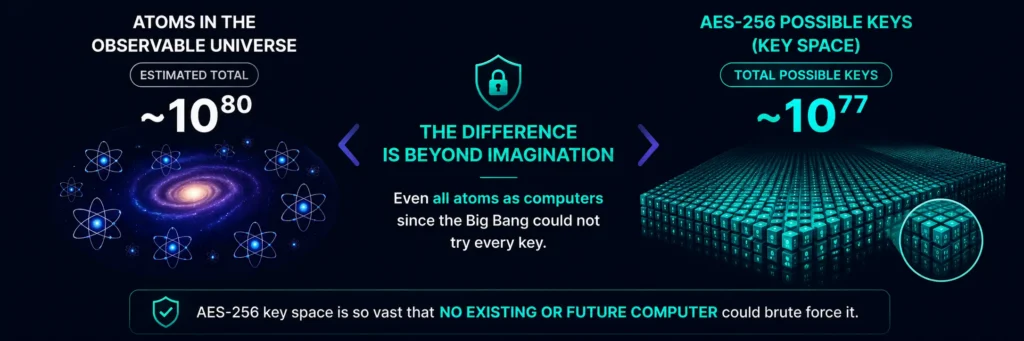
“256-bit” refers to the length of the encryption key — the secret value used to lock and unlock data. The number of possible 256-bit keys is 2²⁵⁶ — a number with 77 digits. To put this in context:
- The estimated number of atoms in the observable universe is approximately 10⁸⁰
- 2²⁵⁶ ≈ 1.16 × 10⁷⁷
Even if every atom in the universe were a computer running at maximum speed since the Big Bang, trying every possible 256-bit key would still take far longer than the age of the universe. AES-256 gives about 128-bit security against a quantum attack — still infeasible to break. CNSA 2.0, the US government’s post-quantum cryptographic standards, mandates AES-256 for high-security applications.
The encryption algorithm used is AES — Advanced Encryption Standard. AES was adopted by NIST in 2001 to protect electronic data and is the encryption standard behind WPA2 and WPA3 Wi-Fi security, HTTPS connections, and VPNs. AES-256 is the highest key-length variant.
The Two Places 256-Bit Encryption Applies to Your Card Data
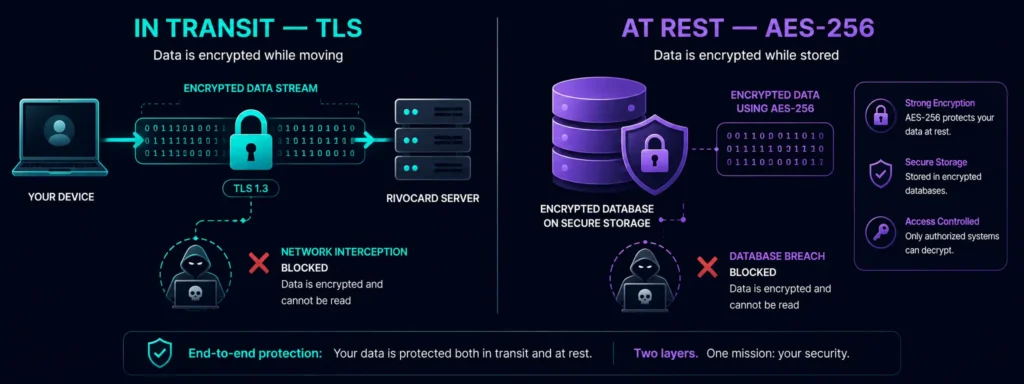
Encryption on a crypto card platform applies in two distinct contexts — in transit and at rest — and they address different threats.
Encryption in Transit: TLS
When your device communicates with Rivocard’s servers — logging in, viewing your balance, initiating a deposit, creating a card — all data is encrypted using TLS (Transport Layer Security). TLS ensures three core principles: encryption (hides data from unauthorized parties), authentication (verifies you are connecting to the legitimate server), and integrity (guarantees data is not altered during transmission).
TLS works through a handshake process:
- Your device connects to Rivocard’s server and requests a secure session
- The server presents its digital certificate — proof of identity issued by a trusted Certificate Authority
- Your device verifies the certificate is legitimate and not expired
- Both sides agree on encryption parameters and exchange an AES key securely
- All subsequent communication is encrypted with that AES key
The encryption happens at the transport layer — meaning every piece of data leaving your device is scrambled before it enters the network. An attacker monitoring your Wi-Fi connection, your ISP’s infrastructure, or any point between your device and Rivocard’s server sees only encrypted gibberish.
TLS 1.3 — the current version — removes the weaker cipher options that existed in earlier TLS versions, mandating forward-secure key exchange algorithms that ensure past communications cannot be decrypted even if a server key is later compromised.
Encryption at Rest: AES-256
Data stored in Rivocard’s databases — your account information, transaction history, identity documents — is encrypted using AES-256. This means the database files themselves are encrypted. Anyone who gains unauthorized access to the storage layer (through a breach, a physical intrusion, or a compromised server) encounters encrypted data rather than readable records.
The cipher is only as strong as the system around it. AES-256 protects data at rest and in transit. It does not protect against a stolen key, a compromised endpoint, or an authorized user with malicious intent. This is why key management — how encryption keys themselves are stored and controlled — is as important as the algorithm. Well-implemented systems store encryption keys in hardware security modules (HSMs), separate from the data they protect, with strict access controls.
How This Applies to Your Specific Card Data
Different types of data receive different encryption treatment under PCI DSS requirements:
Card Number (PAN — Primary Account Number) Your 16-digit Visa card number is stored encrypted under AES-256 with strict access controls. When displayed in your dashboard, only the last four digits are shown. The full number is only accessible through secure, authenticated API calls with proper authorization.
CVV (Card Verification Value) AES-256 protects data at rest. However, CVVs receive even stricter treatment: PCI DSS explicitly prohibits storing CVVs after a transaction has been authorized. The CVV is verified during authorization and then discarded — it is never stored in any database, encrypted or otherwise. This means a database breach cannot expose CVVs, because they are not there to expose.
Expiry Date Stored encrypted alongside the card number under the same AES-256 protections.
Personal Information Your email address, name (if provided), and identity documents (if KYC completed) are stored encrypted at rest, transmitted encrypted in transit.
Password Your password is never stored in any form. Instead, a one-way cryptographic hash of your password is stored. When you log in, the system hashes the password you enter and compares the hash values — never the passwords themselves. Even if the hash database were breached, recovering the original password from the hash is computationally infeasible with a strong, unique password.
Why AES-256 Is Considered Unbreakable in Practice
The security of AES-256 comes from the key space — the number of possible keys an attacker would need to try to find the right one.
Brute force: Trying every possible key at the speed of the fastest supercomputers would take longer than the age of the universe. This is not an exaggeration. It is mathematically demonstrable.
Cryptanalysis: The best known attacks against AES reduce the key space marginally but do not bring it into the realm of practical attack. AES has been studied by the global cryptographic community for over two decades with no practical break found.
Quantum computing: Quantum computers do not break AES the way they break RSA and ECC. The relevant quantum attack (Grover’s algorithm) only halves the effective key strength — so AES-256 retains about 128 bits of security against a quantum adversary, which is still infeasible to break. AES-256 is quantum-resistant in practice for the foreseeable future.
The encryption algorithm itself is not the weak point in most real-world breaches. Most breaches never touch the algorithm — they exploit stolen keys, compromised endpoints, or authorized users with malicious intent. This is why Rivocard’s security posture includes not just AES-256 encryption, but also strict access controls, hardware 2FA, and key management practices — because the math is secure, but the surrounding system must be too.
TLS vs AES: The Relationship Between the Two
A common point of confusion: TLS and AES are not competing technologies. They work together.
In practice, most secure systems use both: RSA (or elliptic-curve cryptography) to establish a session and exchange an AES key, and AES to encrypt the actual data. TLS handshakes, HTTPS connections, and VPN tunnels all follow this pattern.
The relationship:
- TLS is the protocol — the set of rules for establishing a secure connection. It handles authentication (proving you are talking to the right server), key exchange (agreeing on a shared encryption key securely), and session establishment.
- AES-256 is the cipher — the actual algorithm that encrypts and decrypts data once the connection is established.
When you see a padlock in your browser, it means TLS is active. The encryption of the actual data flowing through that TLS connection is AES (at 128-bit or 256-bit key length, depending on the negotiated cipher suite).
What 256-Bit Encryption Does Not Protect Against
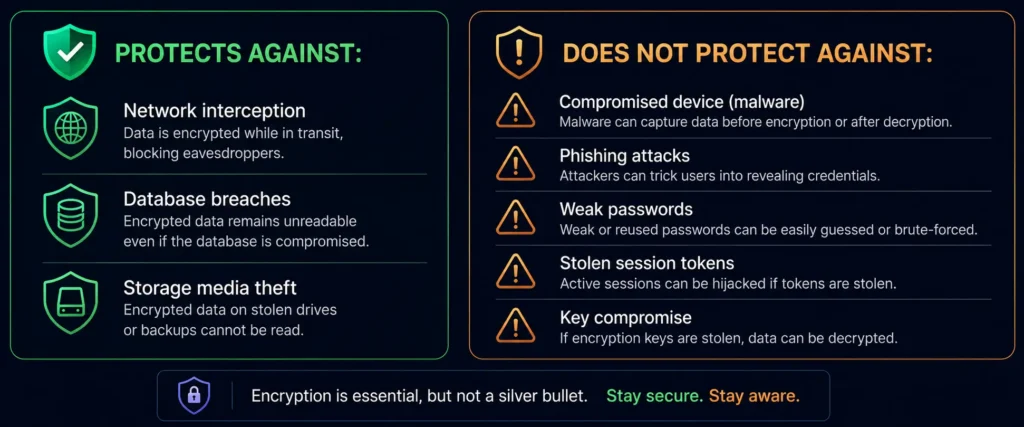
Being specific about what encryption protects against — and what it does not — gives a more accurate picture of your actual security:
Protects against:
- Network interception — someone monitoring traffic between your device and Rivocard
- Database breaches — unauthorized access to stored data
- Storage media theft — physical access to servers or storage devices
Does not protect against:
- A compromised device — if malware is on your phone, it can read data before encryption or after decryption
- Phishing — if you enter your credentials on a fake site, the real Rivocard’s encryption is irrelevant
- Weak passwords — AES-256 is unbreakable, but a weak password that gets guessed bypasses encryption entirely
- Stolen session tokens — if a valid session token is stolen after authentication, the encryption of data at rest is irrelevant to account access
- Key compromise — if encryption keys themselves are poorly managed and stolen, encrypted data can be decrypted
This is why Rivocard’s full security posture — strong authentication (hardware 2FA, biometrics), secure session management, access controls on key material, and regular security audits — is as important as the encryption standard used.
AES-128 vs AES-256: Is the Difference Meaningful?
Some systems use AES-128 (128-bit keys) rather than AES-256. Both are considered secure against current attacks — the difference is in the margin of security.
AES-256 gives about 128-bit security against a quantum attack and is required by CNSA 2.0 for high-security use. AES-128 gives about 64-bit security against quantum attacks — which is still large but provides less margin for future quantum computing advances.
For a financial platform handling card data and personal information, AES-256 is the appropriate choice. It is also the requirement under PCI DSS for data encryption in certain contexts and under most government and enterprise security standards.
FAQs
What is 256-bit encryption on a crypto card?
256-bit encryption — specifically AES-256 — means your card data and personal information are encrypted using a key with 2²⁵⁶ possible values. Brute-force decryption is computationally impossible with any existing technology. It is the same standard used by banks, governments, and the US military for securing sensitive data.
Is AES-256 unbreakable?
In practice, yes. No practical attack exists against correctly implemented AES-256. Brute-force decryption would take longer than the age of the universe with current and foreseeable computing power. Quantum computers reduce effective key strength by half, giving AES-256 approximately 128-bit security against quantum attacks — still computationally infeasible to break.
What is TLS and how does it protect my Rivocard connection?
TLS (Transport Layer Security) is the cryptographic protocol that encrypts data in transit between your device and Rivocard’s servers. It authenticates the server (confirming you are connected to the real Rivocard, not a fake), encrypts all data transmitted (using AES), and ensures data integrity (confirming data was not altered in transit). The padlock icon in your browser indicates TLS is active.
How does Rivocard protect my card number specifically?
Your 16-digit card number is stored encrypted under AES-256 with strict access controls and displayed only as the last four digits in most contexts. Your CVV is never stored at all — it is verified during authorization and immediately discarded, as required by PCI DSS. Even a database breach could not expose CVVs because they are not retained.
What is the difference between AES-256 and TLS?
TLS is the connection protocol — the rules for establishing a secure channel, authenticating the server, and exchanging encryption keys. AES-256 is the cipher used to actually encrypt data once the TLS connection is established. They work together: TLS uses AES-256 to encrypt the data flowing through the secure connection.
Can quantum computers break AES-256 encryption?
Not in practice. Quantum computers can theoretically halve AES-256’s effective key strength via Grover’s algorithm — reducing it from 256-bit to approximately 128-bit equivalent security. This is still computationally infeasible to attack. AES-256 is quantum-resistant for the foreseeable future and is mandated by CNSA 2.0 for high-security US government applications.
Why does encryption not fully protect against all security risks?
AES-256 encryption is mathematically unbreakable, but most real-world breaches bypass the algorithm entirely — through stolen keys, compromised user devices, phishing, weak passwords, or session token theft. This is why strong authentication (hardware 2FA, biometrics), good password hygiene, and device security practices are as important as the platform’s encryption standard.
What is PCI DSS and what encryption does it require?
PCI DSS (Payment Card Industry Data Security Standard) is the global security standard for handling card data. It requires encrypted storage of card numbers (PANs) using strong cryptography, prohibits storing CVVs post-authorization, and mandates strict key management. Rivocard’s payment infrastructure operates under PCI DSS compliance.
Is my password encrypted on Rivocard?
Your password is not stored in any form — not even encrypted. Instead, a one-way cryptographic hash of your password is stored. When you log in, your entered password is hashed and compared to the stored hash. The original password cannot be recovered from the hash. A unique, strong password ensures that even a hash breach provides no value to an attacker.
What does “encrypted in transit and at rest” mean for my Rivocard data?
In transit” means data is encrypted while moving between your device and Rivocard’s servers — using TLS. “At rest” means data is encrypted while stored in Rivocard’s databases — using AES-256. Together, these two protections cover the two primary locations where data can be intercepted or accessed without authorization.
Get Started
Your data is protected by the same encryption standard used by banks and governments. Create your account →