
Quick answer: Yes — Rivocard supports bank transfer top-ups in addition to cryptocurrency deposits. The same 5% fee applies to bank transfers as to crypto deposits (deducted when you fund a card from your wallet balance). The key difference is speed: crypto deposits via TRC-20 USDT arrive in seconds, while bank transfers typically take 1-3 business days depending on your bank, country, and transfer method. For most users who already hold crypto, depositing directly via crypto is faster and simpler. Bank transfers are useful for users who want to convert fiat to spending power without first buying crypto on an exchange.
This guide explains how bank transfer top-ups work on Rivocard, when they make sense over crypto deposits, and the practical differences to know before choosing.
How Bank Transfer Top-Ups Work on Rivocard
The bank transfer flow on Rivocard follows the same two-stage model as crypto deposits:
Stage 1: Bank transfer to your Rivocard wallet (free) You initiate a bank transfer from your bank account to your Rivocard wallet. The amount arrives as a dollar (or supported fiat currency) balance in your wallet. No fee at this stage — the deposit itself is free.
Stage 2: Fund a virtual card from your wallet (5% fee) Once your wallet has a fiat balance from the bank transfer, you create or reload a virtual card. The 5% fee is deducted at this step — the same fee that applies when funding a card from a crypto deposit.
The destination is the same: your Rivocard wallet balance. Whether that balance came from a crypto deposit or a bank transfer, it behaves identically for funding cards.
Bank Transfer vs Crypto Deposit: The Key Differences
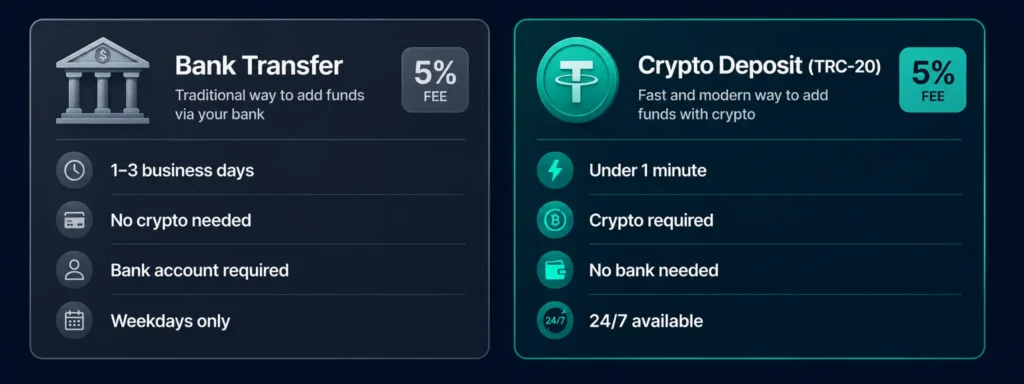
| Bank Transfer | Crypto Deposit (TRC-20 USDT) | |
|---|---|---|
| Speed | 1-3 business days (SEPA Instant: minutes) | Seconds to under 1 minute |
| Deposit fee | Free | Free |
| Card funding fee | 5% (same) | 5% (same) |
| Weekend availability | Often delayed (standard transfers) | 24/7/365 |
| Requires crypto holding | No | Yes |
| Requires bank account | Yes | No |
| Minimum deposit | $10 equivalent | $10 equivalent |
| Maximum per transaction | $10,000 equivalent | $10,000 equivalent |
| Price variance during transfer | None (fiat is stable) | Possible for volatile assets (not stablecoins) |
The fee structure is identical. The only meaningful differences are speed and what you need to initiate the transfer.
When a Bank Transfer Makes More Sense Than Crypto
You do not hold crypto and do not want to buy it. If you have fiat in a bank account and want to fund a Rivocard card without first purchasing cryptocurrency on an exchange, a bank transfer is the direct path. You skip the exchange account creation, KYC on an exchange, and the buy transaction.
You have a large fiat balance you want to move. If you regularly receive fiat income (salary, client payments in fiat, etc.) and want to convert it to card spending power, a bank transfer from your regular bank account is straightforward.
You are comfortable with the transfer timeline. For planned spending — loading a card for travel next week, funding ad spend budgets a few days in advance — a 1-3 day transfer timeline is not a problem. The funds arrive before you need them.
Your bank supports SEPA Instant. In regions where SEPA Instant Credit Transfer is available (many EU countries), bank transfers can arrive in seconds to minutes rather than 1-3 business days. If your bank supports this, the speed gap with crypto deposits largely disappears for EUR transfers.
When Crypto Deposits Are Better Than Bank Transfers
You need card balance immediately. If you need to fund a card right now — for an ad campaign launching today, a subscription billing tonight, or any same-day purchase — a standard bank transfer cannot meet that timeline. A TRC-20 USDT deposit from an exchange takes under 4 minutes end-to-end.
You already hold crypto. If you have USDT, BTC, ETH, or any supported coin in a wallet or exchange, depositing directly is simpler than sending money to your bank account, waiting for it to land, and then transferring to Rivocard.
You are depositing outside business hours. Standard bank transfers do not process on weekends or bank holidays in many countries. A crypto deposit works at 2am on a Sunday with no delay.
You want to avoid a bank seeing the transfer. Some users prefer not to have bank transfers to crypto-related platforms visible in their bank statement. Crypto deposits bypass the traditional banking system entirely.
Transfer Methods and Their Timelines
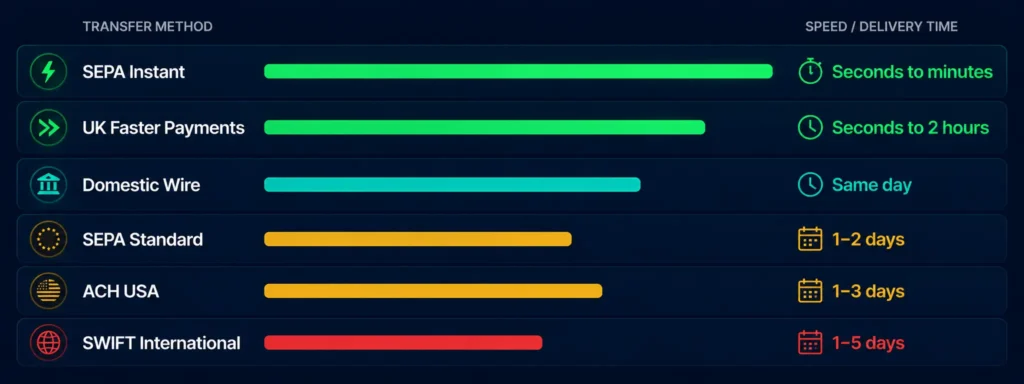
The speed of a bank transfer to Rivocard depends on which transfer method your bank uses and what your region supports:
| Transfer method | Typical speed | Common regions |
|---|---|---|
| SEPA Instant Credit Transfer | Seconds to minutes | EU/EEA (participating banks) |
| SEPA Standard Credit Transfer | 1-2 business days | EU/EEA |
| UK Faster Payments | Seconds to 2 hours | United Kingdom |
| ACH (Automated Clearing House) | 1-3 business days | United States |
| SWIFT International Wire | 1-5 business days | International |
| Domestic wire transfer | Same day to 1 business day | Varies by country |
Check which methods Rivocard supports for your specific country in your dashboard deposit options — available transfer methods vary by region.
What Happens If a Bank Transfer Is Delayed
Unlike crypto transactions (which you can track on a blockchain explorer in real time), bank transfers are opaque — you send the transfer from your bank and wait. If a transfer is delayed beyond the expected timeline:
Step 1: Confirm the transfer was sent. Check your bank’s transaction history to verify the transfer was actually debited from your account. Sometimes transfers appear as “pending” before being sent.
Step 2: Verify the recipient details were correct. Ensure the account number, sort code/IBAN, and any reference number Rivocard provided were entered exactly as shown. Bank transfers sent to incorrect details typically bounce back to the sender rather than being lost — but this takes additional time.
Step 3: Check for bank holds. Some banks add holds or extra review steps for transfers to financial services platforms. Contact your bank if a transfer that was debited has not arrived after the expected processing time.
Step 4: Contact Rivocard support. If the expected timeline has passed and the transfer appears sent from your bank but has not credited to your wallet, contact Rivocard support with your bank’s proof of transfer (usually available as a PDF or transaction reference from your bank’s app).
The Fee Comparison: Bank Transfer vs Crypto
One common misconception is that bank transfers might avoid fees that crypto deposits carry, or vice versa. On Rivocard, this is not the case:
| Fee point | Bank transfer | Crypto deposit |
|---|---|---|
| Deposit to wallet | Free | Free (+ blockchain network fee, paid to network) |
| Card funding from wallet | 5% | 5% |
| Purchase fee | 0% | 0% |
| International transaction | 0% | 0% |
The only cost difference is the blockchain network fee on crypto deposits — typically fractions of a cent on Tron, potentially $1-$20 on Bitcoin or Ethereum. For bank transfers, your bank may charge an outgoing wire fee (usually $15-$35 for international wire transfers, typically free for domestic transfers), but this is a bank charge, not a Rivocard charge.
For domestic bank transfers or SEPA within the EU, the bank fee is typically zero. For international SWIFT wires, the sending bank usually charges a fee. Factor your bank’s outgoing transfer fees into the comparison.
Practical Scenarios: Which Should You Use?
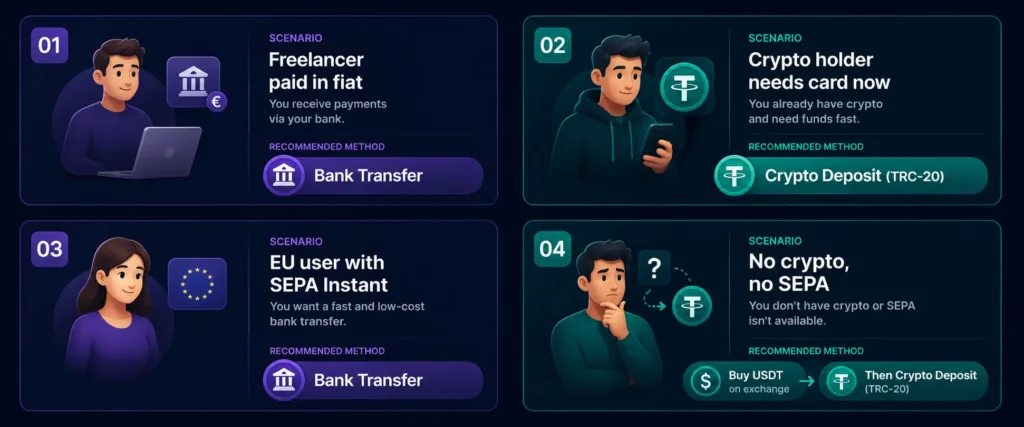
Scenario 1: Freelancer paid in fiat, wants to use Rivocard for spending Receives salary in USD to a US bank account. Wants to use Rivocard for online purchases. → Bank transfer (ACH) to Rivocard wallet. Takes 1-3 business days. Fund card. Spend. No crypto exchange needed.
Scenario 2: Crypto holder who needs card balance immediately Holds $500 USDT on Binance. Needs card balance today for an ad campaign. → Withdraw USDT via TRC-20 to Rivocard wallet. Takes under 4 minutes. Fund card. Done.
Scenario 3: EU user who prefers bank funding, bank supports SEPA Instant Has EUR in a German bank. Wants to fund a Rivocard card. → SEPA Instant transfer to Rivocard. Takes seconds to minutes. Fund card immediately.
Scenario 4: User with neither crypto holdings nor a supported bank Wants to use Rivocard but has no crypto and their bank does not support SEPA. → Buy USDT on a crypto exchange (most exchanges accept card purchases), then withdraw to Rivocard via TRC-20. Faster than waiting for bank transfer to settle.
Does Rivocard Require KYC for Bank Transfers?
No additional KYC is triggered specifically by using a bank transfer versus a crypto deposit. The standard Rivocard KYC tier structure applies regardless of how you fund your wallet:
- Basic KYC (email verification only): Available for both bank transfers and crypto deposits, up to Basic tier limits
- Full KYC (ID + selfie): Required to access higher spending limits, regardless of funding method
- Enhanced KYC: For highest tiers
The funding method does not change which KYC tier you need.
Prefer crypto instead? Fund your instant virtual card with Bitcoin, USDT, Ethereum and 50+ other assets.
FAQs
Can you top up a Rivocard with a bank transfer?
Yes. Rivocard supports bank transfer deposits to your wallet in addition to cryptocurrency deposits. The same 5% fee applies when you fund a card from your wallet balance, regardless of whether the balance came from a bank transfer or a crypto deposit.
How long does a bank transfer take to arrive on Rivocard?
It depends on your transfer method and region. SEPA Instant (EU participating banks) takes seconds to minutes. Standard SEPA takes 1-2 business days. ACH in the US takes 1-3 business days. International SWIFT wires take 1-5 business days.
Is the fee different for bank transfers vs crypto deposits on Rivocard?
No. The Rivocard fee is the same 5% regardless of funding method — it applies when you fund a virtual card from your wallet balance. The only potential cost difference is your bank’s outgoing transfer fee (if any) or the blockchain network fee on crypto deposits.
Can I fund a Rivocard card immediately with a bank transfer?
Only if your bank supports an instant transfer method (like SEPA Instant in the EU or UK Faster Payments in the UK). Standard bank transfers (ACH, standard SEPA) take 1-3 business days. If you need a funded card immediately, a TRC-20 USDT crypto deposit is faster.
Do I need to complete KYC to use a bank transfer on Rivocard?
The same KYC tier structure applies regardless of funding method. Basic KYC (email verification only) is available for both bank transfers and crypto deposits up to Basic tier limits. Higher tiers require ID verification for higher spending limits.
What bank transfer methods does Rivocard support?
Available methods depend on your country. Check your Rivocard dashboard deposit options for the specific methods supported in your region. Common supported methods include SEPA (EU/EEA), SWIFT international wire, and domestic transfer options for specific countries.
What if my bank transfer does not arrive?
First confirm the transfer was debited from your bank account. Verify recipient details were correct. Check if your bank placed a hold on the transfer. If the transfer appears sent but has not credited after the expected timeline, contact Rivocard support with your bank’s proof of transfer.
Is a bank transfer or crypto deposit better for Rivocard?
It depends on your situation. Crypto deposits (especially TRC-20 USDT) are faster — under 4 minutes vs 1-3 business days for standard bank transfers. Bank transfers are better if you do not hold crypto or if your bank supports instant transfer methods. Both have the same fee structure on Rivocard.
Can I link my bank account directly to Rivocard?
This depends on Rivocard’s current supported funding methods in your region. Check your dashboard for the latest options — direct bank account linking (like Plaid in the US) may or may not be available, and this can change as the platform adds new deposit methods.
Does Rivocard accept bank transfers on weekends?
The availability depends on your bank and transfer method. Standard bank transfers (ACH, standard SEPA) typically do not process on weekends or bank holidays — they queue and process on the next business day. SEPA Instant and some domestic wire methods in certain countries work 24/7.
Get Started
Ready to top up your Rivocard? Create your account →