
Quick answer: The minimum deposit to your Rivocard wallet is $10 USD equivalent in any supported cryptocurrency. However, the practical starting amount for most users is $20-$50 — because after the 5% card funding fee, a $10 deposit that goes entirely to a card leaves only $9.50 to spend. For USDT on Tron (TRC-20), network fees are negligible, so $10 is genuinely workable. For Bitcoin, network fees alone can exceed $5 during congestion, making very small deposits inefficient.
This guide explains exactly what the minimum means in practice, how different deposit assets affect it, and what starting amount makes sense for your specific use case.
The Official Minimum: $10 USD Equivalent
Rivocard accepts deposits of $10 USD equivalent or more in any supported cryptocurrency. Below $10, the deposit may not credit to your account.
This $10 minimum applies to the wallet deposit step — sending crypto from an external wallet or exchange to your Rivocard account. It is not a minimum card balance. Once your wallet has funds, there is no stated minimum for how much of that balance you can put on a virtual card.
What $10 Actually Gets You
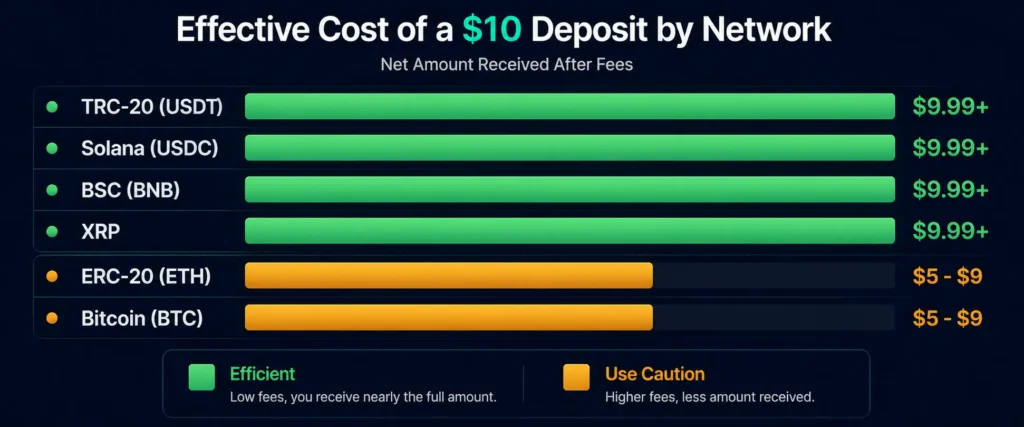
The minimum deposit does not mean $10 of spending power. Two deductions apply between “I deposited $10” and “I have $X on my card”:
Deduction 1: Blockchain network fee (paid to the network, not Rivocard) This varies enormously by network:
| Network | Typical network fee on a $10 deposit |
|---|---|
| USDT on TRC-20 (Tron) | Under $0.01 — negligible |
| USDC on Solana | Under $0.01 — negligible |
| BNB on BSC | Under $0.01 — negligible |
| XRP | Under $0.01 — negligible |
| USDT on ERC-20 (Ethereum) | $1-$15+ depending on congestion |
| Ethereum (ETH) | $1-$20+ depending on congestion |
| Bitcoin (BTC) | $1-$20+ depending on congestion |
For fast, low-fee networks (Tron, Solana, BSC), the network fee is so small on a $10 deposit that it is irrelevant. For Ethereum and Bitcoin, a $10 deposit during congestion could lose 10-50% of its value just to network fees before it even reaches your wallet.
Deduction 2: Rivocard’s 5% card funding fee (applied when you fund a card) When you move money from your wallet to a virtual card, 5% is deducted:
- $10 funded to a card → $0.50 fee → $9.50 on the card
- $20 funded to a card → $1.00 fee → $19.00 on the card
- $50 funded to a card → $2.50 fee → $47.50 on the card
So the realistic minimum-to-spend starting point, using USDT on TRC-20:
Deposit $10 USDT → wallet shows ~$10 → fund card with $10 → card has $9.50
That $9.50 is enough for many small purchases — a digital subscription under $10, an in-app purchase, a small SaaS payment.
The Practical Minimum for Different Use Cases
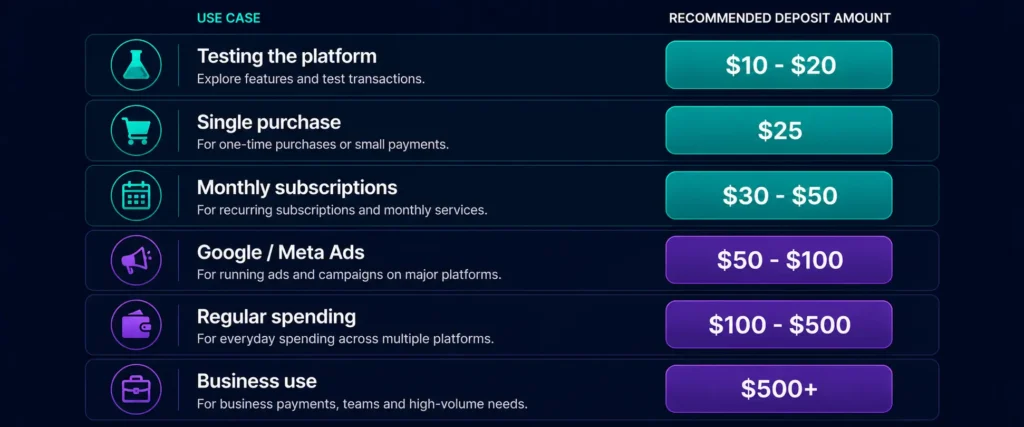
The “right” minimum deposit depends entirely on what you intend to use the card for:
| Use case | Recommended starting deposit | Why |
|---|---|---|
| Testing the platform | $10-$20 USDT via TRC-20 | Low risk, enough to verify the full flow works |
| Single online purchase under $20 | $25 USDT | Leaves enough buffer for the 5% fee and minor variance |
| Monthly subscriptions ($10-$15/month) | $30-$50 USDT | Covers 1-3 months of the subscription with the fee already accounted for |
| Google or Meta Ads (minimum daily budgets) | $50-$100 USDT | Ad platforms typically have their own minimum spend requirements |
| Regular everyday spending | $100-$500 USDT | Avoids frequent small reloads; one deposit covers weeks of use |
| Business use (multiple cards, vendors) | $500+ USDT | Enough to fund multiple cards and maintain a wallet buffer |
Why Bitcoin Has a Higher Effective Minimum
Bitcoin is perfectly valid for Rivocard deposits — but the network fee structure creates a higher practical minimum than stablecoins.
During normal Bitcoin network conditions, a medium-priority transaction costs $1-$5 in network fees. During high-congestion periods (major market events, weekends), fees can rise to $10, $20, or even higher.
Practical math for a $10 BTC deposit during moderate congestion:
- You send $10 worth of BTC
- Bitcoin network fee: $3 (deducted before arrival)
- Rivocard wallet receives: ~$7
- Fund card with $7: 5% fee = $0.35 → card has $6.65
That is a 33.5% reduction from what you sent to what you can spend — all from a $10 starting deposit.
The Bitcoin minimum that makes practical sense: $50-$100+, depending on current fee conditions. At $100 with a $3 network fee and 5% card funding fee, you end up with $91.65 to spend — a 8.35% total reduction, which is more reasonable.
To check current Bitcoin fees before sending, use mempool.space — it shows live fee rates and estimated confirmation times.
Why USDT on TRC-20 Has the Lowest Effective Minimum
USDT on Tron (TRC-20) is the most efficient asset for small deposits on Rivocard for two reasons:
- Network fees are fractions of a cent. On a $10 USDT TRC-20 deposit, the entire network fee is typically under $0.01. Your wallet receives effectively the full $10.
- Stable value. USDT is pegged to $1. There is no price movement between when you send and when it arrives — $10 USDT sent is $10 USDT received (minus the negligible network fee).
This makes TRC-20 USDT the right asset for minimum deposits, testing the platform, or any situation where you want to start with a small amount and see how the system works.
How to Calculate the Right Deposit Amount
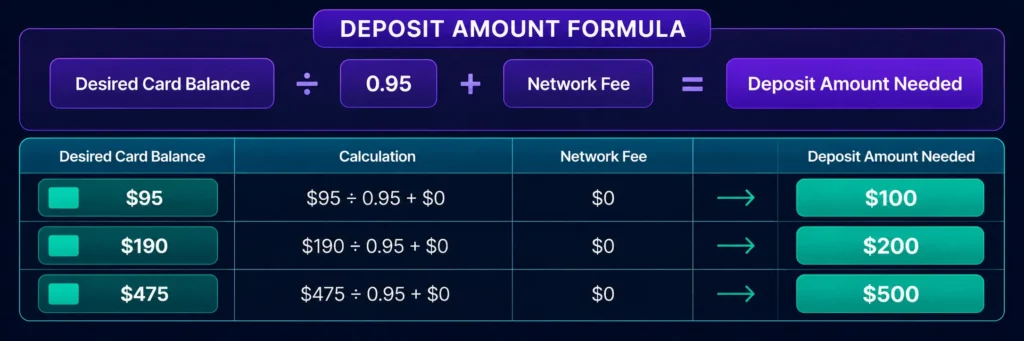
If you know what you want to spend on the card, work backward:
Formula: Deposit amount needed = (Desired card balance ÷ 0.95) + network fee
Examples:
- Want $95 on card → need to deposit ~$100 from wallet → need to deposit $100 + negligible network fee (TRC-20) ≈ $100.10 total sent
- Want $190 on card → need ~$200 from wallet → deposit $200 + network fee
- Want $475 on card → need ~$500 from wallet → deposit $500 + network fee
If you want to account for both the network fee and the 5% card funding fee in one calculation for Bitcoin:
Deposit amount = (Desired card balance ÷ 0.95) + estimated BTC network fee
For a $100 card balance with a $3 BTC fee: ($100 ÷ 0.95) + $3 = $105.26 + $3 = $108.26 total BTC to send
Minimum Deposit vs. Maximum Deposit
| Minimum | Maximum per transaction | |
|---|---|---|
| Wallet deposit | $10 USD equivalent | $10,000 USD equivalent |
| Card funding per transaction | No stated minimum | Depends on KYC tier |
| Card load limit (total) | — | $2,000 (Basic), $20,000 (Full), $100,000 (Enhanced) |
The $10,000 per-transaction maximum on deposits means that if you need to deposit more than $10,000 at once, you send multiple deposits. They all aggregate into the same wallet balance. There is no maximum on total wallet balance stated per the platform terms — though KYC tier limits constrain how much you can load onto individual cards.
For the full fee and limits breakdown, see our Rivocard fees breakdown.
What Happens If You Send Below the Minimum
If you send less than $10 USD equivalent to your Rivocard deposit address, the deposit may not credit. This creates a specific risk with Bitcoin and Ethereum: if fees are high and you send a small amount, the net amount after fees might fall below the $10 minimum — even though you sent more than $10 in total.
Example: You send $12 worth of Bitcoin during a congestion period with $5 network fees. Rivocard receives $7 — below the minimum. The deposit may not credit.
The fix: always send enough to ensure that after network fees, at least $10 arrives. For Bitcoin and Ethereum, build in extra buffer during high-fee periods. For Tron-based USDT, the minimum is effectively $10 since network fees are negligible.
First Deposit Strategy: What Most New Users Do
For users testing Rivocard for the first time, the most common first deposit is $20-$50 USDT via TRC-20. This gives enough to:
- Verify the deposit and conversion works
- Create a card and fund it with enough to make a real purchase
- Experience the full flow (deposit → wallet → card → purchase) without committing a large amount
After that test, most users increase subsequent deposits based on their actual spending patterns.
Starting from just $50, you can fund your virtual card funded by crypto and start spending the same day.FAQs
What is the minimum deposit for a Rivocard crypto card?
The minimum deposit to your Rivocard wallet is $10 USD equivalent in any supported cryptocurrency. However, the practical minimum for a useful card balance is $20-$50 when you account for the 5% card funding fee and (for some networks) blockchain network fees.
Can I deposit exactly $10 to start?
Yes, if you are using USDT on TRC-20 or another low-fee network. For Bitcoin or Ethereum, network fees may reduce a $10 deposit below the minimum that credits to your wallet. Add a fee buffer — send $12-$15 to ensure at least $10 arrives if using higher-fee networks.
What is the practical minimum deposit using Bitcoin?
With Bitcoin’s variable network fees, a practical minimum is $50-$100+ depending on current fee conditions. During high congestion, even a $20 Bitcoin deposit could lose significant value to fees. Check mempool.space for current fee rates before sending small BTC amounts.
What is the practical minimum using USDT on TRC-20?
$10 USDT is genuinely workable on TRC-20 because network fees are under $0.01. Send $10 USDT, your wallet receives approximately $10.00, fund a card with $10.00, and your card has $9.50 to spend. For most users, $20-$30 is a better starting amount to allow for a useful purchase.
How much should I deposit to get $100 on my card?
Deposit approximately $105.50 in stablecoin (USDT TRC-20) to get $100 on the card. This covers the 5% card funding fee: $105.26 × 95% = $100. For Bitcoin, add an estimate of the current network fee on top of that $105.26.
Is there a minimum card balance requirement?
No ongoing minimum balance is required on your card. Your card can sit at $0 balance with no penalty. Fund it only when you need to spend.
Is there a minimum wallet balance requirement?
No. Your Rivocard wallet balance can be $0 with no fees or penalties. Deposit when you need to fund cards.
What happens if my deposit is below the minimum?
The deposit may not credit to your wallet. Always confirm your deposit amount (after estimated network fees) will be $10 or above before sending. If a deposit does not arrive, check the transaction on a blockchain explorer and contact Rivocard support with the transaction hash.
Can I deposit multiple small amounts to reach the minimum?
Each individual deposit transaction must meet the $10 minimum. Sending two $5 deposits is not the same as one $10 deposit — each transaction is evaluated independently. Send a single transaction of $10 or more.
Does the minimum apply to card reloads too?
The $10 minimum applies to wallet deposits. For card reloads, check the minimum in your dashboard — effectively, you need enough wallet balance to cover the reload amount plus you should reload enough for the 5% fee not to make the reload impractical.
Get Started
Ready to make your first deposit? Create your Rivocard account →