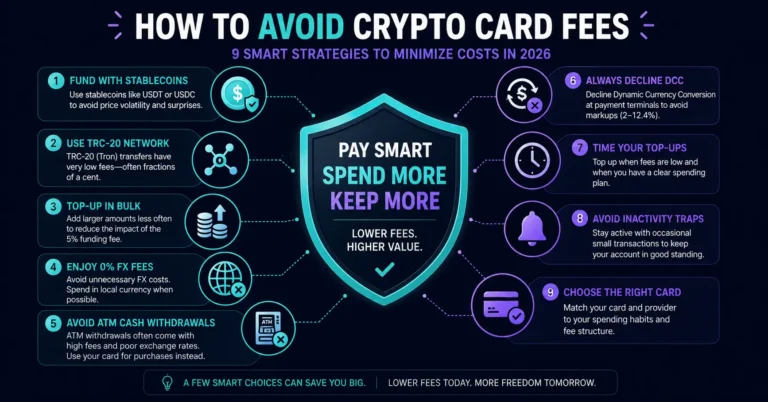
Quick answer: You cannot avoid crypto card fees entirely — every legitimate card platform has infrastructure costs that must be recovered somewhere. But you can minimize them significantly through nine practical strategies: use stablecoins instead of volatile assets, deposit on the cheapest network (TRC-20 USDT), fund cards in larger amounts less frequently, avoid ATMs, always pay in local currency to dodge DCC, choose a card with 0% FX fees for international spending, avoid inactivity on platforms that charge dormancy fees, time deposits during low network congestion, and pick a card whose fee structure matches your actual usage pattern. A typical crypto card user in 2026 pays 2–4% total on each dollar spent through the card. Power users who optimize their approach get that closer to 1–1.5%.
Why You Cannot Avoid All Fees — But Can Cut Most of Them
Common fees include monthly or annual maintenance fees, per-transaction fees on purchases, conversion spreads when converting volatile crypto to fiat, ATM withdrawal fees, and FX markups on non-USD spending. Not every card charges all of these, but many combine several simultaneously.
The costs that are genuinely unavoidable on any crypto card:
- Blockchain network fees — paid to miners or validators when you deposit. Not a card fee — a blockchain infrastructure cost. Ranges from fractions of a cent (Tron) to $15+ (Ethereum during congestion).
- The platform’s card funding fee — the mechanism by which the platform recovers its operational costs. On Rivocard this is 5%; on other platforms it may be a top-up %, a spread, a subscription, or a combination.
Everything else — FX fees, ATM fees, inactivity fees, card creation fees, conversion spreads — is avoidable through either platform choice or usage behavior. Here is how.
Strategy 1: Use Stablecoins Instead of Volatile Assets
Stablecoin spending avoids the liquidation fee and conversion spread that applies to volatile assets. It also reduces tax and budgeting complexity, because you are not disposing of an asset that may have appreciated since you acquired it.
When you deposit a volatile asset like Bitcoin or Ethereum, two costs apply that stablecoins avoid:
Conversion spread risk: Platforms that embed a spread in the exchange rate charge you on every volatile asset conversion. With USDT or USDC, the peg to $1 means the spread is minimal or zero — there is no meaningful gap between market rate and credited amount.
Price volatility window: With Bitcoin, the dollar value credited to your wallet is determined at the moment of blockchain confirmation — which could be 20-60 minutes after you sent. Price drops during that window reduce your credited amount. Stablecoins are $1 at send and $1 at confirmation.
On Rivocard: All 12+ supported coins have the same 0% deposit fee and 0% spread. But using USDT on TRC-20 specifically eliminates network fee cost (next strategy) and price risk simultaneously.
Strategy 2: Use the Cheapest Deposit Network
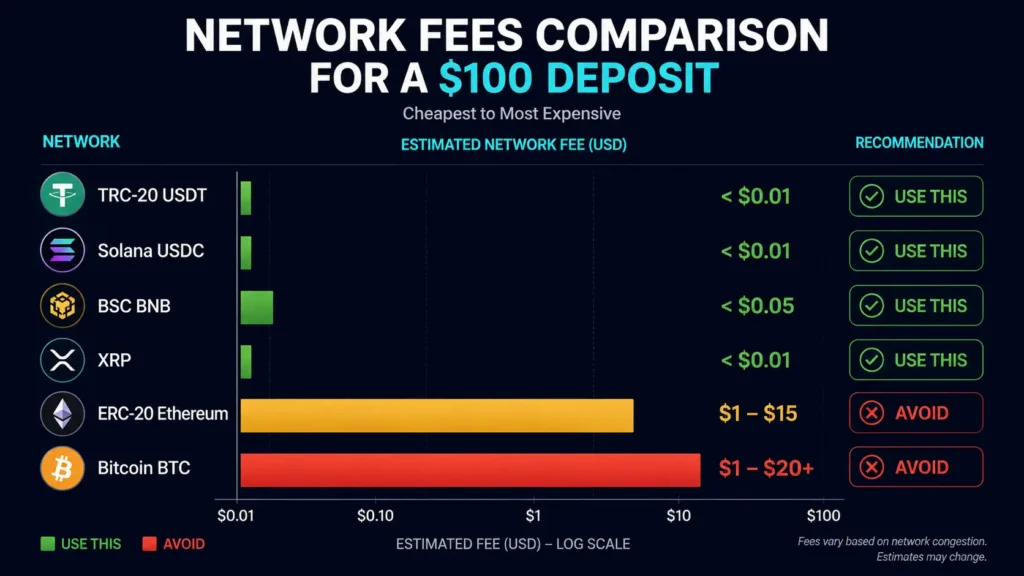
Sending USDT via TRC-20 usually costs under $1, while ERC-20 transfers cost $5-$15 or more during congestion. Choosing the right network is the single easiest way to reduce the unavoidable network fee cost.
Network fee comparison for a $100 deposit:
| Network | Typical network fee | % of $100 deposit |
|---|---|---|
| USDT on TRC-20 (Tron) | Under $0.01 | Under 0.01% |
| USDC on Solana | Under $0.01 | Under 0.01% |
| BNB on BSC | Under $0.05 | Under 0.05% |
| XRP on XRP Ledger | Under $0.01 | Under 0.01% |
| USDT on ERC-20 (Ethereum) | $1-$15+ | 1-15%+ |
| Bitcoin (BTC) | $1-$20+ | 1-20%+ |
Use TRC-20 USDT on Tron for the lowest chain fees — this is the consistent recommendation across the industry for minimizing deposit network costs. For a $50 deposit, a $3 Ethereum gas fee represents a 6% surcharge before any platform fee even applies. On Tron, the same deposit’s network fee is effectively $0.
Strategy 3: Fund Cards in Larger Amounts Less Frequently
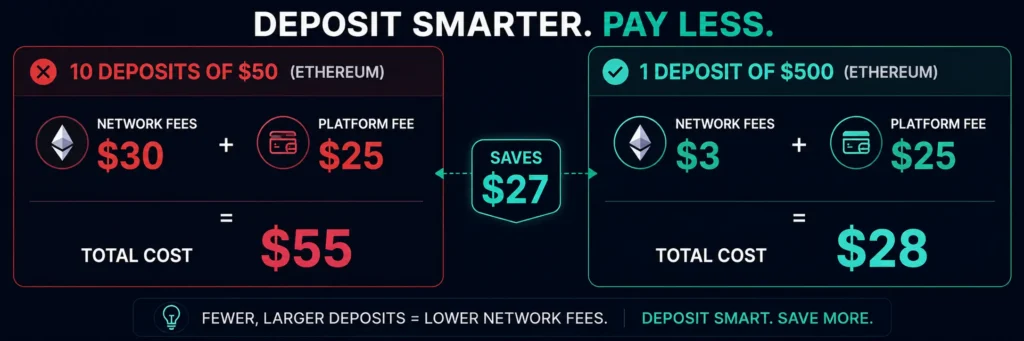
Top up in larger, less-frequent amounts to amortize top-up fees. Batch deposits into larger, less frequent loads rather than topping up small amounts repeatedly.
On platforms with a percentage-based funding fee (like Rivocard’s 5%), the percentage is the same regardless of amount — $10 funded costs $0.50 in fees, $500 funded costs $25. The percentage does not change.
However, if there is any per-transaction element (a flat fee, a minimum charge, or a network fee paid each time you deposit), batching saves significantly. Here’s the math for Ethereum deposits:
10 deposits of $50 via Ethereum (assume $3 gas each):
- Network fees: 10 × $3 = $30
- Platform funding fee (5%): 10 × ($50 × 5%) = $25
- Total fees: $55 on $500 deposited
1 deposit of $500 via Ethereum (assume $3 gas once):
- Network fee: $3
- Platform funding fee (5%): $500 × 5% = $25
- Total fees: $28 on $500 deposited
Same platform fee percentage, but batching saves $27 in network fees.
On Tron (TRC-20), where network fees are fractions of a cent, the batching benefit is minimal — but it is still good practice to avoid unnecessary transactions.
Strategy 4: Choose a Card With 0% FX Fee for International Use
Foreign transaction fees average around 1.5% in 2026, with some cards charging up to 3%. For anyone spending in currencies other than their card’s base currency — travelers, international online shoppers, anyone buying from foreign merchants — this fee compounds on every single transaction.
Annual cost of FX fees at different spending volumes:
| Monthly international spend | 0% FX (Rivocard) | 1.5% FX average | 3% FX high |
|---|---|---|---|
| $200/month | $0/year | $36/year | $72/year |
| $500/month | $0/year | $90/year | $180/year |
| $1,000/month | $0/year | $180/year | $360/year |
A card with a higher top-up fee but 0% FX can cost significantly less annually for international spenders. When comparing cards, always calculate the FX fee separately from the top-up fee — they are different costs that compound differently.
Strategy 5: Never Use ATMs Unless You Genuinely Need Cash
Avoid ATMs unless you genuinely need cash — they are the single most expensive way to use a crypto card.
ATM withdrawals on crypto cards typically involve three layers of cost:
- Platform ATM fee: 2-3% of the withdrawal, or a flat fee above the free monthly allowance
- ATM operator surcharge: $1.50-$5.00 charged by the ATM owner, unavoidable
- FX fee (if foreign ATM): Additional % on international ATM use at some platforms
A $100 ATM withdrawal can realistically cost $5-$10 in combined fees. The same $100 spent via card purchase at most platforms costs nothing extra.
Alternatives to ATMs:
- Use Apple Pay or Google Pay at merchants with NFC terminals for in-person spending
- At retailers that offer cash-back at point of sale, request cash-back on a purchase (treated as a purchase, not an ATM withdrawal)
- Plan cash needs in advance at home through a bank account rather than ATM from a crypto card abroad
Strategy 6: Always Pay in Local Currency (Decline DCC)
Dynamic Currency Conversion (DCC) is an option some ATMs and merchants offer: they convert the transaction to your home currency at the terminal rather than letting your card issuer do it.
DCC markups range from 2% to 12.4% on ATM withdrawals. Consumers are financially worse off in practically every case when they accept DCC. The exchange rate used by the merchant’s DCC service is almost always worse than the rate your card would apply.
The rule: When a terminal asks “Would you like to pay in [your home currency] or [local currency]?” — always choose local currency. Without exception. Even if the amount in your home currency looks familiar and “easier.”
This applies to both ATM withdrawals and point-of-sale terminals. The DCC provider profits from the markup; you pay it.
Strategy 7: Check Network Congestion Before Depositing Bitcoin or Ethereum
For volatile asset deposits on fee-market blockchains (Bitcoin and Ethereum), network congestion directly determines how much you pay in gas and how long you wait.
Avoid peak network times to limit gas spikes. Choose low-fee networks such as TRC-20 instead of ERC-20. Combine transactions to reduce on-chain volume.
How to time deposits:
- Bitcoin: Check mempool.space before sending. The current fee rate (in sat/vB) tells you what fee level confirms in which time window. During weekday evenings (UTC) and weekend peaks, fees are typically highest.
- Ethereum: Check etherscan.io/gastracker before sending. Gas prices fluctuate by 2-5x between low and high periods. Depositing during low-activity hours (typically early morning UTC weekdays) saves meaningfully.
If timing is not possible, the simpler solution is switching to Tron for the deposit — fees are always fractions of a cent, regardless of time or congestion.
Strategy 8: Avoid Platforms With Inactivity Fees
Some crypto card providers charge a monthly inactivity fee after 12 months of no cardholder-initiated financial activity — a fee that can increase over time as a dormancy penalty.
This fee is particularly costly for users who:
- Use a card seasonally (heavily for travel, then not at all for months)
- Load a card for a specific purpose and then leave the account idle
- Forget about an account with a small balance
How to avoid it: Choose a platform with no inactivity fee (Rivocard charges $0 for inactivity at any duration) or set a calendar reminder to make a small transaction before the inactivity trigger period expires.
Strategy 9: Match the Fee Structure to Your Usage Pattern
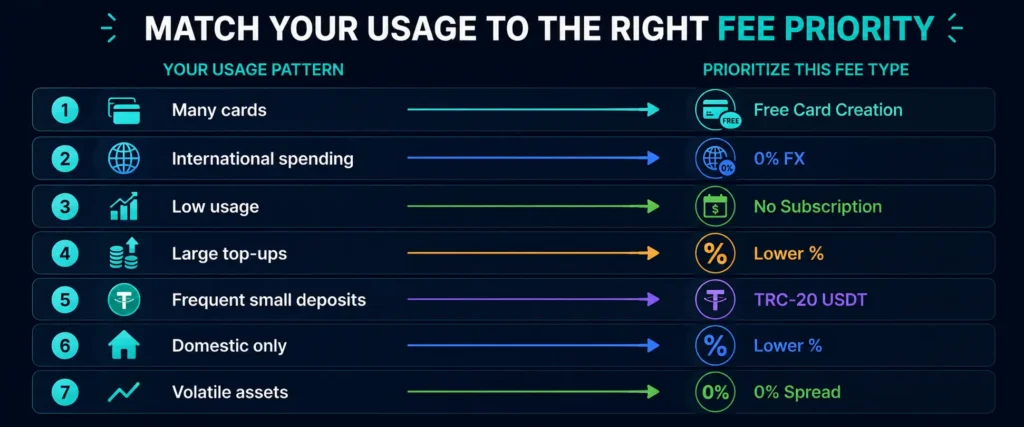
The most effective fee avoidance strategy is choosing the card whose fee model aligns with how you actually spend. The difference between a transparent provider and an opaque one is not always the fees themselves — it is whether you can find, understand, and predict them before you commit your funds.
Quick matching guide:
| Your usage pattern | Fee type that matters most | What to prioritize |
|---|---|---|
| Many virtual cards (10+) | Card creation fee | Free card creation |
| Heavy international spending | FX fee | 0% FX |
| Occasional use, low volume | Monthly fee | No subscription |
| Large, infrequent top-ups | Top-up fee % | Lower percentage |
| Frequent small top-ups | Network fee | TRC-20 USDT |
| Primarily domestic spending | Top-up fee % | Lower percentage |
| Volatile asset deposits | Conversion spread | 0% spread |
No single card is cheapest for every pattern. The card that minimizes your fees is the one whose fee structure penalizes your usage pattern the least.
How These Strategies Apply on Rivocard
On Rivocard specifically, the fee you cannot avoid is the 5% card funding fee. Every other strategy above reduces costs that are either already zero on Rivocard or apply to the unavoidable network fee:
| Strategy | Rivocard impact |
|---|---|
| Use stablecoins | Reduces price risk; deposit fee already 0% |
| Use TRC-20 network | Network fee from fractions of a cent to $0.01 |
| Fund in larger amounts | Reduces number of network fee transactions |
| 0% FX card | Already applies — Rivocard charges 0% FX |
| Avoid ATMs | Virtual cards cannot use ATMs — N/A |
| Decline DCC | Always applicable when using the card in person |
| Avoid congestion | Mainly relevant if depositing BTC/ETH |
| Avoid inactivity fees | Already applies — Rivocard charges $0 inactivity |
| Match fee structure | 5% top-up + free everything else matches multi-card, international users |
The one fee you cannot reduce on Rivocard is the 5% card funding fee itself — it applies equally on all top-up amounts. The strategies above minimize every other cost layer that surrounds it.
FAQs
Can you completely avoid crypto card fees?
No — every legitimate crypto card platform has operational costs that must be recovered somewhere. What you can avoid: FX fees (choose a 0% FX card), inactivity fees (choose a platform that does not charge them), ATM fees (avoid ATMs), conversion spreads (use stablecoins on low-spread platforms), and card creation fees (choose platforms with free card creation). The platform’s core funding fee and blockchain network fees cannot be entirely avoided.
What is the best cryptocurrency to use to minimize crypto card fees?
USDT on TRC-20 (Tron) is consistently the most cost-efficient deposit asset: fractions of a cent in network fees, stablecoin pricing eliminates conversion spread risk, and confirmation in seconds. For most crypto card users, TRC-20 USDT is the default best choice for deposits.
How do I avoid paying high network fees when topping up a crypto card?
Use the Tron network (TRC-20) for USDT deposits — network fees are fractions of a cent regardless of congestion. If you must use Ethereum, check gas prices on etherscan.io/gastracker and deposit during low-activity periods (early morning UTC on weekdays). If you must use Bitcoin, check mempool.space for current fee conditions before sending.
Does topping up in larger amounts save on fees?
Yes, if you deposit via high-fee networks like Ethereum or Bitcoin, where each transaction carries a fixed gas cost. Depositing $500 once pays gas once; depositing $50 ten times pays gas ten times. On Tron, the gas is negligible so this matters less — but it is still good practice.
How can I avoid FX fees on a crypto card?
Choose a card that charges 0% on foreign currency transactions. Rivocard charges 0% FX fees. Additionally, always decline Dynamic Currency Conversion (DCC) when an ATM or merchant offers to charge you in your home currency — DCC exchange rates add 2-12% over what your card would charge.
What is Dynamic Currency Conversion and why should I avoid it?
DCC is when a merchant or ATM offers to convert a transaction to your home currency at the terminal. The exchange rate used is set by the DCC provider and is almost always worse than your card’s rate — by 2% to 12.4%. Always choose to pay in the local currency instead.
How do I avoid inactivity fees on a crypto card?
Either choose a platform that charges no inactivity fee (Rivocard charges $0 regardless of how long the account is inactive), or set a calendar reminder to make at least one small transaction before your platform’s inactivity trigger period expires.
Is it cheaper to make many small top-ups or fewer large ones?
Fewer larger top-ups are typically cheaper when there is a per-transaction cost (like blockchain network fees). The percentage-based platform funding fee is the same regardless of amount, but the network fee may be paid once for a large deposit versus many times for multiple small deposits.
Can I avoid the 5% card funding fee on Rivocard?
No. The 5% fee is the only fee Rivocard charges and applies to every card funding and reload. It cannot be reduced or waived. What you can do is minimize all surrounding costs: use TRC-20 USDT to minimize network fees, fund in appropriately sized amounts to reduce transaction count, and use the card for international spending where Rivocard’s 0% FX saves money vs alternatives.
What is the best strategy to minimize total crypto card costs in 2026?
Use TRC-20 USDT for deposits (near-zero network fees, stablecoin stability), choose a card with 0% FX for international spending, avoid ATMs, decline DCC at terminals, fund in appropriately sized batches rather than frequent tiny top-ups, and choose a card with no inactivity fee. Applied together, these strategies can reduce total effective cost from the industry average of 2-4% to closer to 1-1.5% for engaged users.
Get Started
Want to see exactly what you will pay on Rivocard before signing up? Read the complete fee breakdown →