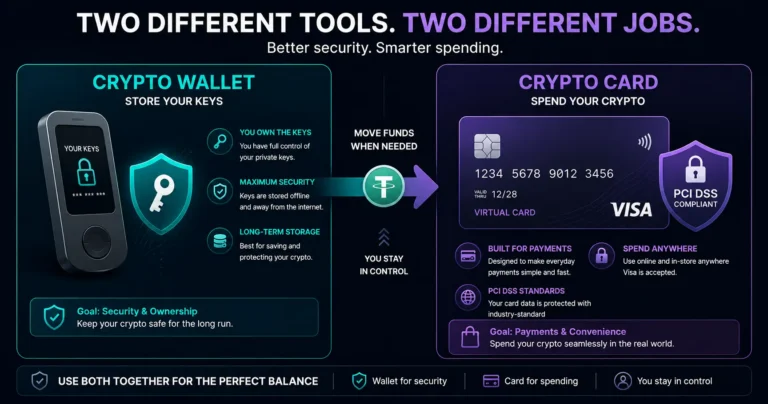
Quick answer: A crypto wallet and a crypto card solve fundamentally different security problems and are not competing tools — they are complementary. A crypto wallet (hardware or software) secures your private keys and protects cryptocurrency you are holding long-term. A crypto card (like Rivocard) converts crypto to a spendable fiat balance and protects that fiat balance using payment card infrastructure — PCI DSS compliance, encrypted storage, Visa network fraud protections, and instant card freeze. The security models are entirely different because the assets being protected are different: a wallet protects on-chain crypto assets via private key security; a card protects a fiat spending balance via financial services security infrastructure. Most crypto users need both.
What a Crypto Wallet Protects and How
A crypto wallet does not actually store cryptocurrency — it stores the private keys that prove ownership of cryptocurrency on a blockchain. A hardware wallet stores private keys offline, reducing exposure to malware, phishing attacks, and compromised online environments. Unlike software wallets, hardware devices isolate sensitive cryptographic operations from internet-connected devices.
The security model of a crypto wallet is built around one critical concept: private key protection.
Your private key is a cryptographic secret that, when combined with your public address, allows you to authorize transactions from that address. Anyone who has your private key has full, irrevocable access to all assets associated with it. Blockchain transactions are irreversible — there is no dispute process, no chargeback, no support call that recovers funds taken by someone with your private key.
Wallet types and their security models:
| Wallet type | Where keys are stored | Online exposure | Best for |
|---|---|---|---|
| Hardware wallet (cold) | Offline device (Ledger, Trezor) | None — air-gapped | Long-term holdings, large amounts |
| Software wallet (hot) | Device RAM / encrypted file | Always online | Active trading, DeFi, small amounts |
| Exchange custody | Exchange’s servers | Always online | Convenience — you do not control keys |
| Paper wallet | Physical paper | None | Long-term, low-tech cold storage |
The fundamental security risk for any crypto wallet is key exposure — through malware, phishing, physical theft of the device, or a compromised seed phrase. Recovery from a compromised wallet is typically impossible: funds are moved to the attacker’s address and are gone.
What a Crypto Card Protects and How
A crypto card like Rivocard converts cryptocurrency to a fiat balance and provides a Visa card to spend that fiat. The security model is completely different from a wallet’s because the asset being protected has changed.
Once you deposit crypto to Rivocard and it converts to a wallet balance, you no longer have crypto — you have a dollar balance on a regulated payment platform. The security model now mirrors fintech and banking security:
- PCI DSS compliance: Card data encrypted, CVVs never stored, access controls audited
- Encryption: All data encrypted in transit (TLS) and at rest (AES-256)
- Segregated accounts: Your fiat balance held separate from company funds
- Visa network protections: 3D Secure authentication, fraud monitoring, Zero Liability Policy
- Account security: Password hashing, 2FA (hardware key, FaceID, TouchID)
- Instant card controls: Freeze, delete, and replace cards from the dashboard
The security risk for a crypto card is different from a wallet: it is account compromise (phishing, credential theft, SIM swapping) and card number theft — not private key exposure. And crucially, the dispute resolution mechanisms that do not exist for blockchain transactions do exist for card payments.
The Critical Difference: Reversibility
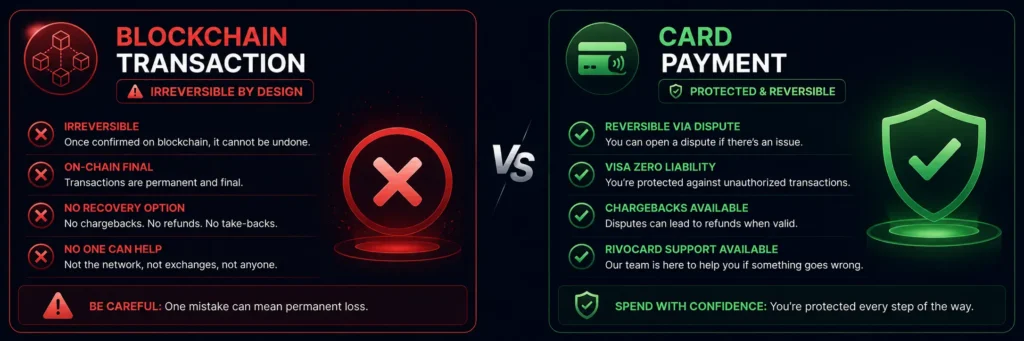
This is the most important distinction between wallet and card security:
| Crypto wallet transaction | Crypto card purchase | |
|---|---|---|
| Reversibility | Irreversible — blockchain transactions are final | Reversible via card dispute process |
| Recovery if unauthorized | Typically none | Visa Zero Liability Policy — report and dispute |
| Time to resolve | Never — funds are gone | Days to weeks via standard dispute process |
| Who can help | No one — blockchain is decentralized | Rivocard support + Visa network |
When you spend from a Rivocard virtual card, you are making a standard Visa transaction. If the merchant fails to deliver, overcharges you, or acts fraudulently, you have standard card dispute rights. If the card is used without authorization, Visa’s Zero Liability Policy protects you when the transaction is reported promptly.
None of this exists for blockchain transactions. If you send Bitcoin to the wrong address from a hardware wallet, no one can reverse it. The blockchain is indifferent to mistakes.
The Asset Flow: From Wallet to Card
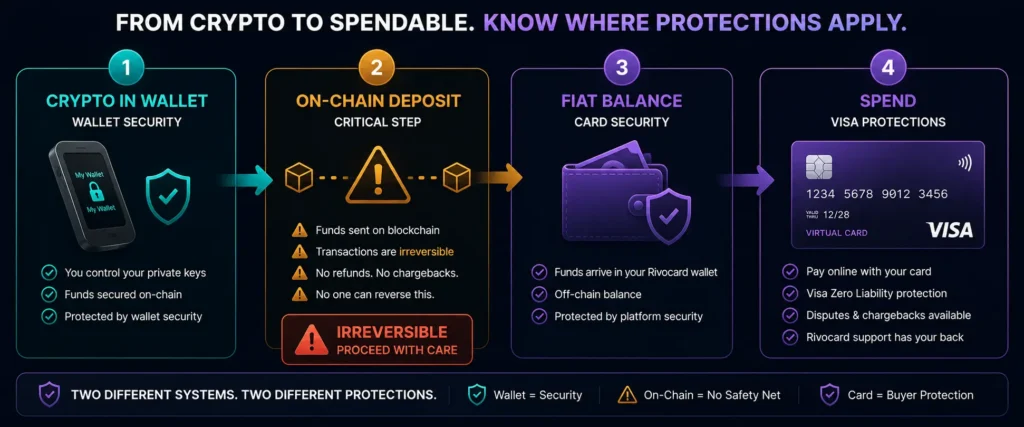
Understanding the security of each tool requires understanding how assets flow between them:
Step 1: Crypto in your wallet (wallet security applies) You hold 500 USDT in a hardware wallet or exchange account. This is protected by your wallet’s private key security model.
Step 2: You send 500 USDT to your Rivocard deposit address (on-chain transaction) This is the critical bridge moment. You are making an irreversible blockchain transaction. Your wallet’s private key security must be intact. The deposit address must be correct — a clipboard hijacker attack here results in lost funds.
Step 3: Rivocard converts USDT to $500 wallet balance (card security applies) Once confirmed on-chain, the 500 USDT is converted to $500 in your Rivocard wallet. From this point, you are in the card security model. The crypto is gone — the fiat balance is what exists now.
Step 4: You fund a virtual card and spend (card security applies) From your $500 wallet balance, you fund a virtual card ($475 on card after 5% fee). Every purchase is a Visa transaction with card security protections.
The on-chain step (Step 2) is where wallet-level security risks apply. Steps 1 and 3-4 are wallet and card security respectively. Getting through Step 2 safely is where clipboard hijacker awareness, address verification, and network matching matter.
Side-by-Side Security Comparison
| Security dimension | Crypto wallet | Crypto card (Rivocard) |
|---|---|---|
| What is protected | Private keys → blockchain assets | Fiat balance → spending power |
| Primary security mechanism | Key storage security (offline ideal) | PCI DSS, encryption, 2FA, Visa network |
| Key security risk | Private key theft, seed phrase exposure | Account compromise, card number theft |
| Transaction reversibility | Never | Yes — via card dispute process |
| Recovery from unauthorized access | Typically none | Visa Zero Liability + dispute process |
| Regulatory protection | Minimal — blockchain is decentralized | Card network rules, financial regulations |
| Freeze capability | N/A — cannot freeze blockchain address | Instant card freeze from dashboard |
| Dispute resolution | None | Rivocard support + Visa network |
| Best suited for | Storing crypto you are not spending | Spending crypto you have already converted |
When You Need a Wallet and When You Need a Card
These tools serve different stages of your crypto financial life:
Use a crypto wallet when:
- Storing crypto you intend to hold for months or years
- Holding large amounts where losing the key would be catastrophic
- Interacting with DeFi protocols, NFTs, or on-chain applications
- You need to self-custody assets (not your keys, not your coins)
- Protecting cryptocurrency before you are ready to spend it
Use a crypto card when:
- You want to spend crypto at real-world merchants
- You need a card number for online purchases, subscriptions, or digital advertising
- You want spending with dispute resolution and consumer protections
- You need a Visa card accepted anywhere in the world
- You want instant card controls (freeze, replace, delete) without on-chain operations
The typical user flow: Hold long-term crypto in a hardware wallet → when ready to spend, transfer to Rivocard wallet → card balance for day-to-day purchases. The hardware wallet for storage, the Rivocard for spending.
Common Security Mistakes That Arise From Confusing the Two
Mistake 1: Treating a card platform as a long-term crypto wallet Your Rivocard wallet balance is fiat — it is not crypto storage. It is appropriate for funds you plan to spend in the near term, not for long-term crypto holdings. For long-term storage, a hardware wallet with your own private keys is the right tool.
Mistake 2: Treating a crypto wallet as a payment card A hardware wallet address is not a payment card number. You cannot enter a wallet address at an online checkout. The wallet must be used to fund a card platform first.
Mistake 3: Ignoring the on-chain deposit step Users who understand card security (and trust Rivocard’s PCI DSS infrastructure) sometimes underestimate the risk of the deposit step. The blockchain transaction from wallet to Rivocard is the most dangerous single step — irreversible, clipboard hijackable, and network-error-prone. Apply maximum attention to the deposit step even if you trust the card platform completely.
Mistake 4: Using exchange custody as both wallet and card Keeping crypto at an exchange for spending is not equivalent to having a dedicated card. Exchange accounts are not designed for card-payment use cases and lack the freeze/replace/virtual card features of a dedicated card platform.
The Combined Security Model: Wallet + Card Together
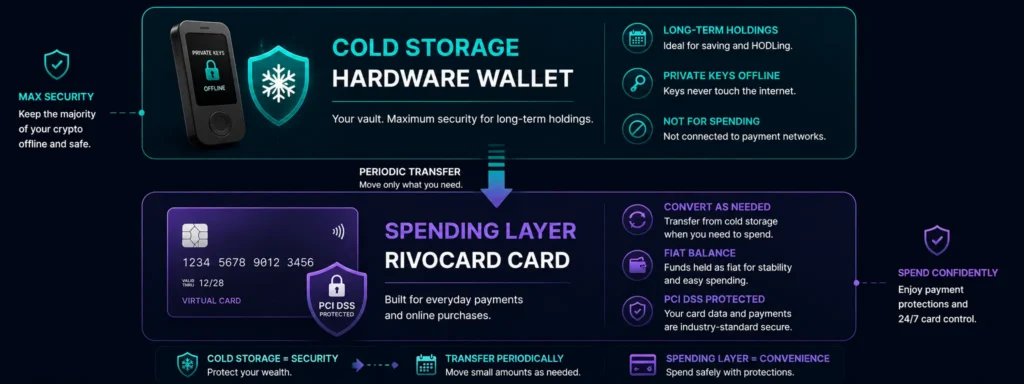
The strongest security model for a crypto user who wants both storage and spending capability:
Cold storage layer (hardware wallet): Long-term holdings that you do not need to spend imminently. Private keys never touch an internet-connected device. Best protection against remote attacks.
Spending layer (Rivocard): Funds you plan to spend in the coming weeks or months. Converted to fiat, protected by card security infrastructure, accessible for immediate spending. Replace the balance periodically from the cold storage layer.
This two-layer approach means that:
- A compromise of the Rivocard account (credential theft, card number exposure) affects only the card spending balance — not long-term holdings in cold storage
- A compromise of the cold storage wallet affects only the crypto there — not the already-converted fiat on the card
- Each layer is appropriate to its security model — the wallet for asset custody, the card for spending
FAQs
What is the difference between a crypto card and a crypto wallet?
A crypto wallet stores private keys that control on-chain cryptocurrency assets. A crypto card (like Rivocard) converts cryptocurrency to a fiat balance and provides a Visa card to spend it. They use completely different security models: wallets rely on private key protection; cards rely on PCI DSS compliance, encryption, and Visa network protections.
Which is more secure — a crypto wallet or a crypto card?
They protect different things, so direct comparison is not meaningful. A hardware wallet is the most secure way to store private keys for long-term crypto holdings. A crypto card is the most appropriate tool for spending converted crypto at merchants — with dispute resolution and consumer protections that blockchain transactions do not have.
Can a crypto card replace a crypto wallet?
No. A crypto card converts crypto to a spendable fiat balance — it does not store or custody your cryptocurrency. You still need a wallet (or exchange account) as the source of funds. The card is the spending layer; the wallet is the custody layer.
What happens to my crypto when I deposit it to Rivocard?
Once your deposit confirms on-chain and Rivocard processes it, the crypto is converted to a fiat dollar balance in your Rivocard wallet. The crypto itself is gone from your control — you now hold a fiat balance on Rivocard’s regulated platform. This is irreversible from your side.
If my Rivocard account is compromised, are my crypto holdings affected?
Only if your long-term holdings are also on Rivocard. If you maintain long-term crypto in a separate hardware wallet or exchange, a Rivocard compromise affects only the fiat balance on Rivocard — not your other crypto assets.
What security risks are unique to the deposit step from wallet to card?
The on-chain deposit is the highest-risk step: it is irreversible, vulnerable to clipboard hijacker malware (which replaces addresses in your clipboard), and vulnerable to network-matching errors (sending on the wrong blockchain). Always copy-paste addresses and verify the first and last 4 characters. Always confirm the network on your sending wallet matches the network shown on Rivocard’s deposit page.
Does a crypto card provide the same protections as a bank card?
Crypto cards on Visa rails carry the same card-network protections as traditional Visa debit or prepaid cards — 3D Secure authentication, fraud monitoring, and the Visa Zero Liability Policy for unauthorized transactions. They do not typically carry FDIC insurance (a bank-specific protection), but the card network fraud protections are equivalent.
Should I use a hardware wallet or a crypto card for large amounts?
Use a hardware wallet for long-term storage of large crypto holdings. Use a crypto card for converting smaller amounts to spend. Keeping large amounts on a card platform carries counterparty risk (platform risk) that holding your own private keys in cold storage does not.
Is it safe to keep a balance in my Rivocard wallet?
Your Rivocard wallet balance (fiat) is held in segregated banking accounts under PCI DSS-compliant infrastructure. It is appropriate for funds you plan to spend soon. For long-term storage of significant amounts, a hardware wallet with self-custody private keys offers a stronger security model.
What is the best security setup for someone who wants to hold and spend crypto?
The recommended two-layer setup: hardware wallet for long-term holdings (private keys under your control, offline), Rivocard for spending (convert smaller amounts as needed, protected by card security infrastructure). This isolates long-term holdings from spending-account risk and spending from long-term-storage risk.
Get Started
Ready to set up your spending layer alongside your existing wallet? See how Rivocard works as a spending card →