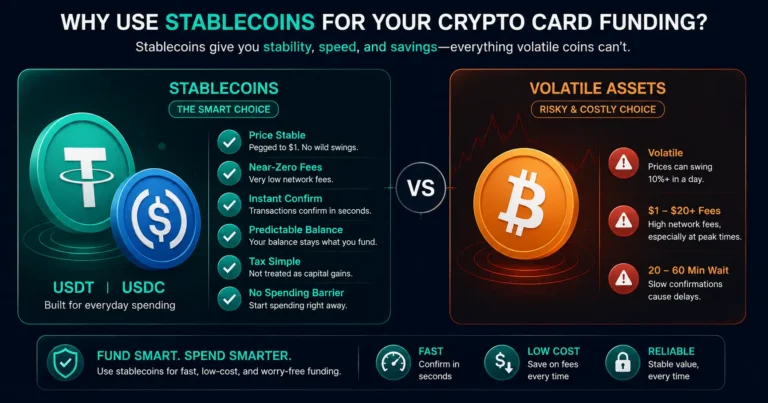
Quick answer: Stablecoins are the best cryptocurrency for card funding because they eliminate the four biggest frictions of using volatile crypto for spending: price uncertainty during deposit confirmation, high and unpredictable network fees (for Ethereum-based assets), tax complexity from disposing of appreciated assets, and the psychological difficulty of spending something you think might be worth more tomorrow. USDT on TRC-20 specifically confirms in seconds, costs fractions of a cent, arrives at exactly the dollar value you sent, and raises no capital gains concern on its own because its value has not changed. Monthly crypto card transaction volumes reached $7.8 billion cumulative through May 2026, with the majority driven by stablecoin-funded cards. Stablecoins have won the card funding layer — and for good practical reasons.
What Is a Stablecoin and Why Does the Peg Matter
A stablecoin is a cryptocurrency designed to maintain a constant value relative to a reference asset — almost always the US dollar. The two largest are USDT (Tether) and USDC (USD Coin by Circle), both pegged 1:1 to $1 USD.
The peg matters for card funding because it eliminates the variable that makes every other deposit asset complicated: price movement between when you send and when the deposit confirms.
Most people do not want to pay for a purchase with an asset that can move 5% before lunch. That is the basic reason stablecoins matter — USDC and USDT give users a crypto-native balance that feels close to dollars, moves across blockchains, and is supported by many wallets and exchanges.
When you send $200 USDT, you receive approximately $200 in your wallet. Not $191 if the market dropped, not $209 if it rose. $200. For a tool whose entire purpose is converting crypto to spending power, this predictability is foundational.
Advantage 1: Price Stability During Deposit
Every cryptocurrency deposit involves a confirmation window — a period of time between when you send and when the blockchain finalizes the transaction. For Bitcoin, this window is 20-60 minutes. For Ethereum, 1-30+ minutes during congestion.
During that window, the dollar value of your deposit is unfixed. The exchange rate credits your wallet at the price when the transaction confirms — not when you sent it.
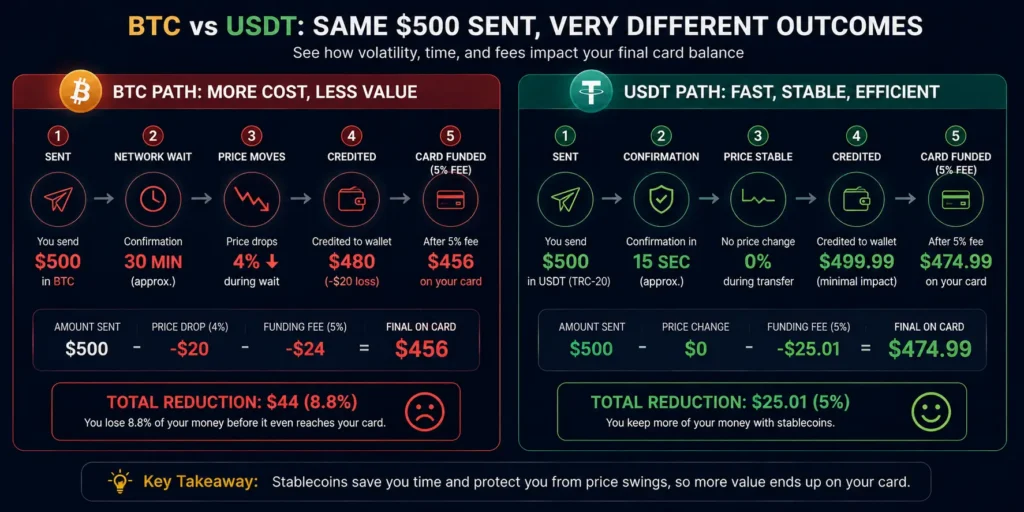
Example with Bitcoin: You send $500 worth of BTC at 10:00. BTC drops 4% during a 30-minute confirmation window. Your wallet is credited $480. Combined with Rivocard’s 5% card funding fee on $480, your card has $456. You sent the equivalent of $500 and have $456 to spend — a 8.8% total reduction from volatility plus fee.
Example with USDT on TRC-20: You send $500 USDT at 10:00. It confirms in 15 seconds. Your wallet is credited $499.99. Fund a card: 5% fee leaves $474.99. Total reduction: 5.01% — entirely from Rivocard’s fee, with nothing lost to price movement.
The stablecoin user pays only the platform’s fee. The volatile-asset user pays the platform’s fee plus whatever price moved against them during confirmation.
Advantage 2: Near-Zero and Predictable Network Fees
Network fees are paid to blockchain validators — not to Rivocard — and directly reduce how much arrives in your wallet from a given deposit. The fee amounts differ dramatically by asset:
| Asset | Typical network fee | Fee on a $100 deposit |
|---|---|---|
| USDT on TRC-20 (Tron) | Under $0.01 | Under 0.01% |
| USDC on Solana | Under $0.01 | Under 0.01% |
| Ethereum (ETH) | $1-$30+ | 1-30%+ |
| Bitcoin (BTC) | $1-$20+ | 1-20%+ |
| USDT on ERC-20 (Ethereum) | $1-$30+ | 1-30%+ |
For regular card top-ups of $50-$300, Ethereum and Bitcoin network fees represent a meaningful percentage of the deposit before Rivocard’s 5% even applies. USDT on TRC-20 and USDC on Solana have fees so low they are negligible at any deposit size.
This is not a minor difference. A user who tops up $200/month with Ethereum at average gas costs ($5 per deposit) pays $60/year in network fees alone. The same top-ups with TRC-20 USDT cost under $0.12/year in network fees.
Advantage 3: Predictable Card Balance
With volatile assets, you cannot know exactly how much will be on your card until the deposit confirms and you fund the card. This creates friction for planning:
- You want $190 on your card but you cannot be certain your $200 BTC deposit will arrive as $200 (it might be $191 or $208 depending on price movement)
- You want to top up for a specific purchase but you cannot calculate the right send amount without knowing the current-and-future-confirmed price
- You want to budget a card for a specific monthly spend limit, but volatile deposits make budgeting imprecise
With stablecoins, the math is simple and deterministic:
- Want $190 on your card? Deposit approximately $200 USDT (the 5% Rivocard fee leaves $190)
- Want $475 on your card? Deposit $500 USDT
- Want to top up for a $95 purchase? Deposit $100 USDT
Because stablecoins are pegged to fiat currencies, purchasing power remains steady — your balance is predictable when you spend.
Advantage 4: Speed — Seconds vs 30-60 Minutes
For a card funding tool, confirmation speed determines how quickly you can spend. A card top-up that takes 45 minutes to confirm is not useful if you need the balance in the next 10 minutes.
| Asset | Typical confirmation time |
|---|---|
| USDT on TRC-20 (Tron) | 3-30 seconds |
| USDC on Solana | Under 5 seconds |
| XRP | 3-5 seconds |
| Ethereum | 1-30+ minutes |
| Bitcoin | 20-60+ minutes |
USDT on TRC-20 and USDC on Solana are the fastest practical deposit options available. From Binance withdrawal to funded Rivocard card: under 4 minutes end-to-end. From a Bitcoin deposit to a funded card: 25-70 minutes minimum.
For ad spend that needs to go live today, subscriptions billing tonight, or any time-sensitive purchase, only a fast-confirming stablecoin reliably meets the requirement.
Advantage 5: Simplified Tax Treatment
This is one of the most underappreciated reasons to use stablecoins for card funding. In most jurisdictions, spending or converting a cryptocurrency that has appreciated in value is a taxable disposal event — you owe capital gains tax on the appreciation.
Example with Bitcoin: You bought 0.01 BTC at $30,000 ($300). You spend this BTC to fund a card when BTC is at $60,000 ($600). You have realized a $300 capital gain — taxable in most jurisdictions.
Example with USDT: You bought $300 USDT at $1 per token (300 tokens). You spend 300 USDT to fund a card when USDT is still $1 (as it always is). You have realized a $0 capital gain. Nothing taxable.
Stablecoins, by design, do not appreciate. A USDT purchased at $1 is worth $1 when you spend it. The absence of appreciation means no capital gains event from stablecoin spending in most tax frameworks (though you should confirm with a qualified tax advisor for your jurisdiction — rules vary and evolve).
For users who hold appreciated Bitcoin or Ethereum and want to avoid triggering tax events, funding a card with stablecoins acquired at parity (not from conversion of appreciated crypto) is the cleaner approach.
Advantage 6: No Psychological Spending Barrier
This is a behavioral advantage that gets less attention but matters in practice.
Spending Bitcoin or Ethereum involves an implicit cost calculation every time: “If I spend this BTC now and BTC doubles next month, I spent $X but lost $2X in future value.” This is not irrational — it is economically accurate. Using an appreciated asset for consumption is a form of opportunity cost that makes spending feel more expensive than the nominal amount.
Stablecoins eliminate this entirely. A USDT that was $1 yesterday is $1 today and will be $1 tomorrow. There is no future-value calculus. Spending $100 USDT for a software subscription costs $100 — not $100 plus whatever BTC might do next month.
Stablecoins solved a boring but expensive problem: moving digital dollars across crypto rails without the friction of fiat bank transfers every time. Payments came later because the user experience was worse than cards. That is changing.
For card spending specifically, stablecoins feel more like money and less like spending an investment. That psychological alignment with “this is for spending, not holding” makes them the natural card funding asset.
The 2026 Market Context: Stablecoins Have Won
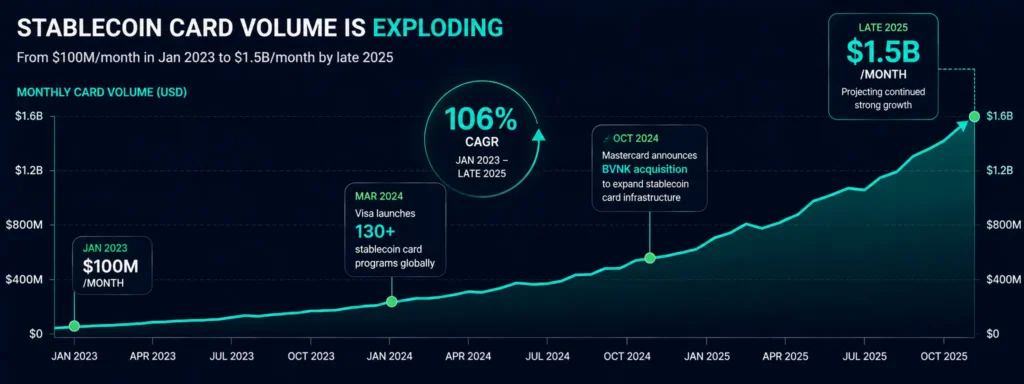
In 2026, Visa runs more than 130 stablecoin-linked card programs across more than 50 countries. Mastercard acquired stablecoin infrastructure provider BVNK for up to $1.8 billion.
Crypto card volume grew from around $100 million per month in early 2023 to more than $1.5 billion per month by late 2025 — a 106% compound annual growth rate. McKinsey separately estimated that stablecoin-linked card spending reached $4.5 billion in 2025, up 673% from 2024.
Visa is expanding stablecoin settlement because banking partners are not only asking about it — they are preparing to use it.
The data is unambiguous: stablecoins are the primary funding layer for crypto card spending in 2026, not a niche option. The market has validated what the practical advantages suggest: stablecoins are the right tool for converting crypto-native value to real-world spending power.
Which Stablecoin Is Best for Rivocard Funding
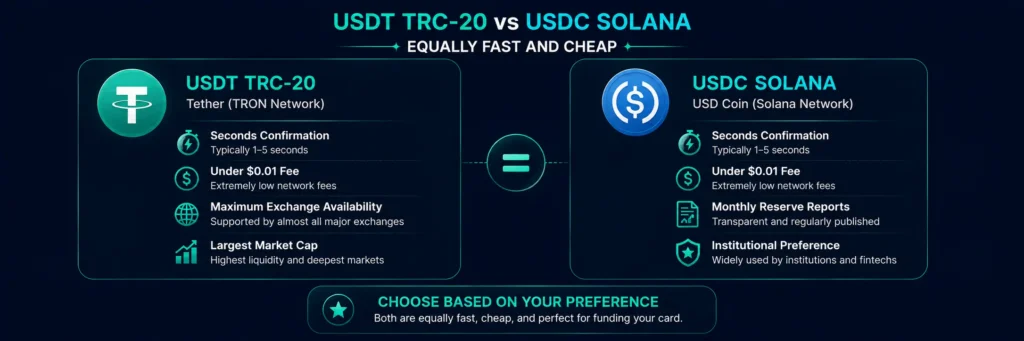
Rivocard accepts both USDT and USDC across multiple networks. The practical comparison:
| USDT on TRC-20 | USDC on Solana | |
|---|---|---|
| Confirmation time | Seconds | Seconds |
| Network fee | Under $0.01 | Under $0.01 |
| Price peg | $1 USD | $1 USD |
| Issuer | Tether Limited | Circle Internet Financial |
| Reserve transparency | Published periodically | Published monthly |
| Global exchange availability | Maximum | Very broad |
| Institutional preference | Liquidity-focused | Compliance-focused |
For most Rivocard users, USDT on TRC-20 is the default choice — broader availability on global exchanges, maximum liquidity, and fractions of a cent in fees. USDC on Solana is equally fast and cheap and preferred by users who value Circle’s reserve transparency or who are already in the Solana ecosystem.
Both are significantly better than any volatile asset for routine card funding.
When Volatile Assets Are Still Appropriate for Card Funding
Stablecoins are not the only valid deposit option — volatile assets make sense in specific situations:
You hold a large BTC or ETH balance and prefer direct conversion. Swapping to USDT first adds an exchange step and potentially a conversion fee. For large deposits ($500+) where Bitcoin network fees are proportionally small, direct BTC deposit is reasonable if you have timing flexibility.
You hold XRP, BNB, TRX, DOGE, or LTC. These assets have fast enough confirmation windows (3 seconds to 3 minutes) and low enough fees that direct deposit is practical without converting to stablecoins first.
The deposit amount is large enough that price variance is acceptable. At $5,000 per deposit, a 1% BTC price move during confirmation is $50. For users comfortable with this variance, direct volatile-asset deposits work.
The threshold question: if price certainty, low fees, and fast confirmation all matter for this top-up — use a stablecoin. If you have time flexibility and prefer direct conversion from the coin you hold — volatile assets work above certain deposit sizes.
FAQs
Why should I use stablecoins instead of Bitcoin to fund a crypto card?
Stablecoins give you price certainty (no value lost during confirmation), near-zero network fees (fractions of a cent on TRC-20 vs $1-$20+ for Bitcoin), instant confirmation (seconds vs 20-60 minutes), and predictable card balance. Bitcoin is the least efficient card funding asset. Stablecoins are the right tool for converting crypto to spending power.
What is the best stablecoin to use for Rivocard top-ups?
USDT on TRC-20 (Tron) is the best for most users – available on all major exchanges, fractions of a cent in fees, seconds to confirm, and $1 stable value. USDC on Solana is an equally fast and cheap alternative preferred by users in the Solana ecosystem or who value Circle’s reserve transparency.
Do stablecoins have any price risk when used for card funding?
Stablecoins maintain a $1 peg – there is no meaningful price movement between when you send and when the deposit confirms. $500 USDT sent arrives as approximately $500 in your wallet regardless of confirmation time. This eliminates the price-during-confirmation risk that affects Bitcoin and Ethereum deposits.
Is there a tax advantage to using stablecoins for card funding vs Bitcoin?
Yes, in most jurisdictions. Spending appreciated Bitcoin triggers a capital gains tax event on the appreciation. USDT purchased at $1 and spent at $1 has no appreciation – no capital gains event. Using stablecoins acquired at parity for card funding typically avoids triggering capital gains. Confirm with a qualified tax advisor for your specific jurisdiction.
How fast is a USDT TRC-20 deposit on Rivocard?
USDT on TRC-20 (Tron) confirms in 3-30 seconds. Combined with exchange withdrawal processing time of 1-2 minutes, total time from initiating a Binance withdrawal to a funded Rivocard card is typically under 4 minutes.
Are stablecoins safer than Bitcoin for card funding?
Stablecoins eliminate price risk – but both are subject to the same irreversibility of blockchain transactions. A mis-sent USDT deposit is as unrecoverable as a mis-sent BTC deposit. The safety advantage of stablecoins is price certainty, not transaction security. Follow the same address verification practices for any deposit: copy-paste, verify first and last 4 characters, confirm network match.
Why have stablecoins become the standard for crypto card spending?
Stablecoin card volume has grown from $100 million per month in early 2023 to over $1.5 billion per month by late 2025 – driven by practical advantages over volatile assets. Visa now runs 130+ stablecoin-linked card programs globally. The practical reasons: price stability, low fees on fast networks, instant confirmation, and simplified tax treatment make stablecoins the logical card funding layer.
Can I use USDC instead of USDT on Rivocard?
Yes. Both USDT and USDC are accepted on Rivocard. USDC on Solana has equivalent speed and fees to USDT on TRC-20. Choose based on which you can access most easily from your exchange or wallet.
Does the 5% Rivocard fee change if I use stablecoins?
No. The 5% card funding fee is the same regardless of which cryptocurrency funded your wallet. The advantage of stablecoins is that the deposit step loses nothing to price movement or excessive network fees – so the 5% is the only cost between sending and spending, not 5% plus volatility loss plus high network fees.
What is the difference between USDT and USDC?
Both are stablecoins pegged to $1 USD. USDT is issued by Tether Limited and is the largest stablecoin by market cap and trading volume globally – maximum liquidity and exchange availability. USDC is issued by Circle Internet Financial with monthly reserve attestations and strong institutional backing. Both maintain tight $1 pegs and are practically equivalent for Rivocard card funding.
Get Started
Ready to top up with the most efficient card funding asset? See the complete USDT top-up guide –