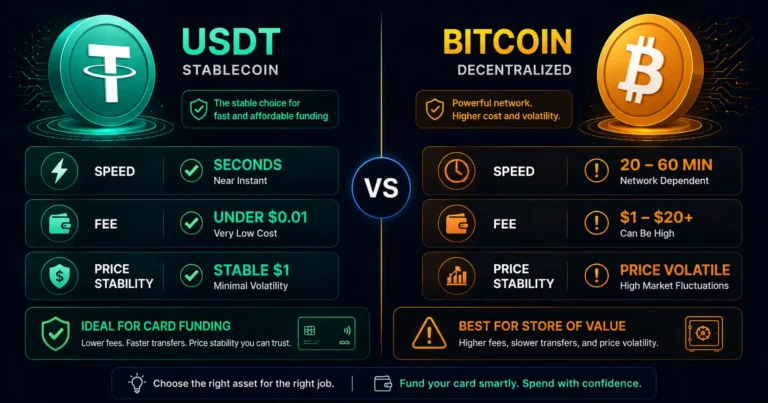
Quick answer: For funding a Rivocard prepaid card, stablecoins — specifically USDT on TRC-20 — are better than Bitcoin in almost every practical metric: they confirm in seconds vs 20-60 minutes, cost fractions of a cent in network fees vs $1-$20+ for BTC, and carry zero price volatility during the confirmation window. Bitcoin is the better choice only if you already hold BTC and need to convert it to spending power without first swapping to a stablecoin, or if you are making a large, planned deposit where timing flexibility is acceptable. In 2026, most active crypto card spenders load stablecoins, and card providers optimize around USDC and USDT rails — volatility killed the early pitch of spending Bitcoin on everyday purchases.
The 2026 Context: Stablecoins Have Won the Spending Layer
This was not always the obvious answer. Early crypto card marketing featured Bitcoin prominently — the idea that you could spend BTC at any Visa merchant was a compelling pitch. But two practical realities have shifted actual user behavior decisively toward stablecoins for card funding:
Reality 1: Price volatility is incompatible with predictable spending. If you deposit $500 worth of Bitcoin and BTC drops 10% during the 30-60 minute confirmation window, you receive $450 in your wallet — not $500. For card spending, where you need predictable dollar amounts, this creates constant friction. Stablecoins eliminate this entirely: $500 USDT in equals approximately $500 in your wallet.
Reality 2: Bitcoin network fees erode small-to-medium deposits. Bitcoin functions mainly as a decentralized store of value, while stablecoins are engineered for price stability and real-world payments. Bitcoin’s network fees ($1-$20+ under normal conditions, $20-$100+ during congestion) are sized for its intended use case — large-value, infrequent settlement — not for card top-ups of $50-$500. USDT on TRC-20 carries fractions of a cent in fees regardless of deposit size.
Stablecoin-funded cards are now processing roughly $18 billion annualized — 15x growth since 2023 — becoming the primary bridge between on-chain balances and everyday commerce.
Head-to-Head Comparison
| Factor | USDT on TRC-20 | Bitcoin (BTC) |
|---|---|---|
| Confirmation time | Seconds to ~1 minute | 20-60 minutes (normal), 1-3+ hours (congestion) |
| Network fee (typical) | Under $0.01 | $1-$20+ |
| Network fee (congestion) | Under $0.01 (stable) | $20-$100+ |
| Price during confirmation | Stable — $1 peg | Volatile — can move 2-5%+ |
| Dollar certainty | High — $500 sent ≈ $500 received | Low — rate set at confirmation time |
| Rivocard deposit fee | Free | Free |
| Card funding fee (Rivocard) | 5% (same) | 5% (same) |
| Purchase fee | 0% (same) | 0% (same) |
| Practical minimum deposit | $10 (gas negligible) | $50-$100+ (gas meaningful below this) |
| Best for | All deposits — reliable default | Already-held BTC, large planned deposits |
Speed: Why Seconds vs 60 Minutes Matters in Practice
Bitcoin’s 10-minute block time means waiting 20-60 minutes (1-6 blocks × 10 minutes) before a deposit confirms. Under congestion, this extends further. During that window:
- You cannot fund a card from your wallet until the deposit confirms
- If you needed the card balance for an immediate purchase, it is not available
- Bitcoin’s price may have moved, changing the credited amount
USDT on TRC-20 confirms in seconds — the same time it takes to select a shipping option or complete a checkout. From Binance withdrawal to funded Rivocard card: under 4 minutes end-to-end. From Bitcoin wallet to funded card: 25-70 minutes minimum.
For time-sensitive card top-ups — funding an ad account before a campaign launches, topping up before travel, covering an invoice deadline — USDT’s speed is not just a convenience, it is a functional requirement.
Network Fees: The Full Cost Comparison
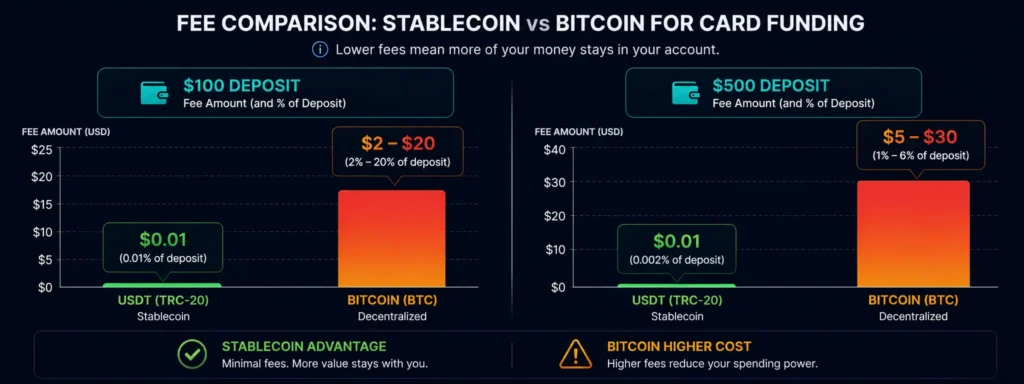
Network fees are paid to miners or validators — not to Rivocard — and directly reduce how much arrives in your wallet from a given amount sent. This is separate from Rivocard’s 5% card funding fee.
For a $100 deposit:
| Asset | Amount sent | Network fee | Amount arriving in wallet | Effective loss to fees |
|---|---|---|---|---|
| USDT TRC-20 | $100 | ~$0.01 | ~$99.99 | ~0.01% |
| USDT ERC-20 | $100 | $2-$15 | $85-$98 | 2-15% |
| Bitcoin (BTC) | $100 | $2-$20 | $80-$98 | 2-20% |
For a $500 deposit:
| Asset | Amount sent | Network fee | Amount arriving | Effective loss |
|---|---|---|---|---|
| USDT TRC-20 | $500 | ~$0.01 | ~$499.99 | ~0.01% |
| Bitcoin (BTC, normal) | $500 | $5 | $495 | ~1% |
| Bitcoin (BTC, high congestion) | $500 | $30 | $470 | ~6% |
At $500, Bitcoin’s fees under normal conditions are acceptable — around 1%. But at $100, a $5 fee represents 5% of the deposit before Rivocard’s 5% card funding fee even applies. Effectively: a $100 BTC deposit during moderate congestion costs you 10%+ total before you have spent a single dollar.
Price Volatility: The Hidden Cost of Bitcoin Deposits
For Bitcoin deposits, the dollar value credited to your wallet is fixed at the BTC price when the blockchain confirms the transaction. During the 20-60 minute (or longer) confirmation window:
- Bitcoin’s 30-day realized volatility was approximately 26% annualized entering mid-2026 — even in periods of relative calm, Bitcoin’s price was still moving hundreds of times more than stablecoins.
- At 26% annualized, Bitcoin moves approximately 1.6% per day on average — meaning a 30-minute confirmation window carries a typical price risk of around 0.1-0.3%, and a worst-case risk of several percent during volatile periods
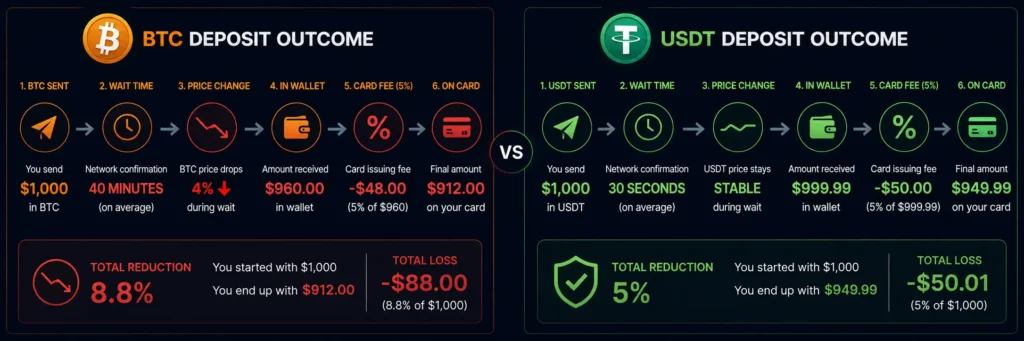
Practical example: You send $1,000 worth of Bitcoin on a day when the market is moving. During a 40-minute confirmation window, BTC drops 4%. Your wallet is credited $960. Combined with Rivocard’s 5% card funding fee on $960, your card receives $912. You sent the equivalent of $1,000 and have $912 to spend — an 8.8% total reduction including fees and price movement.
The same deposit in USDT TRC-20: You send $1,000 USDT. It confirms in 30 seconds. Wallet credited $999.99. Fund card: 5% fee = $949.99 on card. Total reduction: 5.01% — entirely from Rivocard’s card funding fee.
The difference is real and compounds on every large Bitcoin deposit.
When Bitcoin Is Actually the Better Choice
Stablecoins win on most metrics — but Bitcoin makes genuine sense in specific scenarios:
You already hold BTC and do not want to swap. Swapping BTC to USDT adds an exchange step — conversion fee, potentially a spread, another confirmation. If you are comfortable with BTC’s fees and confirmation time for this deposit, depositing directly avoids the extra step. For large deposits ($500+) where BTC fees are proportionally small and you have flexibility on timing, direct BTC deposit is reasonable.
You are making a large, planned deposit with timing flexibility. A $2,000 BTC deposit during a low-fee period ($3-$5 gas) loses under 0.5% to network fees — well within the margin of a predictable card spend plan. If you know you will need $2,000 on a card next week, depositing BTC now at low fees and accepting the 30-60 minute wait is entirely practical.
You cannot or do not want to access a stablecoin exchange. In some jurisdictions, acquiring USDT involves extra steps or is less accessible than Bitcoin. If BTC is what you have available, direct BTC deposit remains functional — just account for the fee and volatility factors.
You are making a very large deposit where volatility risk is acceptable. At $5,000+ per deposit, a 0.5% BTC price swing during confirmation is $25. For users comfortable with this level of variance, BTC deposits work fine. The fee percentage also becomes proportionally smaller at larger sizes.
The Real-World Deposit Strategy
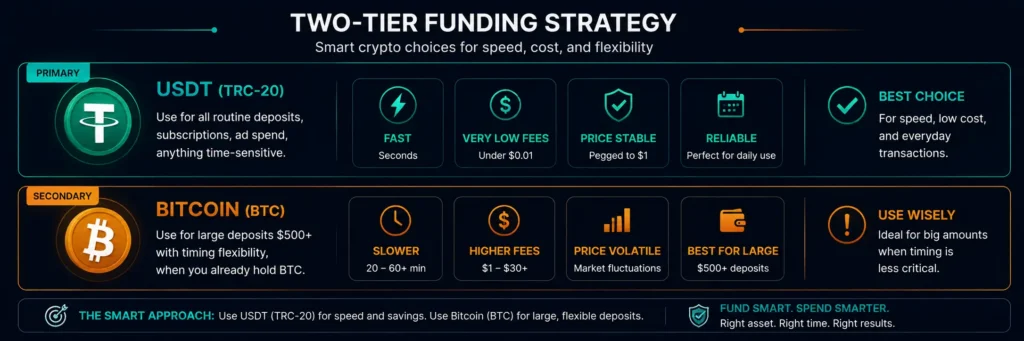
For most Rivocard users, the practical approach:
Primary deposit asset: USDT on TRC-20 Use this for all routine card top-ups, subscriptions, ad spend, and situations where speed or dollar-certainty matters. Zero practical network fee, seconds to confirm, $1 stability.
Secondary deposit asset: Bitcoin (BTC) Use this when you have BTC that needs converting to spending power and the timing flexibility exists. Best for larger, less-frequent deposits ($500+) during periods of lower Bitcoin network congestion. Check mempool.space before sending.
Not recommended: Bitcoin for small deposits Under $100, Bitcoin network fees under normal conditions take 5-20% of your deposit. For small deposits, USDT on TRC-20 is unambiguously better in every dimension.
USDC vs USDT: Does It Matter?
Both USDT (Tether) and USDC (Circle) are stablecoins pegged to $1, and both are accepted on Rivocard. The practical differences for card funding:
| USDT on TRC-20 | USDC on Solana | |
|---|---|---|
| Confirmation time | Seconds | Seconds |
| Network fee | Fractions of a cent | Fractions of a cent |
| Peg stability | Very tight ($1 ± <0.01%) | Very tight ($1 ± <0.01%) |
| Issuer | Tether Limited | Circle Internet Financial |
| Market cap (2026) | ~$140B (larger) | ~$60B |
| Availability | Most exchanges globally | Most major exchanges |
For Rivocard deposits, USDT on TRC-20 and USDC on Solana are functionally equivalent — both are fast, cheap, and stable. USDT has broader exchange availability globally; USDC has stronger institutional adoption and a more transparent reserve disclosure program. Choose based on which you can access most easily from your exchange or wallet.
Summary: The Decision Framework
Use a stablecoin (USDT TRC-20) if:
- You need card balance fast (under 2 minutes total)
- You want exact dollar certainty on your deposit
- You are depositing under $200 (fees make BTC impractical)
- You top up frequently (fees add up)
- Network congestion is unpredictable in your usage window
Use Bitcoin if:
- You already hold BTC and want to avoid a swap
- You are depositing $500+ with timing flexibility
- Bitcoin fees are currently low (check mempool.space first)
- You plan large, infrequent deposits rather than frequent small ones
FAQs
Is USDT or Bitcoin better for funding a crypto card?
For most users in most situations, USDT on TRC-20 is better — it confirms in seconds, costs fractions of a cent in network fees, and maintains $1 stability so the credited amount matches exactly what you sent. Bitcoin takes 20-60 minutes, costs $1-$20+ in gas, and carries price volatility during the confirmation window. Bitcoin makes sense for already-held BTC at larger deposit sizes where timing is flexible.
What is the fastest way to top up a Rivocard?
USDT on TRC-20 (Tron network) is the fastest — deposits typically confirm in seconds and arrive in your Rivocard wallet in under a minute. From Binance withdrawal to funded card takes under 4 minutes end-to-end.
How much do Bitcoin network fees cost on a Rivocard deposit?
Bitcoin network fees (paid to miners, not Rivocard) typically range from $1-$20 under normal conditions and $20-$100+ during high congestion. For a $100 BTC deposit, a $5 fee represents 5% of your deposit before Rivocard’s 5% card funding fee even applies — effectively 10% total cost on a small BTC deposit.
Why do most crypto card users use stablecoins instead of Bitcoin?
In 2026, stablecoins have won the spending layer for three practical reasons: they are faster (seconds vs 30-60 minutes), cheaper (fractions of a cent vs $1-$20+ in fees), and more predictable (stable $1 value vs volatile BTC price during confirmation). Bitcoin functions better as a store of value than as a card funding asset.
Does it cost more to fund a Rivocard with Bitcoin than USDT?
Rivocard’s own 5% card funding fee is the same regardless of which cryptocurrency you deposited. But Bitcoin’s network fees ($1-$20+) reduce how much arrives in your wallet, effectively adding 1-20%+ to the real cost depending on deposit size and current congestion. USDT on TRC-20 has negligible network fees, making it cheaper end-to-end.
Can I deposit USDT instead of Bitcoin to avoid price volatility?
Yes. USDT (Tether) on the TRC-20 network is accepted on Rivocard and maintains a $1 peg. Depositing USDT eliminates the price-during-confirmation risk entirely — $500 USDT sent arrives as approximately $500 in your wallet regardless of how long confirmation takes.
What is USDC and how does it compare to USDT for card funding?
USDC (USD Coin, issued by Circle) is another dollar-pegged stablecoin accepted on Rivocard. Functionally equivalent to USDT for card funding purposes — both are fast, stable, and low-fee when using efficient networks like Solana for USDC or Tron for USDT. Choice depends on which you can access most easily from your exchange.
Is Bitcoin too slow for everyday crypto card top-ups?
For routine top-ups, yes. The 20-60 minute wait (sometimes longer during congestion) makes Bitcoin impractical for time-sensitive funding needs. It works better for large, planned deposits where you are comfortable waiting for the balance to appear. For daily or weekly card top-ups, stablecoins on fast networks are significantly more practical.
What happens if Bitcoin’s price drops while my deposit is confirming?
The dollar amount credited to your Rivocard wallet is based on BTC’s price at the moment the transaction confirms on-chain — not when you sent it. A 4% price drop during a 40-minute confirmation window means you receive 4% less in your wallet than the amount you sent. Stablecoins eliminate this risk entirely.
Which cryptocurrency is best for a first Rivocard deposit?
USDT on TRC-20. It offers the lowest network fees, fastest confirmation, best price stability, and is accepted from every major exchange. The experience is the simplest and most predictable — $50 USDT sent arrives as $50 in your wallet within seconds.
Get Started
Ready to fund your card in under 4 minutes? See the complete USDT deposit guide →