Quick answer: PCI DSS — the Payment Card Industry Data Security Standard — is the global security framework that every organization handling Visa or Mastercard data must follow. On a crypto card like Rivocard, PCI DSS compliance means your card number is stored encrypted (never in plain text), your CVV is never stored at all after a transaction, your card data is accessible only to authorized systems, and the platform undergoes regular independent security audits. PCI DSS v4.0.1 is now the only active standard in 2026 — it defines technical and operational controls that protect cardholder data across storage, processing, and transmission. For users, PCI DSS compliance is the baseline assurance that a card platform’s infrastructure meets a globally validated security standard — not self-declared, but independently assessed.
What PCI DSS Is and Why It Exists
PCI DSS (Payment Card Industry Data Security Standard) was created by the major card networks — Visa, Mastercard, American Express, Discover, and JCB — to establish a unified security baseline for every organization that touches payment card data. Before PCI DSS existed, individual card brands each had their own security programs, creating inconsistency and compliance fragmentation.
PCI DSS is a security regulation implemented globally to hinder credit card fraud and various data security vulnerabilities. While there is no specific regulation mandating PCI compliance, court precedent treats it as mandatory for all companies processing payment card data.
The standard is maintained by the PCI Security Standards Council (PCI SSC) — an independent body. Card networks (Visa, Mastercard) require compliance contractually through their network agreements with card issuers and processors. A crypto card platform cannot issue Visa cards without maintaining PCI DSS compliance.
The 12 PCI DSS Requirements: What They Mean for Your Card Data
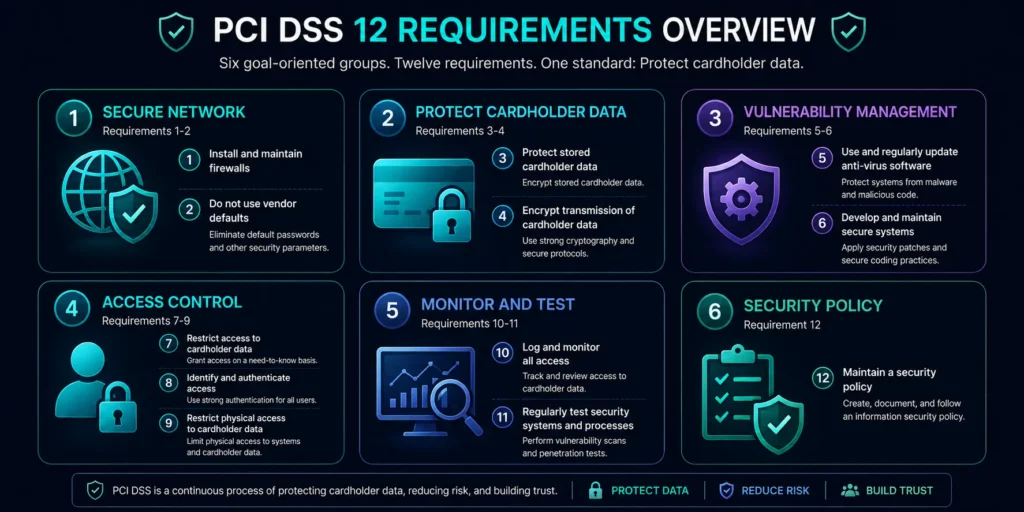
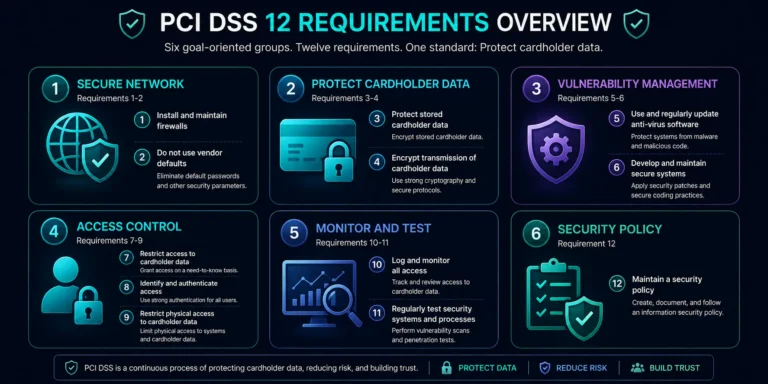
PCI DSS compliance is based on six groups of requirements with 12 requirements in total. Here is what each requirement means from a user perspective:
Requirement 1: Build and maintain a secure network Firewalls must protect cardholder data environments. Network architecture must prevent unauthorized access to systems that hold card data. For you: the network infrastructure handling your card details is segmented and protected from the broader internet.
Requirement 2: Do not use vendor-supplied defaults Default passwords, settings, and configurations on payment systems must be changed. For you: the servers handling your data are not running with factory-default security settings that attackers know and target.
Requirement 3: Protect stored cardholder data PCI DSS requires rendering the PAN (Primary Account Number — your card number) unreadable anywhere it is stored, using strong cryptography like AES-256. Prohibited data includes sensitive authentication data after authorization — CVVs must never be stored post-authorization. For you: your 16-digit card number is stored encrypted. Your CVV is never stored anywhere — it is verified and immediately discarded.
Requirement 4: Encrypt transmission of cardholder data Card data transmitted over open public networks must be encrypted. TLS (Transport Layer Security) is the required protocol. For you: your card details are encrypted in transit between your device and Rivocard’s servers, and between Rivocard and payment processors.
Requirement 5: Use and maintain anti-malware software Systems that store or process cardholder data must run anti-malware solutions and keep them updated. For you: the servers handling your data are actively protected against malware infiltration.
Requirement 6: Develop and maintain secure systems Software vulnerabilities must be addressed through patching and secure development practices. For you: known security vulnerabilities in the systems processing your card data must be patched within defined timeframes.
Requirement 7: Restrict access to cardholder data by business need Only personnel who need access to cardholder data to perform their job function should have it. For you: Rivocard’s customer service agents cannot pull up your full card number. Only systems with specific technical authorization can access card data.
Requirement 8: Identify and authenticate access to system components Unique user IDs and strong authentication (including multi-factor authentication) must be used for all access to cardholder data systems. For you: even internal Rivocard staff must authenticate with strong credentials and MFA to access systems that hold card data — preventing insider threats.
Requirement 9: Restrict physical access to cardholder data Physical access to servers and data centers must be controlled and logged. For you: the servers storing your card data are in secured data centers with access logging, not accessible to arbitrary personnel.
Requirement 10: Log and monitor all access to network resources All access to network resources and cardholder data must be logged and monitored. For you: if unauthorized access to card data systems were attempted, it would be detected and logged.
Requirement 11: Regularly test security systems Security systems and processes must be regularly tested through penetration testing, vulnerability scanning, and security control validation. For you: Rivocard’s security posture is regularly challenged by testing, not just documented on paper.
Requirement 12: Maintain an information security policy An organization-wide information security policy must be maintained and communicated to all personnel. For you: security is not just a technical configuration but an organizational commitment across all staff who interact with payment systems.
What PCI DSS Compliance Means in Practice for Crypto Cards
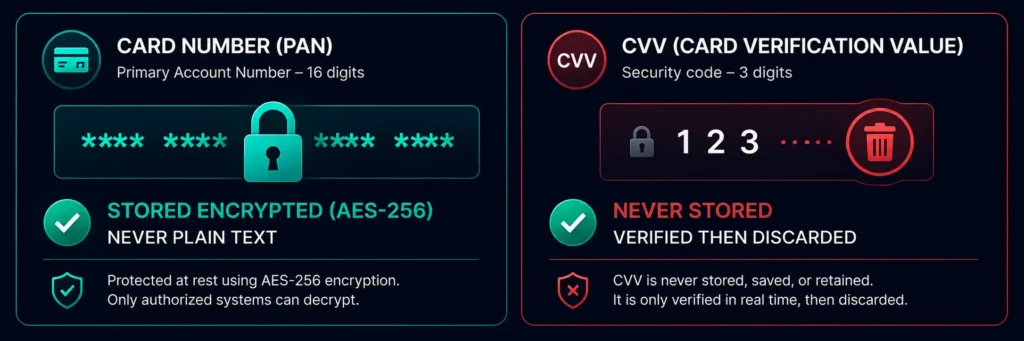
Several PCI DSS requirements have direct, concrete implications for how a crypto card handles your data:
Your Card Number (PAN) Is Never Readable in Plain Text
Requirement 3 mandates rendering the PAN unreadable anywhere it is stored using strong cryptography. Truncation should store only the first six and last four digits if the full PAN is not needed.
What this means for your Rivocard account:
- Your full 16-digit card number is stored encrypted using AES-256
- When you view your card in the dashboard, only the last four digits may be displayed in certain contexts
- Your full card number cannot be retrieved from Rivocard’s database in plain text — not by a breach, not by unauthorized staff access, not by any unencrypted query
Your CVV Is Never Stored
This is one of the most important — and most misunderstood — aspects of PCI DSS. The standard explicitly prohibits storing the CVV (the 3-digit security code) after a card transaction has been authorized. This is not optional. It applies to all PCI-compliant platforms without exception.
What this means: Even if Rivocard’s entire database were breached, an attacker would find no stored CVVs. They simply do not exist in the database. The CVV is verified at the point of card creation (to confirm the card has been correctly issued) and then deleted — permanently.
This is why providing your CVV at checkout is safe when the merchant is PCI-compliant: the CVV proves you physically have (or have access to) the card, but it is never retained anywhere that an attacker could later retrieve it.
Independent Validation — Not Self-Certification
For businesses handling large transaction volumes, compliance validation must be performed either by an external Qualified Security Assessor (QSA) or via a firm-specific Internal Security Assessor (ISA). For smaller volumes, a Self-Assessment Questionnaire (SAQ) is completed.
PCI DSS compliance is not a self-declaration where a platform announces it is “compliant.” Depending on transaction volume, platforms must undergo independent assessment by certified auditors. A Report on Compliance (ROC) from a QSA carries more weight than any self-certification claim.
For users evaluating a crypto card platform: if a platform claims PCI DSS compliance, ask what their current compliance validation level is. A QSA-audited platform provides stronger assurance than a self-assessed one.
PCI DSS v4.0.1: What Changed in 2026
PCI DSS v4.0.1 is now the only active version of the standard. The requirements that were optional for two years are now mandatory, and assessors expect controls to run year-round rather than as a clean snapshot taken before the audit.
The key changes in v4.0.1 relevant to card platform users:
Continuous controls, not point-in-time compliance Previously, platforms could demonstrate compliance through a clean snapshot taken during an annual assessment. v4.0.1 requires controls to operate continuously throughout the year. For users: security is maintained as an ongoing operational practice, not as an annual paper exercise.
Stronger authentication requirements Multi-factor authentication requirements have been extended to more system access scenarios, not just privileged access. For users: more platform staff interactions with card data systems require MFA.
Enhanced e-commerce protections New requirements specifically address security of payment page scripts and client-side protection. For users: the web interface through which you interact with your card account has explicit security controls against script injection attacks.
Why PCI DSS Compliance Is a Baseline, Not a Guarantee
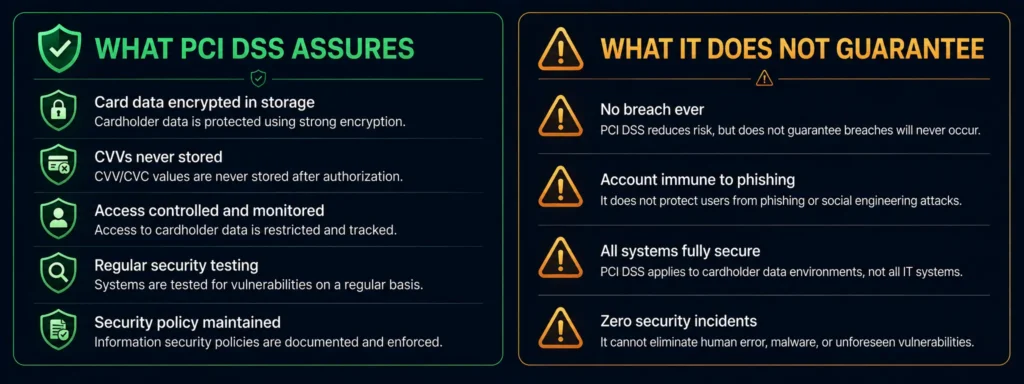
It is worth being precise about what PCI DSS compliance assures and what it does not.
What PCI DSS assures:
- Card data is encrypted in storage and transmission
- CVVs are never stored post-authorization
- Access to card data systems is controlled and monitored
- Security testing is regularly performed
- A security policy exists and is maintained
What PCI DSS does not guarantee:
- That the platform has never been breached (PCI-compliant platforms have been breached in the past)
- That all systems in the organization are secure, only those within PCI scope
- That your account is immune to phishing or credential theft (which attack your credentials, not the card data systems)
- That the platform will never have a security incident
PCI DSS significantly reduces the risk of certain types of breaches — particularly those targeting stored card data — but security is a risk reduction exercise, not an absolute guarantee. The standard is the floor, not the ceiling.
What to Look For When Evaluating a Crypto Card’s PCI DSS Compliance
When a crypto card platform claims PCI DSS compliance, several questions help verify the claim:
What version? PCI DSS v4.0.1 is the only current version. Earlier version compliance is outdated.
What level? Merchant or service provider compliance level determines validation requirements. Service providers processing large volumes require QSA validation.
Is there an Attestation of Compliance (AoC)? An AoC is a document signed by a QSA confirming compliance. Platforms can share this with partners and users as evidence.
When was the last assessment? PCI DSS compliance requires annual validation. A platform whose last assessment was 18 months ago may have lapsed.
For Rivocard specifically, check the current security documentation and privacy policy at rivocard.com for the latest compliance disclosures, as these are updated as the platform’s compliance program evolves.
FAQs
What is PCI DSS and why does it matter for crypto cards?
PCI DSS (Payment Card Industry Data Security Standard) is the global security standard for any organization that processes, stores, or transmits payment card data. For crypto cards, it means the platform must encrypt card numbers, prohibit storing CVVs, control access to card data systems, and undergo regular security testing. Rivocard’s payment processing operates under PCI DSS compliance.
Does PCI DSS compliance mean my card data is completely secure?
PCI DSS significantly reduces risk for specific types of threats — particularly database breaches targeting stored card data. It does not guarantee immunity from all security incidents. Card numbers are encrypted and CVVs are never stored, but phishing attacks, device compromise, or credential theft target your account access rather than Rivocard’s card data storage.
What does PCI DSS say about storing CVVs?
PCI DSS explicitly prohibits storing the CVV (the 3-digit security code on your card) after a transaction has been authorized. This applies to all PCI-compliant platforms without exception. Even if a platform’s entire database were breached, no CVVs would be found because they are not stored.
What is the current version of PCI DSS in 2026?
PCI DSS v4.0.1 is the only active version in 2026. Earlier versions are no longer valid for compliance purposes. v4.0.1 introduces continuous control requirements (not just annual snapshots), stronger authentication mandates, and enhanced e-commerce protections.
How is PCI DSS compliance validated?
For high-transaction-volume platforms, compliance is validated annually by an external Qualified Security Assessor (QSA) who produces a Report on Compliance (ROC). Lower-volume platforms may complete a Self-Assessment Questionnaire (SAQ). A QSA-validated compliance provides stronger independent assurance than self-assessment.
What does PCI DSS require for storing my card number?
Your card number (PAN) must be rendered unreadable wherever it is stored using strong cryptography — specifically AES-256 or equivalent. When displayed, only truncated versions (typically last four digits) should be shown. The full number must never appear in plain text in databases, logs, or audit trails.
Why does PCI DSS matter if I never experience a breach?
PCI DSS compliance is the structural assurance that your card data would be protected in the event of a breach. Because card numbers are encrypted and CVVs are never stored, a database breach at a PCI-compliant platform yields encrypted data that attackers cannot use. Non-compliant platforms store card data in accessible formats that breaches can immediately exploit.
Can a crypto card platform issue Visa cards without PCI DSS compliance?
No. Visa’s network rules require PCI DSS compliance from all card-issuing programs. A platform cannot maintain the banking relationships, payment processor relationships, and card network agreements necessary to issue Visa cards without PCI DSS compliance. It is a structural requirement of being a regulated card issuer.
What is a Qualified Security Assessor (QSA)?
A QSA is an organization certified by the PCI Security Standards Council to assess PCI DSS compliance. QSAs conduct independent audits of card platform infrastructure and issue Reports on Compliance (ROCs) and Attestations of Compliance (AoCs) confirming that requirements are met. Their independence makes QSA validation more credible than self-assessment.
How does PCI DSS interact with other security standards for crypto cards?
PCI DSS covers card data security specifically. It works alongside AML/KYC requirements (covering user identity verification and transaction monitoring), GDPR and data protection laws (covering personal data privacy), and general information security practices (covering broader platform security). A fully compliant crypto card platform meets all applicable frameworks, not just PCI DSS.
Get Started
Rivocard operates under PCI DSS-compliant payment infrastructure — your card data is protected by the global security standard. See how Rivocard protects your data →