
Quick answer: Rivocard has a two-layer model with only one fee. Depositing crypto to your Rivocard wallet is always free. Creating unlimited virtual cards is free. The only fee is 5%, deducted when you fund or reload a card from your wallet balance — fund a card with $100, you get $95 to spend. Once funds are on the card, purchases (online and international) are 0%. No monthly subscriptions, no hidden fees.
If you’ve used other crypto cards, the simplicity here is intentional. Most providers in this space charge five or six different fees layered on top of each other. Rivocard’s fee model is built around exactly one number — and exactly one moment when it applies.
The Two-Layer Model: Wallet vs Card
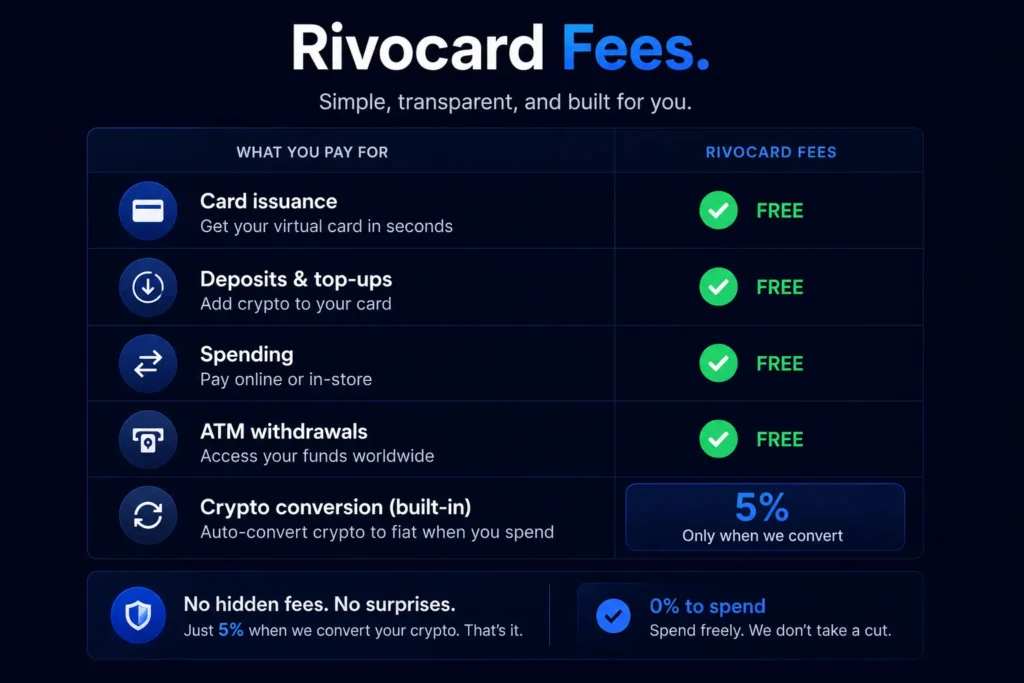
This is the part most explanations skip, and it’s the part that actually matters for understanding what you pay.
Rivocard works in two layers:
Layer 1: Your Rivocard Wallet (always free) Every Rivocard account comes with an internal wallet that holds your deposited funds. You can deposit any supported cryptocurrency — Bitcoin, Ethereum, USDT, USDC, Solana, and more — to this wallet. There’s no fee on deposits. Send $500 worth of crypto, your wallet shows $500.
Layer 2: Your Virtual Cards (5% to fund or reload) From your wallet balance, you can create as many virtual cards as you want — there’s no limit on the number of cards. The 5% fee applies only when you actually fund a card with money from your wallet, or when you reload an existing card. The fee is deducted from the amount you’re funding — fund a card with $100, the card gets $95.
Once funds are on a card, every other action is free: purchases, international transactions, card freezing, replacement, declined payments, account cancellation.
This separation is what makes the pricing simple. You can deposit any amount you want without worrying about fees, and you only pay when you actively move money to a spending card.
The Complete Fee Picture at a Glance
| Action | Fee |
|---|---|
| Account creation | FREE |
| Crypto deposit to wallet (BTC, ETH, USDT, USDC, and more) | FREE |
| Card creation & issuance | FREE |
| Card funding (initial creation amount) | 5% (deducted) |
| Card reload (adding to existing card) | 5% (deducted) |
| Online purchases (Visa) | 0% |
| International transactions | 0% |
| Card freeze / unfreeze | FREE |
| Card replacement | FREE |
| Declined transactions | FREE |
| Account cancellation | FREE |
| Monthly / annual subscription | NONE |
That’s the whole list. There’s no second page of fees somewhere else.
How the 5% Card Funding Fee Actually Works
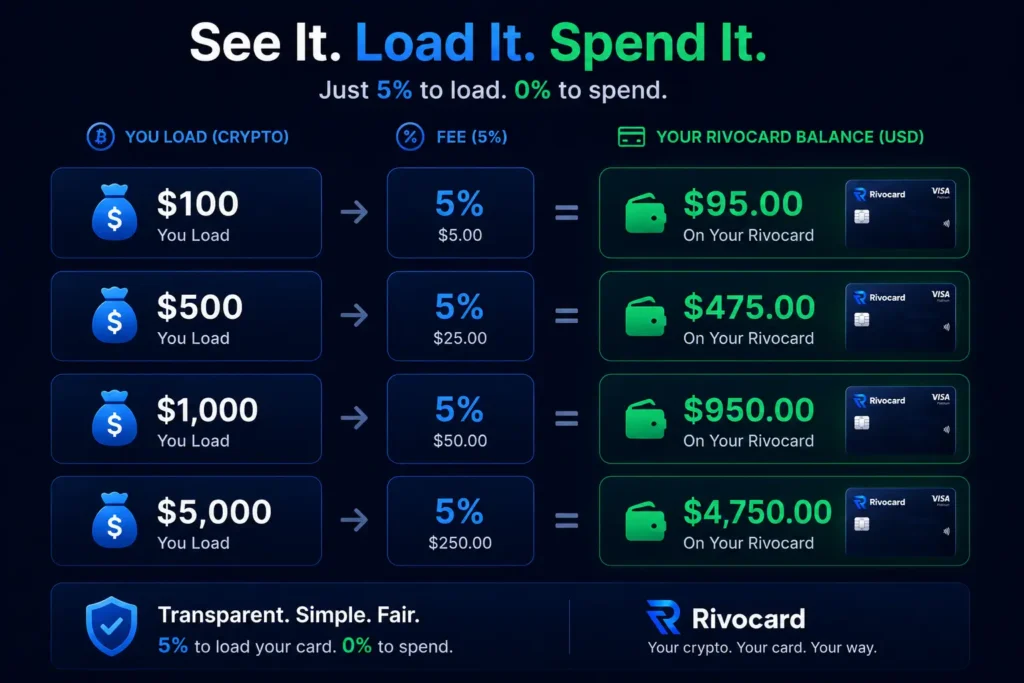
The fee is calculated on the amount you’re funding a card with, and it’s always shown to you before you confirm — no surprises at the end. The fee is deducted from the amount, so the card receives the funded amount minus 5%.
| You Fund a Card With | 5% Fee Deducted | Card Balance |
|---|---|---|
| $100 | $5 | $95 |
| $500 | $25 | $475 |
| $1,000 | $50 | $950 |
| $5,000 | $250 | $4,750 |
If you need a specific amount on a card, fund slightly more to account for the fee. For example, to end up with exactly $200 on a card, fund it with approximately $210.50 (since $210.50 minus 5% = $200).
This same math applies to reloads — adding $100 to an existing card means $5 is deducted and the card balance increases by $95.
A Complete Worked Example
To make all of this concrete, here’s what a typical funding flow looks like:
- You deposit $1,000 worth of USDT to your Rivocard wallet. Cost: $0. Wallet balance: $1,000.
- You create a virtual card and fund it with $300 from your wallet. The 5% fee ($15) is deducted. Card balance: $285. Remaining wallet balance: $700.
- You spend the $285 on Google Ads. Cost: $0 in transaction fees. You used every cent of the $285.
- You create a second card and fund it with $200 for travel spending. The 5% fee ($10) is deducted. Card #2 balance: $190. Remaining wallet balance: $500.
- Two weeks later, you reload Card #1 with $100. The 5% fee ($5) is deducted. Card #1 balance: $95. Wallet balance: $400.
Total fees paid across the entire flow: $30 ($15 + $10 + $5). Total deposit and purchase fees: $0.
Why a Single-Fee Model Matters
This part is worth a moment, because it’s where Rivocard’s pricing genuinely differs from most of the industry.
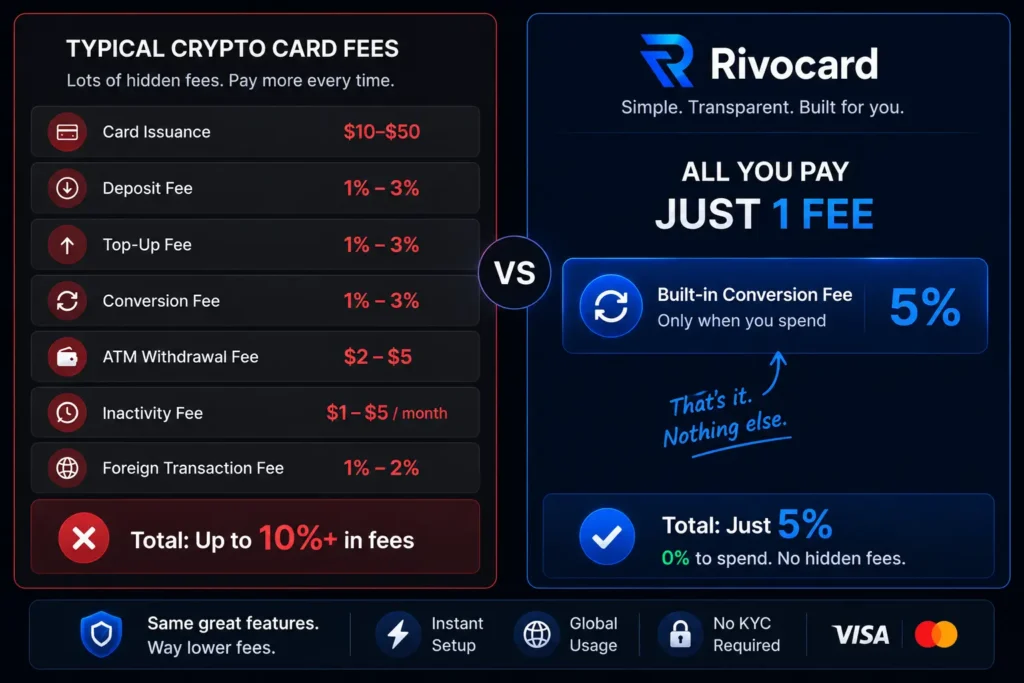
Typical crypto card providers stack fees at multiple points:
- A monthly account fee
- A card issuance fee
- A deposit fee on every top-up
- A transaction fee on every purchase
- A foreign exchange fee on international spending
- An ATM withdrawal fee
- An inactivity fee if you don’t use the card for a while
Each fee on its own looks small. Combined across a year of normal use, they add up significantly — and they make it hard to predict what you’ll actually pay before you commit.
Rivocard collapses this into one number: 0% to deposit, 0% to spend, 5% only when you fund a card from your wallet. The math is predictable, the cost is visible up front, and there’s nothing recurring eating away at your balance in the background.
Funding Method Detail: Crypto, Bank, or Wallet
Worth being clear about which actions trigger the fee and which don’t:
| Action | Triggers 5% fee? |
|---|---|
| Depositing crypto (any supported coin) to your wallet | No |
| Creating a new virtual card | No |
| Funding a card with money from your wallet | Yes |
| Reloading an existing card from your wallet | Yes |
| Making purchases with the card | No |
The blockchain itself charges a small network fee when you send crypto to your wallet — but that’s paid to the network (miners or validators), not to Rivocard. Networks like Tron (TRC-20) typically have very low network fees; Ethereum during congestion can be significantly higher. We cover this in detail in our guide on how to fund a prepaid card with crypto — including which network is cheapest in practice.
Spending Limits by KYC Level
Rivocard’s spending limits scale with your identity verification level. Higher KYC tiers unlock higher per-transaction, daily, monthly, and card funding limits.
| Limit Type | Basic KYC | Full KYC | Enhanced KYC |
|---|---|---|---|
| Per transaction | $500 | $5,000 | $10,000 |
| Daily spend | $1,000 | $10,000 | $50,000 |
| Monthly spend | $5,000 | $50,000 | Unlimited |
| Card load | $2,000 | $20,000 | $100,000 |
If your usage stays within Basic KYC limits, no further verification is needed. To unlock higher tiers, you can complete additional identity verification from your dashboard — typically a quick ID photo and selfie verification process.
What’s Always Free (Even on Higher Volumes)
Worth highlighting separately because it’s not how most card providers work:
- Account creation — sign up with email in under 60 seconds, no setup fee
- Crypto deposits to your wallet — any supported coin, any amount above the minimum, zero fee
- Card creation — create as many virtual Visa cards as you want, no issuance fee per card
- All purchases — 0% transaction fee on every single purchase, regardless of size or frequency
- International spending — no foreign transaction surcharges; spend in any currency at any merchant globally with zero extra cost
- Card freezing and unfreezing — pause your card from your dashboard anytime, no fee to do it or to reactivate
- Card replacement — if your card is ever compromised, get a new one issued immediately at no cost
- Declined transactions — no penalty for failed payments
- Account cancellation — close your account anytime with no exit fee
The pattern: you pay when you actively move money from your wallet to a spending card. Everything else — including how many cards you create, how often you use them, where you use them, and whether you close your account — is free.
Worked Example: A Year of Normal Use
To make the annual cost concrete, consider a realistic scenario. Say you fund cards totaling $300/month for everyday spending (subscriptions, online shopping, occasional travel):
- Monthly card funding: $300
- 5% fee deducted per funding: $15
- Annual card funding total: $300 × 12 = $3,600
- Annual fees paid: $15 × 12 = $180
- Annual cost beyond your actual spending: $180
With a typical multi-fee crypto card charging monthly subscription ($5–10/month) + per-transaction fees (1–3%) + foreign exchange fees (1–3%) + deposit fees, the annual cost can easily exceed $300–500 for the same spending pattern. The single-fee model adds up to materially less for most use cases.
Is the 5% Fee Worth It?
The honest answer depends on what you’re using the card for. The 5% card funding fee is what funds the entire infrastructure — crypto-to-fiat conversion, regulated card issuance, the security stack, instant card delivery, unlimited virtual cards. Compared to alternative paths (manually selling crypto on an exchange, withdrawing to a bank account, then funding a regular prepaid card), the all-in cost is usually similar or lower, with vastly less complexity and time.
If you’re a high-volume user with very specific needs, comparing all-in costs across providers is always worth doing. For most users, predictability — knowing exactly what 5% means before every card funding action, with no other fees anywhere — is worth more than chasing a slightly lower percentage somewhere else that comes with a stack of hidden fees.
Tips to Minimize Fees
Since the 5% fee applies per card funding action, a few simple choices can reduce your total fees:
- Fund cards with larger amounts less frequently rather than many small fundings. Funding $500 once costs $25 in fees; funding $100 five times costs the same $25 — but if you can avoid splitting unnecessarily, you simplify your account management.
- Use a single card for recurring spend (like subscriptions or ads) and reload it as needed, instead of creating new cards for the same recurring expense.
- Don’t overfund. If you only need $50 on a card for a specific purchase, fund $50, not $200. There’s no advantage to “extra” balance sitting on a specific card when you can leave the rest in your wallet (free).
For the full fee schedule and to open an account, visit the RivoCard homepage.
FAQs
What exactly is the 5% fee charged on?
The 5% fee is charged on the amount you load (top-up) onto your virtual card — not on the amount you spend. Load $200, pay $10 in fees, get $200 of spending balance. There are no other fees on purchases, international transactions, or card management.
Are there any hidden fees beyond the 5%?
No. The 5% top-up fee is the only fee Rivocard charges. No monthly subscriptions, no per-transaction fees, no inactivity fees, no cancellation fees, no FX markup, no ATM withdrawal fees. Every charge is shown clearly before you confirm any action.
Is the 5% fee charged every time I top up?
Yes — it applies to each top-up, regardless of funding method (crypto or bank transfer). If you want to minimize total fee impact, loading larger amounts less frequently is more efficient than many small top-ups.
Do I pay a fee when I make a purchase?
No. Once your card is loaded, every purchase is 0% — online shopping, subscriptions, international transactions, ads on Google or Meta, restaurants, hotels, anything. Zero transaction fees on spending.
Is there a monthly or annual subscription?
No. There are no recurring fees of any kind. If you don’t load the card in a given month, you pay nothing that month. The card stays active regardless.
Do I get charged for international transactions or foreign exchange?
No. Foreign transaction fees and FX markup are both 0%. You can use your card globally, in any currency Visa supports, with no extra charge beyond Visa’s standard exchange rate.
Do I pay extra for crypto top-ups vs. bank transfer top-ups?
The Rivocard fee is the same 5% either way. However, crypto top-ups also have a blockchain network fee paid to the blockchain itself (not Rivocard), which varies by network — Tron is typically the cheapest (pennies), Ethereum can be more expensive during congestion.
Is the fee shown before I confirm a top-up?
Yes. The 5% fee is calculated and displayed before you confirm any top-up. You see exactly what you’ll pay before committing.
Do I need to complete KYC to use Rivocard?
Not until your spending exceeds $20,000. The default account level allows spending up to $20,000 with only email signup — no ID required. KYC is only needed to unlock higher tiers beyond that threshold.
What happens to fees if a transaction is declined?
Nothing. Declined transactions cost $0. There’s no penalty fee for a payment that fails, regardless of the reason.
Can I get the 5% fee waived or reduced?
The 5% rate applies uniformly to all users. There are no promotional fee waivers, loyalty discounts, or tier-based reductions — which is part of why the pricing stays predictable and easy to compare.
Are there any fees for closing my account?
No. Account cancellation is free at any time. There’s no exit penalty, no minimum holding period, and no fee to close.
Will my unused balance be charged a fee if I leave it sitting?
No. There is no inactivity fee. Your balance stays valid and your card stays active regardless of how long you go without using it.
How does Rivocard compare to other crypto cards on total cost?
Rivocard’s single-fee model is often more predictable and frequently lower in total annual cost than multi-fee crypto cards, especially for users who make many small purchases or spend internationally. The best comparison is always to add up all fees across a year of expected use, not just the headline rate.
Ready to start using a card with no hidden fees? See full fees & limits →